Complete content from labelf.ai
# Blog
> Articles about AI, machine learning, NLP, and real-world use cases from the Labelf team.
Insights on AI, machine learning, and how to put them to work.
[](/blog/treat-people-as-people-at-scale)
[AI](/blog/treat-people-as-people-at-scale)
## [We Treat People as People, at Scale](/blog/treat-people-as-people-at-scale)
[One-to-one marketing was promised in the 90s and never delivered. Now AI makes it possible — not by automating away the human interaction, but by making every interaction radically smarter.](/blog/treat-people-as-people-at-scale)
[T](/blog/treat-people-as-people-at-scale)
[The Labelf Team](/blog/treat-people-as-people-at-scale)
[· April 8, 2026](/blog/treat-people-as-people-at-scale)
[Read more →](/blog/treat-people-as-people-at-scale)
[](/blog/youre-renting-your-customers)
[AI](/blog/youre-renting-your-customers)
### [You're Renting Your Customers — And The Price Goes Up Every Year](/blog/youre-renting-your-customers)
[While everyone celebrates the shift to self-service and automation, companies are quietly paying more and more to reach the customers they already had. There is another way.](/blog/youre-renting-your-customers)
[T](/blog/youre-renting-your-customers)
[The Labelf Team · April 2, 2026](/blog/youre-renting-your-customers)
[](/blog/every-team-needs-a-different-dashboard)
[Use cases](/blog/every-team-needs-a-different-dashboard)
### [Every Team Needs a Different Dashboard — Here's How to Build Yours](/blog/every-team-needs-a-different-dashboard)
[Your Head of Ops needs cost data. Your team leads need agent scores. Your process developers need root cause alerts. One dashboard can't serve them all. Dashboard Studio can.](/blog/every-team-needs-a-different-dashboard)
[T](/blog/every-team-needs-a-different-dashboard)
[The Labelf Team · June 9, 2023](/blog/every-team-needs-a-different-dashboard)
[](/blog/nlp-techniques)
[AI](/blog/nlp-techniques)
### [NLP Techniques](/blog/nlp-techniques)
[An exploration of the most important natural language processing techniques used in modern AI, from tokenization and word embeddings to transformers and large language models.](/blog/nlp-techniques)
[F](/blog/nlp-techniques)
[Filip Sörlin · November 21, 2022](/blog/nlp-techniques)
[](/blog/what-is-accuracy-precision-recall-and-f1-score)
[AI](/blog/what-is-accuracy-precision-recall-and-f1-score)
### [What Is Accuracy, Precision, Recall, and F1 Score?](/blog/what-is-accuracy-precision-recall-and-f1-score)
[A clear guide to the most common classification metrics in machine learning: accuracy, precision, recall, and F1 score. Learn when to use each metric and how they relate to real-world model performance.](/blog/what-is-accuracy-precision-recall-and-f1-score)
[T](/blog/what-is-accuracy-precision-recall-and-f1-score)
[Ted Tigerschiold · November 7, 2022](/blog/what-is-accuracy-precision-recall-and-f1-score)
[](/blog/10-ways-ai-turns-customer-conversations-into-business-results)
[AI](/blog/10-ways-ai-turns-customer-conversations-into-business-results)
### [10 Ways AI Turns Customer Conversations Into Business Results](/blog/10-ways-ai-turns-customer-conversations-into-business-results)
[Every customer interaction contains signals — churn risk, sales opportunities, broken processes, coaching gaps. Here are ten proven ways to extract them and act on them, today.](/blog/10-ways-ai-turns-customer-conversations-into-business-results)
[T](/blog/10-ways-ai-turns-customer-conversations-into-business-results)
[The Labelf Team · October 25, 2022](/blog/10-ways-ai-turns-customer-conversations-into-business-results)
[](/blog/four-seasons-of-ai-the-brief-history-of-artificial-intelligence-i)
[AI](/blog/four-seasons-of-ai-the-brief-history-of-artificial-intelligence-i)
### [Four Seasons of AI: A Brief History](/blog/four-seasons-of-ai-the-brief-history-of-artificial-intelligence-i)
[A journey through the history of artificial intelligence, from its optimistic beginnings in the 1950s through AI winters and resurgences, to the modern era of deep learning and large language models.](/blog/four-seasons-of-ai-the-brief-history-of-artificial-intelligence-i)
[A](/blog/four-seasons-of-ai-the-brief-history-of-artificial-intelligence-i)
[Antony Lu · August 26, 2022](/blog/four-seasons-of-ai-the-brief-history-of-artificial-intelligence-i)
[](/blog/understand-the-voice-of-the-customers-through-optimizing-text-analytics)
[Use cases](/blog/understand-the-voice-of-the-customers-through-optimizing-text-analytics)
### [Voice of the Customer: AI-Powered Text Analytics](/blog/understand-the-voice-of-the-customers-through-optimizing-text-analytics)
[Discover how Voice of the Customer (VoC) analytics powered by AI can help businesses understand customer sentiment, identify churn drivers, and make data-driven decisions from text feedback.](/blog/understand-the-voice-of-the-customers-through-optimizing-text-analytics)
[A](/blog/understand-the-voice-of-the-customers-through-optimizing-text-analytics)
[Antony Lu · August 26, 2022](/blog/understand-the-voice-of-the-customers-through-optimizing-text-analytics)
[](/blog/deploy-automated-ticket-routing-for-exceptional-customer-support)
[Use cases](/blog/deploy-automated-ticket-routing-for-exceptional-customer-support)
### [AI-Powered Ticket Routing for Customer Support](/blog/deploy-automated-ticket-routing-for-exceptional-customer-support)
[Learn how AI-powered automated ticket routing can improve response times, accuracy, and operational efficiency in customer support, with context-based analysis that understands multiple languages.](/blog/deploy-automated-ticket-routing-for-exceptional-customer-support)
[A](/blog/deploy-automated-ticket-routing-for-exceptional-customer-support)
[Antony Lu · July 6, 2022](/blog/deploy-automated-ticket-routing-for-exceptional-customer-support)
[](/blog/how-does-deep-learning-work)
[AI](/blog/how-does-deep-learning-work)
### [How Does Deep Learning Work?](/blog/how-does-deep-learning-work)
[A comprehensive overview of deep learning, exploring how neural networks learn from data, the architecture behind modern AI systems, and why deep learning has become the backbone of artificial intelligence.](/blog/how-does-deep-learning-work)
[P](/blog/how-does-deep-learning-work)
[Per Näslund · January 11, 2021](/blog/how-does-deep-learning-work)
No posts in this category yet.
---
# 10 Ways AI Turns Customer Conversations Into Business Results
> Every customer interaction contains signals — churn risk, sales opportunities, broken processes, coaching gaps. Here are ten proven ways to extract them and act on them, today.
[ Back to blog](/blog)

***
Your customers tell you everything — in every call, every chat, every email. They tell you what’s broken, what they want, why they’re leaving, and what would make them stay. The problem is that no human can read 50,000 conversations a month and connect the dots.
AI can. And it doesn’t just read them — it classifies, quantifies, and turns them into actions with dollar signs attached.
Here are ten ways companies are doing this right now, each one grounded in real operational outcomes. No theory. No hype. Just what works.
***
## 1. Predict and Prevent Churn
By the time a customer calls to cancel, the decision was made weeks ago. The warning signs were in earlier conversations — a tone shift, a competitor mention, a repeated issue that never got resolved. AI models trained on your conversation data find these patterns and flag at-risk customers before they reach the cancellation page.
But prediction alone is worthless. What matters is the response. That’s why the best systems don’t just flag risk — they generate an individualized recovery plan for each customer: what went wrong, what to say, what to offer, and what’s worked for similar customers in the past.
The numbers: organizations that deploy churn prediction on conversation data routinely identify **67% of preventable churn** in advance. And since it costs 5x more to acquire a customer than to retain one, the math is overwhelming.
[See how churn reduction works →](/solutions/churn-reduction)
***
## 2. Find Sales Signals Hiding in Support Calls
Companies spend millions on cold outreach while ignoring the richest source of sales signals — the conversations already happening with existing customers every day.
A customer mentions their summer house? That’s a broadband upgrade. They stream sports? That’s a TV pitch. They ask about a feature they don’t have? That’s a natural upsell.
AI reads every interaction and builds a living profile of each customer — interests, product gaps, timing signals, campaign fit. Each lead comes with context and a personalized pitch grounded in what the customer actually cares about. Not “Dear valued customer” — “Never miss a game again.”
The companies doing this find their support function contributes meaningfully to revenue growth. Cost center becomes strategic asset.
[See how sales intelligence works →](/solutions/sales-opportunities)
***
## 3. Understand Why Customers Contact You
Before you can fix anything, you need to know what’s happening and why. AI classifies every interaction into your categories — billing, technical, cancellation, sales — automatically, across all channels, in any language.
But classification alone is table stakes. The real value is in the second layer: **root cause analysis**. Not just “billing inquiry” but *why* — system error, unclear invoice format, price change confusion. Each reason gets a volume count and a cost attached.
You define the categories. The AI does the rest. Train models in your language, your lingo, your logic — no data science required. And if you don’t know what categories to start with, auto-categorization reads everything and discovers them for you.
[See how contact reasons work →](/solutions/contact-reasons)
***
## 4. Detect Broken Processes Before They Cost You
Your agents aren’t the problem. Broken processes are. App bugs, IVR misdirections, system errors — they generate thousands of unnecessary contacts. Every one costs money. Most go undetected for months.
AI finds them by reading what customers describe: “the app crashed when I tried to change my address” is a bug report hiding in a support ticket. Cluster enough of these and you get a prioritized list of process issues, each with a monthly cost attached. Bug reports with price tags, routed to the team who can fix them.
One telecom discovered that a single firmware bug was generating 1,200 calls per month at $12 per call — $14,400/month in pure waste. The fix took two days. They’d been paying for it for six months.
[See how process improvement works →](/solutions/process-improvement)
***
## 5. Coach Agents Based on Evidence, Not Guesswork

Every contact center has top performers — agents who consistently resolve issues faster and generate higher satisfaction scores. The gap between them and everyone else is where customer satisfaction lives or dies.
Manual QA catches 2% of interactions. You create playbooks but have no idea if anyone follows them. AI changes both.
First, it analyzes thousands of conversations to identify what top performers actually do differently — specific phrases, techniques, sequences. These become data-backed playbooks with real conversation citations.
Then, custom ML models detect whether agents follow the playbook. Track adherence rates automatically. Measure the cost of non-adherence in dollars. When a coach sits down with an agent, they bring evidence: “Here’s what Sarah does on billing disputes that you skip. Her CSAT on these is 4.6. Yours is 3.1. Let me show you the conversations.”
[See how agent coaching works →](/solutions/agent-coaching)
***
## 6. Monitor AI Agent Quality in Real Time
You’re deploying AI chatbots and voice agents. But who watches them? They hallucinate, go off-script, and break compliance rules — and you won’t know until a customer complains.
AI monitoring scores every bot interaction on accuracy, tone, compliance, and resolution quality. Violations are flagged instantly. Bad agents get replaced. Good ones get promoted. Every decision is logged for regulators.
And it’s not just AI agents — the same system monitors human agent quality too. Same scoring, same compliance checks, same audit trails. Compare human vs AI performance side by side. See which handles which categories better. Route accordingly.
With EU AI Act requirements tightening, this isn’t optional anymore. It’s the cost of deploying AI responsibly.
[See how quality monitoring works →](/solutions/quality-assurance)
***
## 7. Map What Delights and What Frustrates

A CSAT score tells you the temperature. It doesn’t tell you why the patient is sick.
AI connects satisfaction to specific interactions, agent behaviors, and patterns. You don’t just see the score — you see what’s driving it up and what’s pulling it down. Which agent behaviors create promoters? Which touchpoints create friction? What should you do more of?
The output is a delight-and-friction map: ranked lists of what creates happy customers (first-call resolution, proactive callbacks, remembered context) and what destroys trust (unnecessary transfers, repeated explanations, broken promises). Each item quantified by impact and volume.
Promoters have 3.2x the lifetime value of detractors. This is where you move that needle.
[See how customer experience works →](/solutions/customer-experience)
***
## 8. Quantify Operational Waste in Dollars
Knowing why customers call is step one. Knowing what it costs is where savings happen.
AI gives every contact reason a cost breakdown. Every waste source gets a price tag. Every improvement gets measured in dollars saved — not “AHT is up” but **“AHT being 42 seconds above target costs $14,000 per month.”**
The system tracks 13+ KPIs with targets and cost-of-gap: handle time, resolution rate, transfer rate, first contact resolution, CSAT, wait time, cost per contact. When a KPI misses its target, you see what it costs. When you fix it, you prove what you saved.
Average waste identified: 23% of total contact center spend. That’s real money returned to the business.
[See how operational efficiency works →](/solutions/operational-efficiency)
***
## 9. Search by Meaning, Not Keywords
When a customer says “I’ve had enough,” they mean cancellation — but keyword search for “cancellation” won’t find it. Semantic search understands intent.
Type a question, a description, or even a feeling. AI finds matching conversations across millions of interactions — even when the words are completely different. Cross-language too: search in English, find results in Swedish, Norwegian, or German.
This is how you find the 200 fraud cases hiding in 5 million conversations. How you discover that 1,400 customers mentioned a competitor’s new pricing before marketing even knew about the campaign. How a product team confirms a bug exists across customer segments in 30 seconds instead of three weeks.
[See how AI search works →](/platform/ai-search)
***
## 10. Ask Any Question and Get an Answer
You have a question about your customers. Why are they leaving? What do your best agents do differently? Where does your process break? Which campaign converts best for this segment?
An AI agent with access to every model, every metric, and every conversation answers in seconds — with charts, citations, and recommended actions. It writes SQL, reads transcripts, builds visualizations, and suggests next steps. All from a single question in plain language.
This is what democratized business intelligence looks like. Product teams see top customer pain points in real time. Marketing tracks how messaging changes affect sentiment. Operations measures the impact of process changes on contact volume. Every department accesses the data relevant to their work, without waiting for quarterly reports or analyst availability.
[See how the AI agent works →](/platform/ai-agent)
***
## Where to Start

These ten use cases share a common thread: they all start with the conversations you are already having. You don’t need new data sources, expensive integrations, or a team of machine learning engineers.
Start with the problem that costs you the most. Prove the value in 30 days. Expand from there.
The conversations are happening right now. The only question is whether you’re listening.
Share this article
Copy link
[ ](https://www.linkedin.com/sharing/share-offsite/?url=https%3A%2F%2Flabelf.ai%2Fblog%2F10-ways-ai-turns-customer-conversations-into-business-results "Share on LinkedIn")
[](https://twitter.com/intent/tweet?url=https%3A%2F%2Flabelf.ai%2Fblog%2F10-ways-ai-turns-customer-conversations-into-business-results\&text=10%20Ways%20AI%20Turns%20Customer%20Conversations%20Into%20Business%20Results "Share on X")

The Labelf Team
Team
## More articles
[](/blog/treat-people-as-people-at-scale)
[AI](/blog/treat-people-as-people-at-scale)
### [We Treat People as People, at Scale](/blog/treat-people-as-people-at-scale)
[One-to-one marketing was promised in the 90s and never delivered. Now AI makes it possible — not by automating away the human interaction, but by making every interaction radically smarter.](/blog/treat-people-as-people-at-scale)
[T](/blog/treat-people-as-people-at-scale)
[The Labelf Team · April 8, 2026](/blog/treat-people-as-people-at-scale)
[](/blog/youre-renting-your-customers)
[AI](/blog/youre-renting-your-customers)
### [You're Renting Your Customers — And The Price Goes Up Every Year](/blog/youre-renting-your-customers)
[While everyone celebrates the shift to self-service and automation, companies are quietly paying more and more to reach the customers they already had. There is another way.](/blog/youre-renting-your-customers)
[T](/blog/youre-renting-your-customers)
[The Labelf Team · April 2, 2026](/blog/youre-renting-your-customers)
[](/blog/nlp-techniques)
[AI](/blog/nlp-techniques)
### [NLP Techniques](/blog/nlp-techniques)
[An exploration of the most important natural language processing techniques used in modern AI, from tokenization and word embeddings to transformers and large language models.](/blog/nlp-techniques)
[F](/blog/nlp-techniques)
[Filip Sörlin · November 21, 2022](/blog/nlp-techniques)
---
# AI-Powered Ticket Routing for Customer Support
> Learn how AI-powered automated ticket routing can improve response times, accuracy, and operational efficiency in customer support, with context-based analysis that understands multiple languages.
[ Back to blog](/blog)

***
Customer support is no longer a back-office function you can afford to neglect. It is a competitive differentiator — one that directly influences whether customers stay, spend more, or recommend you to others. According to Qualtrics (2020), customers who rate a company’s service as “good” are 38% more likely to recommend that company to someone else. Salesforce found that 89% of consumers are more likely to make another purchase after a positive customer service experience. These are not marginal effects. They represent the difference between a business that grows through advocacy and one that bleeds customers quietly.
The challenge is that delivering consistently great support at scale is extraordinarily difficult. As ticket volumes increase, teams face mounting pressure to respond faster, route inquiries to the right specialists, and maintain quality across every interaction. Manual processes that worked when you had fifty tickets a day collapse under the weight of five hundred or five thousand. This is where automated ticket routing enters the picture — not as a nice-to-have optimization, but as a foundational capability that determines whether your support operation can scale without sacrificing the experience your customers expect.
## The Problems With Manual Ticket Routing
Manual ticket routing relies on human judgment at every step. An agent reads an incoming request, interprets its intent, and assigns it to what they believe is the correct queue or specialist. This works reasonably well in small teams where everyone knows everyone else’s expertise. But as organizations grow, the system breaks down in predictable and costly ways.
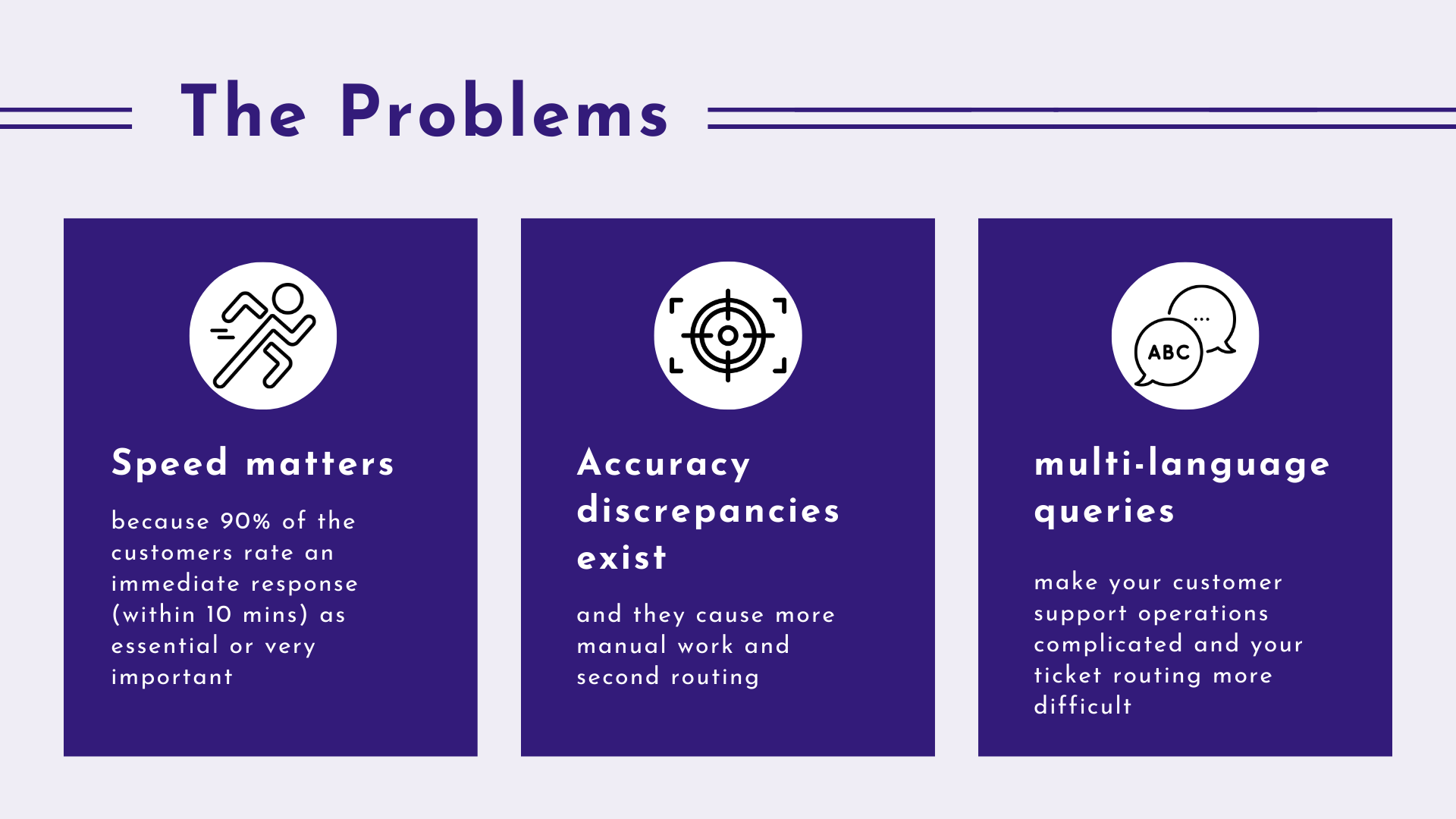
### Speed Is Non-Negotiable
The most immediate problem is speed. Customer expectations around response time have shifted dramatically in recent years, and there is very little tolerance for delays. According to a 2018 HubSpot study, 90% of customers rate an immediate response as essential or very important when they have a customer service question. Even more striking, 60% of customers define “immediate” as ten minutes or less. That is not a lot of time to receive a ticket, read it, understand the context, determine which team should handle it, and route it — especially when the person doing the routing is also handling their own queue of active conversations.
The consequences of slow routing extend beyond individual interactions. Research shows that only 17% of customers would recommend a brand that delivers a slow but ultimately effective solution. In other words, getting the answer right is not enough if it takes too long to deliver. Speed and quality are not separate dimensions of service — customers evaluate them together, and falling short on either one damages the relationship.
When tickets sit in the wrong queue waiting to be rerouted, every minute adds friction. The customer waits longer, the agent who eventually handles the ticket has less context, and the entire chain of handoffs creates opportunities for information to be lost or misunderstood. In high-volume environments, these delays compound across hundreds of tickets per day, creating systemic bottlenecks that no amount of staffing can resolve.
### Accuracy Discrepancies Across AI Approaches
Not all automation is created equal. Many organizations have experimented with basic rule-based routing or keyword-matching systems, only to find that accuracy falls short of what is needed for reliable operation. A ticket containing the word “billing” might seem straightforward to route, but what if the customer is actually asking about a billing error caused by a technical bug? Keyword-based systems struggle with ambiguity, sarcasm, multi-topic tickets, and the countless ways customers express the same underlying issue using different language.
More sophisticated AI approaches — such as traditional machine learning classifiers — improve on keyword matching but still require significant volumes of labeled training data to reach acceptable accuracy levels. Building and maintaining those training datasets is expensive and time-consuming, and the models can degrade quickly as products evolve, new issue types emerge, or customer language shifts. The gap between the accuracy a routing system achieves in testing and the accuracy it delivers in production is often much wider than teams expect.
This accuracy gap has real operational consequences. Every misrouted ticket triggers a chain of inefficiency: the wrong agent spends time reading a ticket they cannot resolve, the ticket gets reassigned, the customer waits longer, and the agent who ultimately handles it has to start from scratch. At scale, even a small percentage of misrouted tickets creates a meaningful drag on team productivity and customer satisfaction.
### Multi-Language Challenges
For organizations that serve customers in multiple languages, manual routing becomes even more complex. Agents need to identify the language of an incoming ticket, assess its content, and route it to a specialist who both speaks that language and has the relevant domain expertise. This is a difficult matching problem even for experienced humans.
Training traditional AI models to handle multiple languages compounds the challenge further. Each language typically requires its own training data, its own labeled examples, and its own validation process. For a company operating in ten or fifteen languages, this means maintaining ten or fifteen separate datasets — each of which needs to be updated as the product and customer base evolve. The cost and complexity quickly become impractical, particularly for mid-size organizations that lack dedicated machine learning teams.
The result is that many multilingual support operations fall back on manual routing for non-primary languages, which reintroduces all the speed and accuracy problems described above — often in markets where the company can least afford to deliver a subpar experience.
## Values and Opportunities of Automated Ticket Routing
The case for automated ticket routing is not about replacing human judgment entirely. It is about removing the bottleneck that human-dependent routing creates and freeing your agents to focus on what they do best: solving problems and building relationships with customers.
### Context-Based Analysis That Actually Understands Meaning
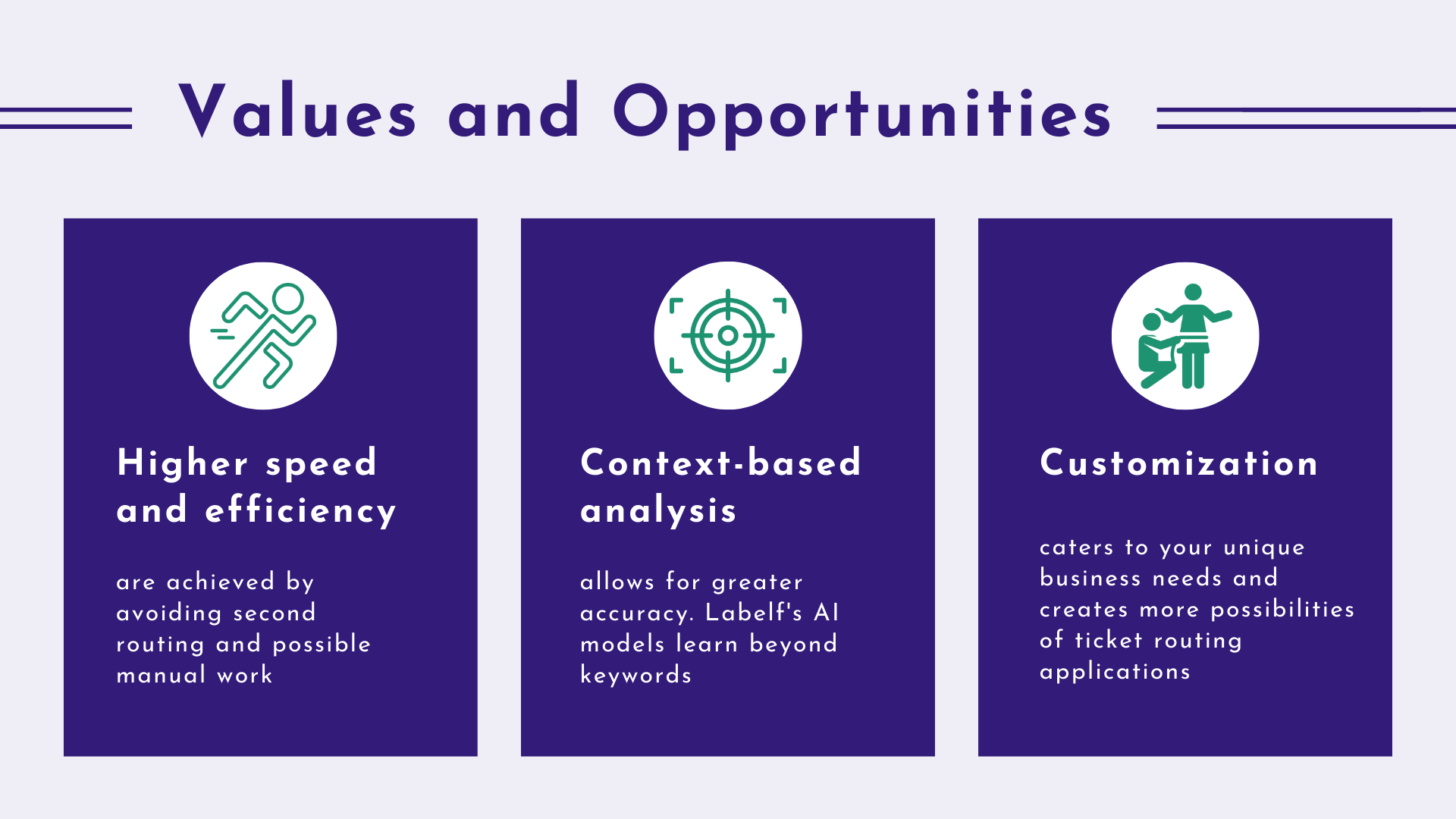
The breakthrough that makes modern automated ticket routing viable is context-based analysis. Rather than matching keywords or relying on rigid rules, advanced natural language processing models analyze the relationships between words in a ticket to understand what the customer is actually asking about. This means the system can distinguish between “I want to cancel my subscription” and “I want to know if I can pause my subscription instead of canceling” — two tickets that contain similar words but require entirely different handling.
Labelf takes this approach and makes it accessible without requiring machine learning expertise. By leveraging contextual language models, Labelf can analyze the meaning behind customer messages and route them with high accuracy. Organizations using this approach have achieved 90% routing accuracy in less than an hour of setup time — a result that would take weeks or months to reach with traditional machine learning workflows that require extensive data labeling and model training.
This context-based approach also handles the multi-language challenge naturally. Because modern language models understand semantic relationships across languages, a single model can process tickets in English, Swedish, Spanish, German, or any other supported language without requiring separate training datasets for each. The system understands that a customer complaint written in French carries the same urgency and intent as the equivalent message in English, and routes both appropriately.
### Higher Speed and Operational Efficiency
Automated routing eliminates the single biggest source of delay in the support workflow: the time between when a ticket arrives and when the right agent starts working on it. Instead of sitting in a general queue waiting for a human dispatcher to read, categorize, and assign it, every incoming ticket is analyzed and routed in seconds.
The impact on response times is immediate and significant. But the second-order effects are equally important. When tickets consistently reach the right agent on the first attempt, the need for internal transfers and rerouting drops dramatically. Agents spend less time on tickets outside their expertise, which means they resolve issues faster and with higher confidence. The overall throughput of the support team increases without adding headcount.
This efficiency gain compounds over time. As the routing system processes more tickets, it generates data that can be used to identify emerging issue types, spot trends in customer behavior, and optimize team structure. The routing layer becomes not just a workflow tool but an intelligence layer that continuously improves the operation it supports.
### Customization That Fits Your Operation
Every support organization is different, and a routing system that forces you into a one-size-fits-all framework will always leave gaps. Effective automated routing needs to accommodate the specific way your team is organized and the specific priorities that drive your business.
With Labelf, you can configure routing logic based on the dimensions that matter most to your operation. Route tickets by query type — separating technical issues from billing questions from feature requests — so that each category reaches the team with the deepest relevant expertise. Route by customer journey stage, ensuring that onboarding questions go to specialists who understand the new-customer experience while retention-related inquiries reach agents trained in save techniques. Route by urgency level, so that time-sensitive issues like service outages or payment failures are escalated immediately rather than waiting their turn in a general queue.
This flexibility means the routing system adapts to your operation rather than the other way around. As your team evolves, new products launch, or customer needs shift, you can adjust the routing logic without rebuilding the underlying model. The system grows with you instead of becoming a constraint you have to work around.
## Conclusion
Automated ticket routing is not a futuristic ambition — it is a practical capability that organizations can deploy today to address some of the most persistent challenges in customer support. The combination of slow manual routing, accuracy limitations in legacy automation, and the complexity of multilingual operations creates a compounding drag on support quality that no amount of incremental process improvement can fully resolve.
Context-based AI routing changes the equation. By understanding the meaning behind customer messages rather than just matching keywords, it delivers the accuracy needed for reliable operation. By processing tickets in seconds rather than minutes, it meets the speed expectations that customers now consider non-negotiable. And by handling multiple languages through a single model, it removes one of the most significant barriers to delivering consistent global support.
The organizations that invest in this capability now will not just reduce costs and improve metrics — they will build the kind of support experience that turns customers into advocates. In a market where 89% of customers are more likely to buy again after a positive service interaction, that is a competitive advantage worth pursuing.
Share this article
Copy link
[ ](https://www.linkedin.com/sharing/share-offsite/?url=https%3A%2F%2Flabelf.ai%2Fblog%2Fdeploy-automated-ticket-routing-for-exceptional-customer-support "Share on LinkedIn")
[](https://twitter.com/intent/tweet?url=https%3A%2F%2Flabelf.ai%2Fblog%2Fdeploy-automated-ticket-routing-for-exceptional-customer-support\&text=AI-Powered%20Ticket%20Routing%20for%20Customer%20Support "Share on X")

Antony Lu
Contributor
## More articles
[](/blog/every-team-needs-a-different-dashboard)
[Use cases](/blog/every-team-needs-a-different-dashboard)
### [Every Team Needs a Different Dashboard — Here's How to Build Yours](/blog/every-team-needs-a-different-dashboard)
[Your Head of Ops needs cost data. Your team leads need agent scores. Your process developers need root cause alerts. One dashboard can't serve them all. Dashboard Studio can.](/blog/every-team-needs-a-different-dashboard)
[T](/blog/every-team-needs-a-different-dashboard)
[The Labelf Team · June 9, 2023](/blog/every-team-needs-a-different-dashboard)
[](/blog/understand-the-voice-of-the-customers-through-optimizing-text-analytics)
[Use cases](/blog/understand-the-voice-of-the-customers-through-optimizing-text-analytics)
### [Voice of the Customer: AI-Powered Text Analytics](/blog/understand-the-voice-of-the-customers-through-optimizing-text-analytics)
[Discover how Voice of the Customer (VoC) analytics powered by AI can help businesses understand customer sentiment, identify churn drivers, and make data-driven decisions from text feedback.](/blog/understand-the-voice-of-the-customers-through-optimizing-text-analytics)
[A](/blog/understand-the-voice-of-the-customers-through-optimizing-text-analytics)
[Antony Lu · August 26, 2022](/blog/understand-the-voice-of-the-customers-through-optimizing-text-analytics)
[](/blog/treat-people-as-people-at-scale)
[AI](/blog/treat-people-as-people-at-scale)
### [We Treat People as People, at Scale](/blog/treat-people-as-people-at-scale)
[One-to-one marketing was promised in the 90s and never delivered. Now AI makes it possible — not by automating away the human interaction, but by making every interaction radically smarter.](/blog/treat-people-as-people-at-scale)
[T](/blog/treat-people-as-people-at-scale)
[The Labelf Team · April 8, 2026](/blog/treat-people-as-people-at-scale)
---
# Every Team Needs a Different Dashboard — Here's How to Build Yours
> Your Head of Ops needs cost data. Your team leads need agent scores. Your process developers need root cause alerts. One dashboard can't serve them all. Dashboard Studio can.
[ Back to blog](/blog)

***
Every role in a customer operation has a different question they wake up to. The Head of Operations wants to know what’s costing money. The team lead wants to know who needs coaching. The process developer wants to know which system bugs are generating the most calls. The CX manager wants to know what’s driving CSAT down.
They all need dashboards. But they don’t need the *same* dashboard.
This is the fundamental problem with most analytics tools: they give you one view and expect everyone to use it. The result is that half the organization ignores the data because it doesn’t answer their specific question. Or worse — they export it to Excel and build their own version, which is outdated by the time they finish.
Dashboard Studio solves this by letting every stakeholder build exactly the view they need — from templates or from scratch.
***
## Start With Templates, Customize Everything
You don’t start from a blank canvas unless you want to. Labelf ships with pre-built dashboard templates for the most common operational views:
* **Churn Dashboard** — at-risk customers ranked by revenue, with recovery actions and save rates
* **Sales Dashboard** — upsell opportunities surfaced from conversations, conversion tracking by campaign
* **Contact Reasons** — why customers call, what it costs, how it’s trending
* **Agent Performance** — quality scores, playbook adherence, coaching priorities
* **Process Alerts** — broken flows and system bugs ranked by monthly cost
Each template is a starting point. Change the metrics, add charts, adjust filters, swap time ranges. Every dimension in your data is a filter. Every metric has a target. Every alert has a cost.
***
## What Each Role Actually Needs
### Head of Operations: The Money View
The ops leader doesn’t need to see individual conversations. They need to see where money is being wasted and where it’s being saved.
Their dashboard shows: total contact volume, cost per contact by category, waste breakdown (unnecessary transfers, repeat contacts, non-resolution), and savings tracking over time. Every number has a dollar sign. Every trend line answers the question: are we getting better or worse?
The most powerful widget: **cost-of-gap**. When AHT is 42 seconds above target, the dashboard doesn’t say “AHT is high.” It says “AHT gap costs $14,000/month.” That changes the conversation from “we should improve” to “we’re losing this much money every month we don’t.”
[See operational efficiency →](/solutions/operational-efficiency)
***
### Team Lead: The People View
Team leads need agent-level data — but not raw numbers. They need coaching intelligence.
Their dashboard shows: agent quality scores benchmarked against the team, playbook adherence rates per agent, CSAT by agent broken down by contact category, and a coaching priority list ranked by impact.
The key insight: it’s not about finding who’s “bad.” It’s about finding the **specific gap** for each agent. Agent A might be excellent at billing but weak on technical. Agent B might have great empathy scores but slow resolution. The dashboard surfaces exactly what each person needs to work on, with conversation citations to use in 1:1 coaching.
[See agent coaching →](/solutions/agent-coaching)
***
### Process Developer: The System View
Process developers don’t care about individual agents. They care about broken systems that generate unnecessary contacts.
Their dashboard shows: process alerts ranked by cost, root cause clusters, deflection opportunities (contacts that shouldn’t exist), and trend monitoring for anomalies.
This is where conversations become bug reports. “The app crashed when I tried to change my address” × 1,200 calls/month × $12/call = $14,400/month. That’s not a support problem. That’s an engineering ticket with a price tag attached.
[See process improvement →](/solutions/process-improvement)
***
### CX Manager: The Relationship View
CX managers need to connect satisfaction to specific drivers — not just track a number.
Their dashboard shows: CSAT by contact reason, delight drivers vs friction points, promoter-to-detractor conversion rates, and relationship trajectory over time. The question it answers: what should we do more of, and what should we stop doing?
The most valuable chart: the delight-and-friction map. A ranked list of what creates happy customers (first-call resolution, proactive callbacks, remembered context) and what destroys trust (unnecessary transfers, repeated explanations, broken promises). Each item quantified by CSAT impact and volume.
[See customer experience →](/solutions/customer-experience)
***
## Build From Scratch: 25+ Chart Types
When templates aren’t enough, Studio gives you the full toolkit:
* **KPI cards** with targets and trend sparklines
* **Time series** for tracking any metric over time
* **Bar charts** for comparing categories, teams, agents
* **Pie and treemap** for volume distribution
* **Tables** with sorting, filtering, and drill-down
* **Gauge charts** for target tracking
* **Radar charts** for multi-dimensional agent comparison
* **Funnel charts** for conversion flows
Every chart supports filters, date ranges, and cross-referencing. Click a bar to drill into the conversations behind it. Every number connects back to the real customer interactions that generated it.
***
## Real-Time, Not Last Quarter
The fundamental shift: these dashboards update continuously. Not weekly. Not monthly. Not “when someone remembers to run the report.”
When a software update ships and calls spike about a specific feature, you see it within hours — not when someone reviews last month’s numbers. When an agent’s quality drops, you catch it in days — not at the next quarterly review.
This is what makes the difference between reactive firefighting and proactive operations. You can push a customer communication about a known issue before the volume spirals. You can coach an agent before a pattern becomes a habit. You can fix a process before it costs you another $50,000.
***
## Getting Started
Every Labelf deployment includes Dashboard Studio. The standard templates are ready on day one. Custom dashboards typically take 30 minutes to build.
The data is already flowing through your conversations. The only question is who needs to see it and what question they need answered.
[See all platform capabilities →](/the-platform)
Share this article
Copy link
[ ](https://www.linkedin.com/sharing/share-offsite/?url=https%3A%2F%2Flabelf.ai%2Fblog%2Fevery-team-needs-a-different-dashboard "Share on LinkedIn")
[](https://twitter.com/intent/tweet?url=https%3A%2F%2Flabelf.ai%2Fblog%2Fevery-team-needs-a-different-dashboard\&text=Every%20Team%20Needs%20a%20Different%20Dashboard%20%E2%80%94%20Here's%20How%20to%20Build%20Yours "Share on X")

The Labelf Team
Team
## More articles
[](/blog/understand-the-voice-of-the-customers-through-optimizing-text-analytics)
[Use cases](/blog/understand-the-voice-of-the-customers-through-optimizing-text-analytics)
### [Voice of the Customer: AI-Powered Text Analytics](/blog/understand-the-voice-of-the-customers-through-optimizing-text-analytics)
[Discover how Voice of the Customer (VoC) analytics powered by AI can help businesses understand customer sentiment, identify churn drivers, and make data-driven decisions from text feedback.](/blog/understand-the-voice-of-the-customers-through-optimizing-text-analytics)
[A](/blog/understand-the-voice-of-the-customers-through-optimizing-text-analytics)
[Antony Lu · August 26, 2022](/blog/understand-the-voice-of-the-customers-through-optimizing-text-analytics)
[](/blog/deploy-automated-ticket-routing-for-exceptional-customer-support)
[Use cases](/blog/deploy-automated-ticket-routing-for-exceptional-customer-support)
### [AI-Powered Ticket Routing for Customer Support](/blog/deploy-automated-ticket-routing-for-exceptional-customer-support)
[Learn how AI-powered automated ticket routing can improve response times, accuracy, and operational efficiency in customer support, with context-based analysis that understands multiple languages.](/blog/deploy-automated-ticket-routing-for-exceptional-customer-support)
[A](/blog/deploy-automated-ticket-routing-for-exceptional-customer-support)
[Antony Lu · July 6, 2022](/blog/deploy-automated-ticket-routing-for-exceptional-customer-support)
[](/blog/treat-people-as-people-at-scale)
[AI](/blog/treat-people-as-people-at-scale)
### [We Treat People as People, at Scale](/blog/treat-people-as-people-at-scale)
[One-to-one marketing was promised in the 90s and never delivered. Now AI makes it possible — not by automating away the human interaction, but by making every interaction radically smarter.](/blog/treat-people-as-people-at-scale)
[T](/blog/treat-people-as-people-at-scale)
[The Labelf Team · April 8, 2026](/blog/treat-people-as-people-at-scale)
---
# Four Seasons of AI: A Brief History
> A journey through the history of artificial intelligence, from its optimistic beginnings in the 1950s through AI winters and resurgences, to the modern era of deep learning and large language models.
[ Back to blog](/blog)

***
Few fields in science have experienced such dramatic swings between euphoria and despair as artificial intelligence. Since the mid-twentieth century, AI has moved through recurring cycles — bursts of optimism where researchers predicted human-level machines were just years away, followed by painful periods of disillusionment, funding cuts, and public skepticism. These phases have come to be known as “AI springs,” “AI summers,” and “AI winters.” Understanding them is not merely an exercise in nostalgia. The patterns of overpromise and correction that shaped the field’s past continue to inform how we develop, fund, and talk about AI today. This is the story of those seasons.
## AI Spring: The Birth of AI
Long before the term “artificial intelligence” existed, thinkers on both sides of the Atlantic were laying its intellectual foundations — sometimes in fiction, sometimes in wartime secrecy, and sometimes with nothing more than pen and paper.
### The United States: Asimov and the Dream of Thinking Machines
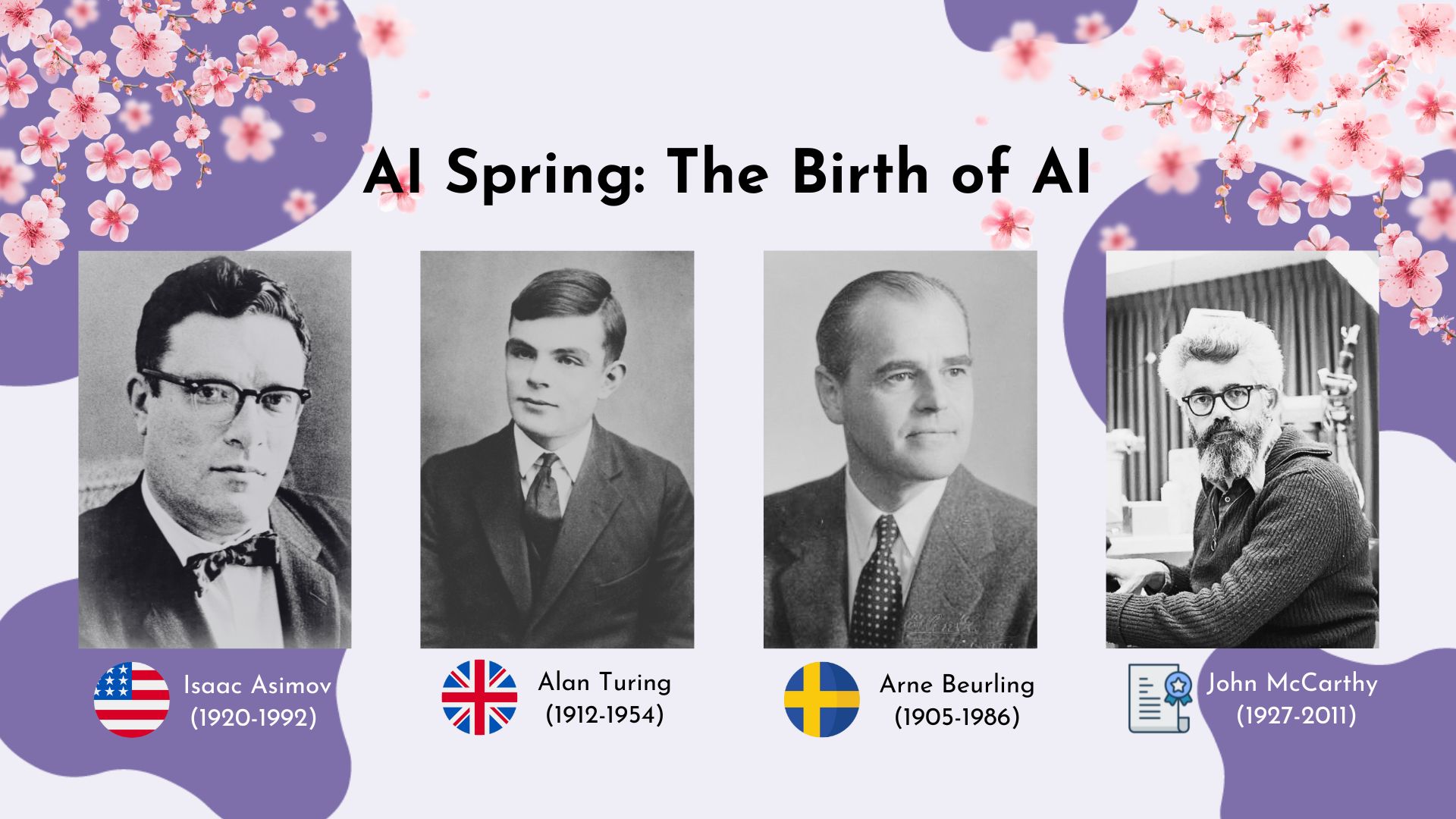
In 1942, Isaac Asimov published the short story *Runaround*, introducing his famous Three Laws of Robotics — a set of ethical rules governing the behavior of intelligent machines. Although pinpointing the exact roots of AI is difficult, Asimov’s fiction proved remarkably influential. His stories gave scientists and engineers a shared vocabulary for thinking about machine autonomy, moral reasoning, and the relationship between humans and their creations. Generations of researchers would later cite Asimov as the spark that first drew them toward the field.
### The United Kingdom: Alan Turing and the Foundations of Computing
Across the Atlantic, the groundwork for AI was being laid in a far more urgent context. During the Second World War, the British mathematician Alan Turing developed “The Bombe,” an electromechanical device used to decipher messages encrypted by the German Enigma machine. Turing’s wartime work demonstrated that complex reasoning tasks could, in principle, be mechanized. In 1950, he published the landmark paper *Computing Machinery and Intelligence*, in which he posed the deceptively simple question: “Can machines think?” He proposed what is now known as the Turing Test — the idea that a machine could be considered intelligent if a human interrogator could not reliably distinguish its responses from those of another person. Turing is widely regarded as the father of both theoretical computer science and artificial intelligence.
### Sweden: Arne Beurling and the Art of Codebreaking
Sweden contributed its own quiet genius. The mathematician Arne Beurling managed to decipher the encrypted teleprinter traffic of Nazi Germany — in just two weeks, using nothing but pen and paper. His feat was one of the great intellectual achievements of the war, and it demonstrated the kind of pattern recognition and abstract reasoning that AI researchers would later try to replicate in machines. When colleagues asked Beurling how he had done it, he offered only a cryptic reply: “A magician does not reveal his secrets.”
### The Dartmouth Conference: AI Gets Its Name
The field officially came into being in the summer of 1956, when a young mathematician named John McCarthy organized a workshop at Dartmouth College in Hanover, New Hampshire. Together with Marvin Minsky, Nathaniel Rochester, and Claude Shannon, McCarthy proposed studying the conjecture that “every aspect of learning or any other feature of intelligence can in principle be so precisely described that a machine can be made to simulate it.” It was in the proposal for this workshop that the term “Artificial Intelligence” was coined. The Dartmouth Conference brought together many of the researchers who would dominate the field for decades. It marked the moment AI ceased to be a scattered collection of ideas and became a recognized discipline with a name, an agenda, and a community.
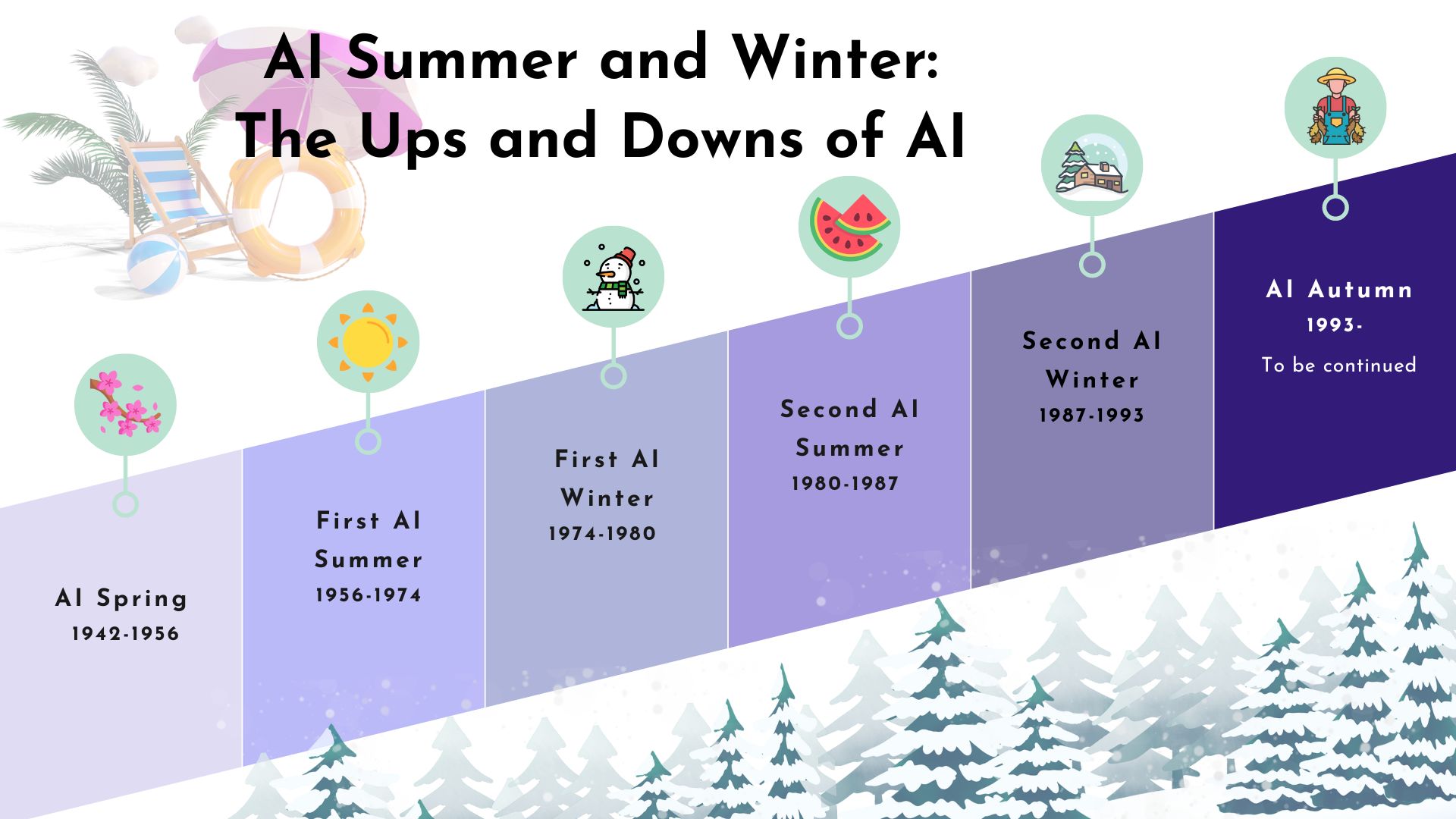
## AI Summer and Winter
### The First Summer: Optimism and Early Breakthroughs
The years following Dartmouth were electric with possibility. Funding flowed from government agencies, and researchers made rapid early progress. One notable achievement was ELIZA, a natural language processing program created by Joseph Weizenbaum at MIT in 1966. ELIZA simulated a Rogerian psychotherapist, reflecting users’ statements back at them as questions. It was remarkably simple in its design, yet people who interacted with it often became emotionally attached, confiding in the program as though it were a real therapist. ELIZA demonstrated — perhaps for the first time — that machines could create a convincing illusion of understanding, even without any actual comprehension.
The optimism of this era reached its peak when Marvin Minsky, by then one of the most prominent figures in AI, declared in 1970 that machines would achieve human-level intelligence “within three to eight years.” It was a bold claim, and it captured the mood of a field that believed its greatest challenges were essentially solved in principle, with only engineering details left to work out.
### The First Winter: Lighthill, Congressional Criticism, and Funding Cuts
Reality intervened swiftly. In 1973, the British mathematician Sir James Lighthill published a devastating critique of AI research for the UK Science Research Council. Lighthill argued that the field had failed to deliver on its grand promises and that progress in AI was far more limited than its advocates admitted. His report led the British government to halt funding for AI research at all but a handful of universities. Across the Atlantic, similar skepticism was building. The United States Congress questioned the return on its AI investments, and funding from agencies like DARPA was sharply reduced. The first “AI winter” had arrived — a period defined not so much by a lack of ideas as by a painful gap between what researchers had promised and what they had actually delivered.
### The Second Summer: Expert Systems and Commercial Interest
The chill did not last forever. In the early 1980s, a new approach called “expert systems” revived interest in AI. These programs encoded the knowledge of human specialists into large sets of if-then rules, enabling machines to make decisions in narrow domains such as medical diagnosis, mineral exploration, and financial analysis. Corporations rushed to build AI departments, and governments launched ambitious national programs. Japan’s Fifth Generation Computer Project, announced in 1982, aimed to create machines capable of reasoning, conversation, and knowledge processing. Investment soared, and for a time it seemed that AI was on the verge of transforming industry.
### The Second Winter: Disillusionment Returns
But expert systems had fundamental weaknesses. They were brittle — they broke down when confronted with situations outside their pre-programmed rules. They were expensive to build and even more expensive to maintain. And as desktop personal computers grew more powerful and more affordable throughout the late 1980s, the specialized LISP machines that had underpinned much of the AI industry were rendered obsolete almost overnight. The expert systems market collapsed. Japan quietly wound down its Fifth Generation project in 1992, acknowledging that its most ambitious goals had not been met. The second AI winter set in, and once again the field retreated from public view, sustained only by a handful of determined researchers who continued their work in relative obscurity.
## Looking Back, Looking Forward
The cyclical history of artificial intelligence is more than a curiosity. It is a reminder that technological progress rarely follows a straight line. Each spring and summer brought genuine breakthroughs — ideas and systems that advanced our understanding of intelligence and computation. Each winter, though painful, cleared away unrealistic expectations and forced the field to develop more rigorous methods. The researchers who persisted through the winters — refining algorithms, building better datasets, and waiting for hardware to catch up with theory — laid the foundations for the modern AI era that would follow. Understanding these seasons helps us approach today’s AI achievements with both the excitement they deserve and the measured perspective that history demands.
*References: Haenlein & Kaplan (2019), “A Brief History of Artificial Intelligence”; Beckman (2002), “A Brief History of AI.”*
Share this article
Copy link
[ ](https://www.linkedin.com/sharing/share-offsite/?url=https%3A%2F%2Flabelf.ai%2Fblog%2Ffour-seasons-of-ai-the-brief-history-of-artificial-intelligence-i "Share on LinkedIn")
[](https://twitter.com/intent/tweet?url=https%3A%2F%2Flabelf.ai%2Fblog%2Ffour-seasons-of-ai-the-brief-history-of-artificial-intelligence-i\&text=Four%20Seasons%20of%20AI%3A%20A%20Brief%20History "Share on X")

Antony Lu
Contributor
## More articles
[](/blog/treat-people-as-people-at-scale)
[AI](/blog/treat-people-as-people-at-scale)
### [We Treat People as People, at Scale](/blog/treat-people-as-people-at-scale)
[One-to-one marketing was promised in the 90s and never delivered. Now AI makes it possible — not by automating away the human interaction, but by making every interaction radically smarter.](/blog/treat-people-as-people-at-scale)
[T](/blog/treat-people-as-people-at-scale)
[The Labelf Team · April 8, 2026](/blog/treat-people-as-people-at-scale)
[](/blog/youre-renting-your-customers)
[AI](/blog/youre-renting-your-customers)
### [You're Renting Your Customers — And The Price Goes Up Every Year](/blog/youre-renting-your-customers)
[While everyone celebrates the shift to self-service and automation, companies are quietly paying more and more to reach the customers they already had. There is another way.](/blog/youre-renting-your-customers)
[T](/blog/youre-renting-your-customers)
[The Labelf Team · April 2, 2026](/blog/youre-renting-your-customers)
[](/blog/nlp-techniques)
[AI](/blog/nlp-techniques)
### [NLP Techniques](/blog/nlp-techniques)
[An exploration of the most important natural language processing techniques used in modern AI, from tokenization and word embeddings to transformers and large language models.](/blog/nlp-techniques)
[F](/blog/nlp-techniques)
[Filip Sörlin · November 21, 2022](/blog/nlp-techniques)
---
# How Does Deep Learning Work?
> A comprehensive overview of deep learning, exploring how neural networks learn from data, the architecture behind modern AI systems, and why deep learning has become the backbone of artificial intelligence.
[ Back to blog](/blog)

***
I will try to give you a quite simple explanation of what actually goes on in a deep learning model that could be read by anybody, no matter previous knowledge. Some things are a bit simplified in order to accommodate that.
Let’s begin with sorting some terms out. Deep learning is a sub-field within the wider machine learning field. Machine learning is sometimes used when building AI software. AI is however a very broad concept which also involves NPCs in games, such as those little ghosts that try to get you in Pacman. Those ghosts does not have any machine- or deep learning behind their intelligence however.

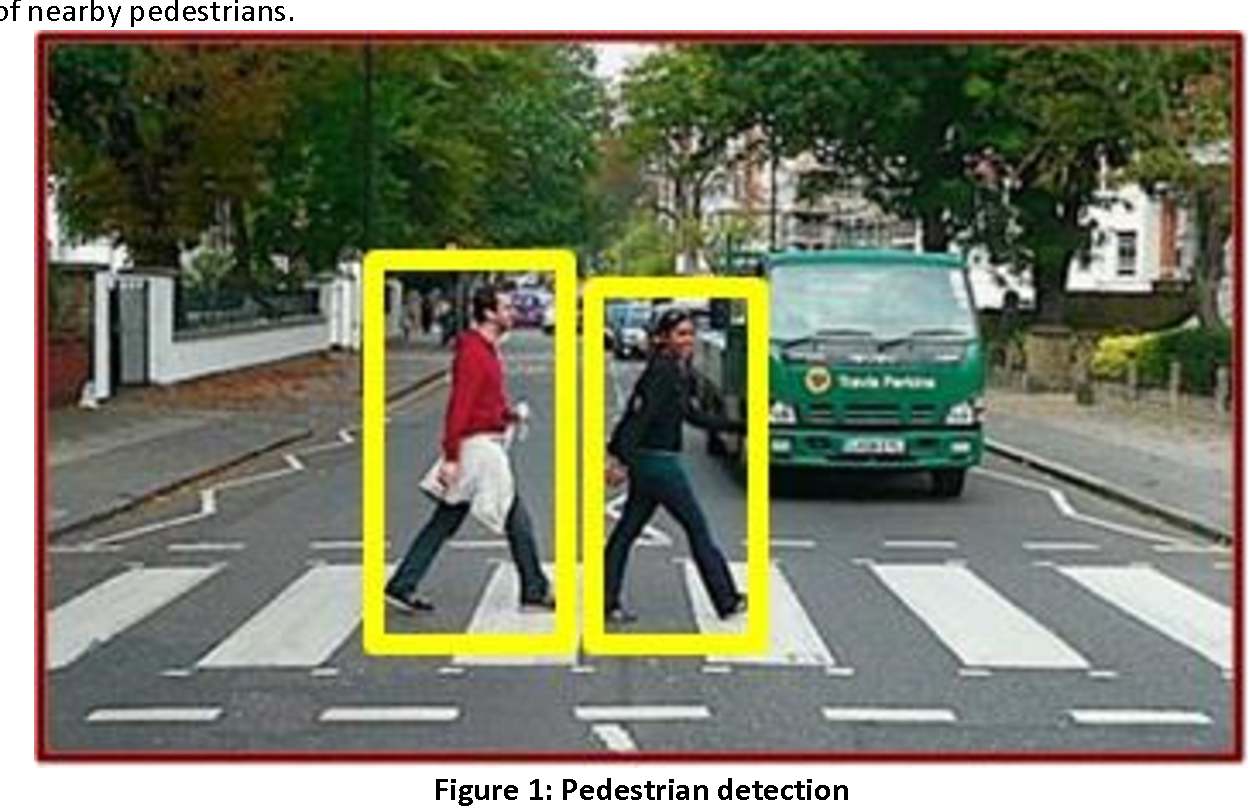
The goal when doing deep learning is to provide a correct output given a certain input. Such ``-pairs could in the case of self driving cars be: `` or in the case of someone building a stock trading bot be ``.
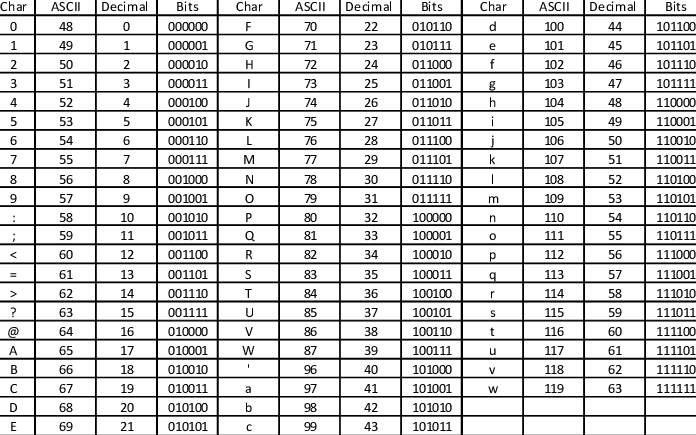
Let’s do our example on text translation, which is actually done with the help of deep learning in Google Translate. In this case, we want to translate sentences from English to Swedish. The first problem we need to solve is that a deep learning model wants its input converted to a numerical representation. Let’s use this ASCII-table to translate the English letters to numbers before we run it through the deep learning model.
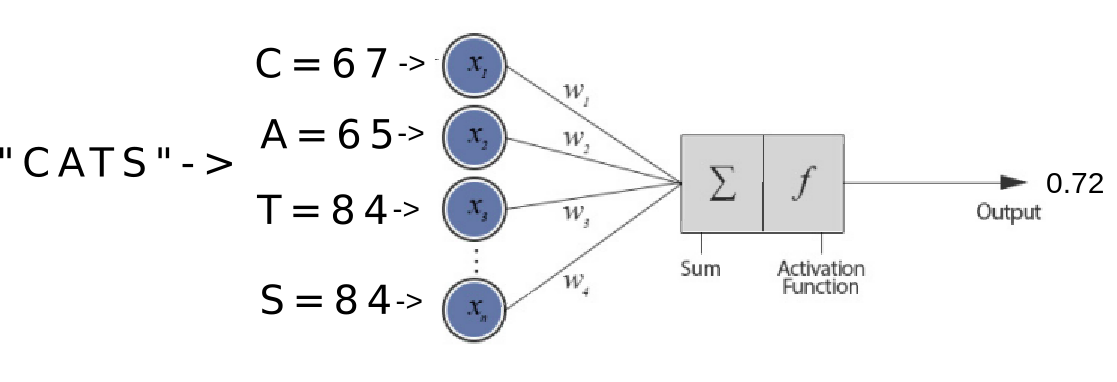
Nice, now let’s send the numbers into what is called a neural network. The neural network consists of something called perceptrons. These perceptrons take many inputs, and each input (seen as x’s in the image below) is multiplied by a weight (seen as w’s in the image). The sum of the results of all these multiplications are run through a quite simple mathematical function called the activation function and a number comes out on the other side.
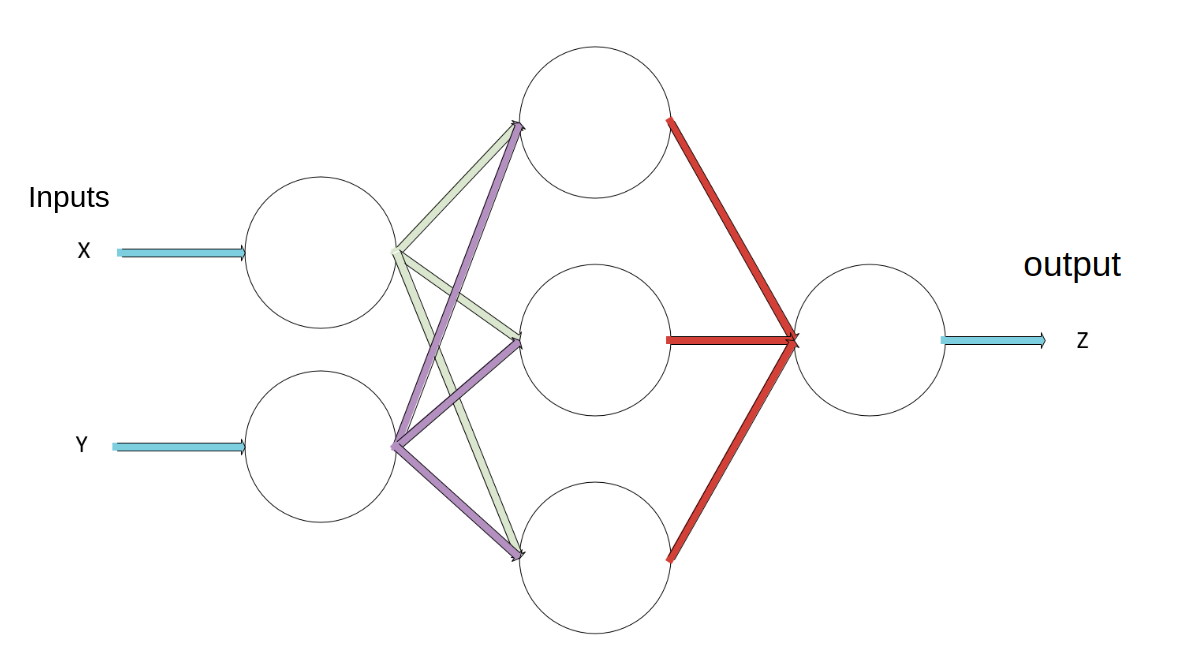
If you put several of these perceptrons in a net you get the actual artificial neural network. The more layers of perceptrons in a network, the “deeper” it is. And hence the term DEEP learning!
Alright, now it is time to train this model so that it does what we want it to do, translating sentences from English into Swedish. For that we also need a training dataset that holds English sentences and their Swedish translations:
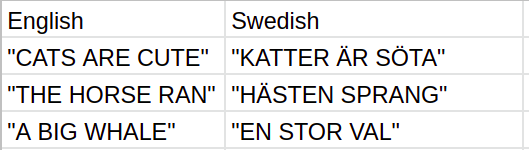
Let’s set those weights (W1-W6 below) to some random numbers and see what happens when we run the sentence “CATS ARE CUTE” through the model:
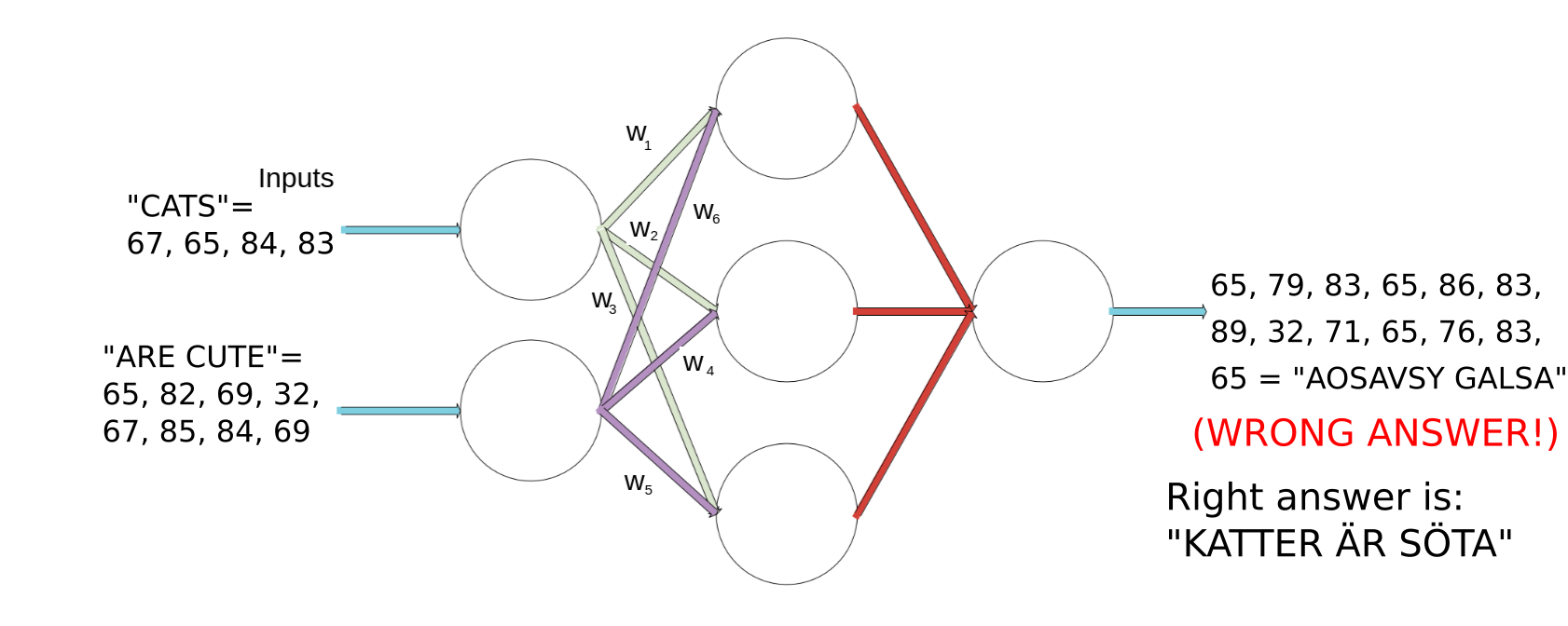
Oops, that didn’t turn out very well. Let’s try to change the weights to some other random numbers and run it again:
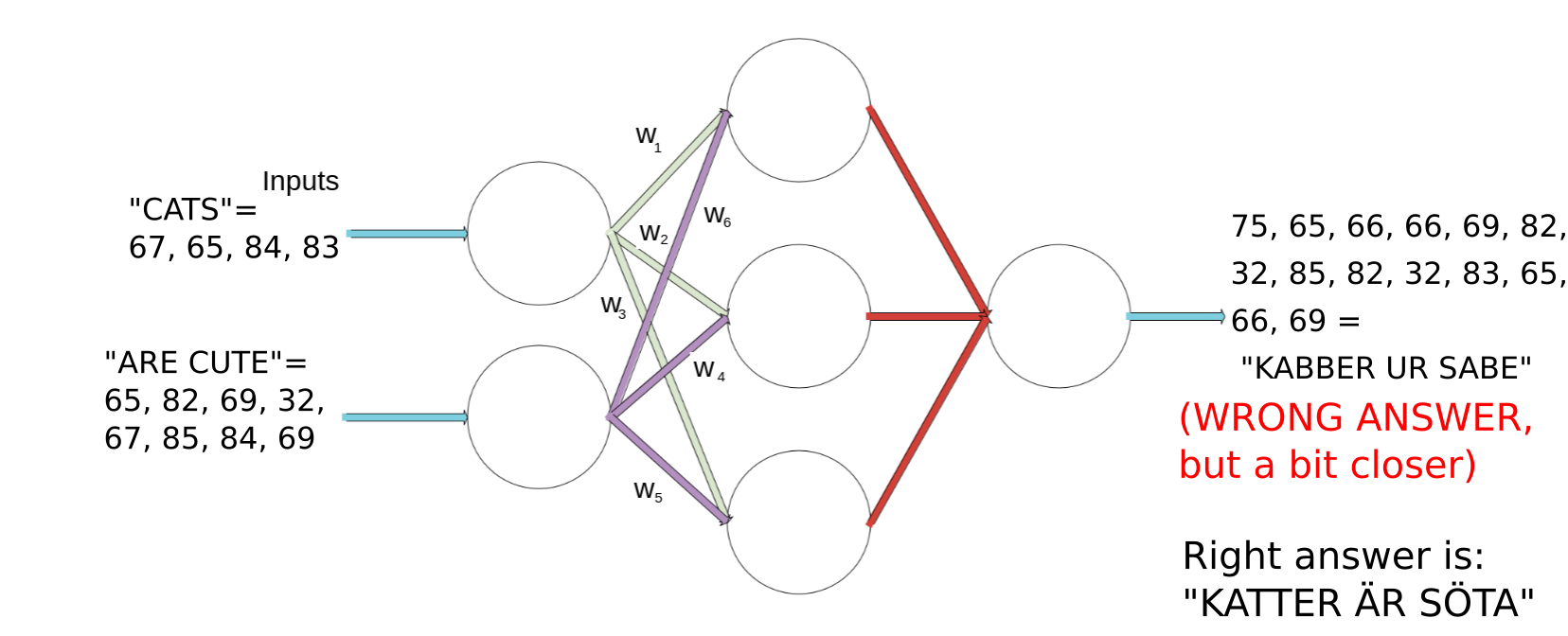
Look! This time i was a bit closer to the answer. Let’s keep changing the numbers in that same “direction”, meaning that if we changed the weight W1 from 0.3 to 0.4, then maybe we should try to set it to 0.5 and see what happens.
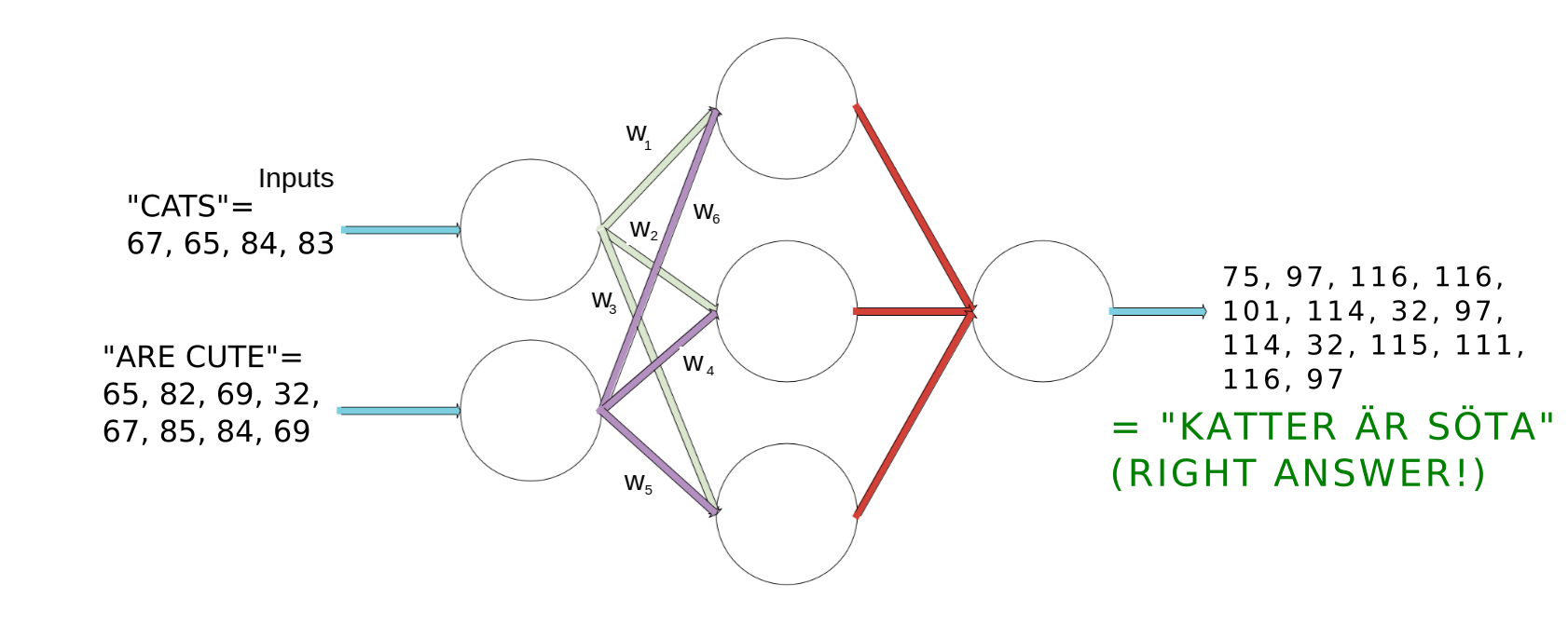
IT WORKED! We got the right answer! Now this usually takes thousands of iterations doing this on thousands data points and changing the weights in a network with more layers and perceptrons. But I hope it conveyed the gist of it.
The next step is to test our newly trained model on sentence-pairs that it hasn’t seen before (a test set). That’s how you know if it actually works in real life or just on the data you trained on (overfitting). If that all works out, we can deploy it to our translation website!
Now I haven’t been completely honest with you. Translation is usually done using two models. But keep reading because this is where it gets really interesting! You normally have one “encoder model” and one “decoder model”. You encode the input sentence into an intermediate representation of the actual meaning of the sentence. You can think of the intermediate representation like one or many dots in one of those Excel dot charts…
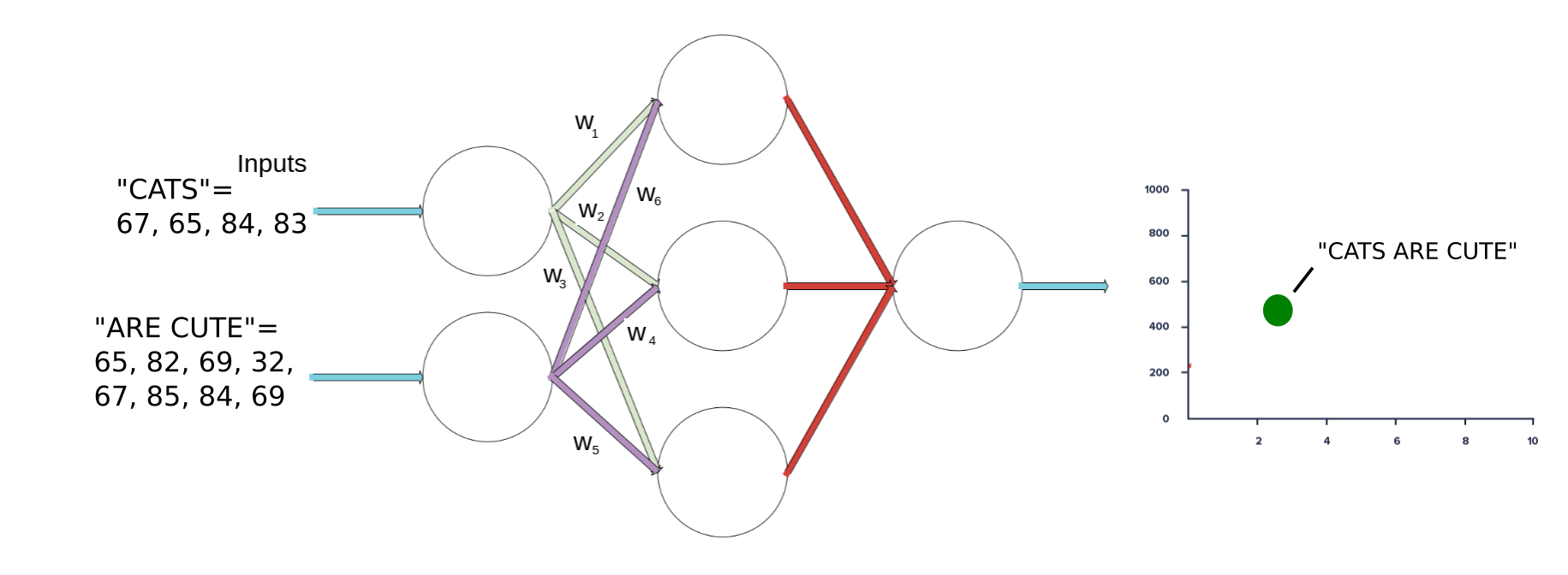
…or maybe not exactly. This chart actually has HUNDREDS of dimensions instead of just two like in Excel! That leads to the fact that it is quite hard to portray in an image, but I’ll give it a shot:

Anyway, let’s take this mathematical representation of the sentence’s inner meaning and run it through the decoder model which will then give us the final result:
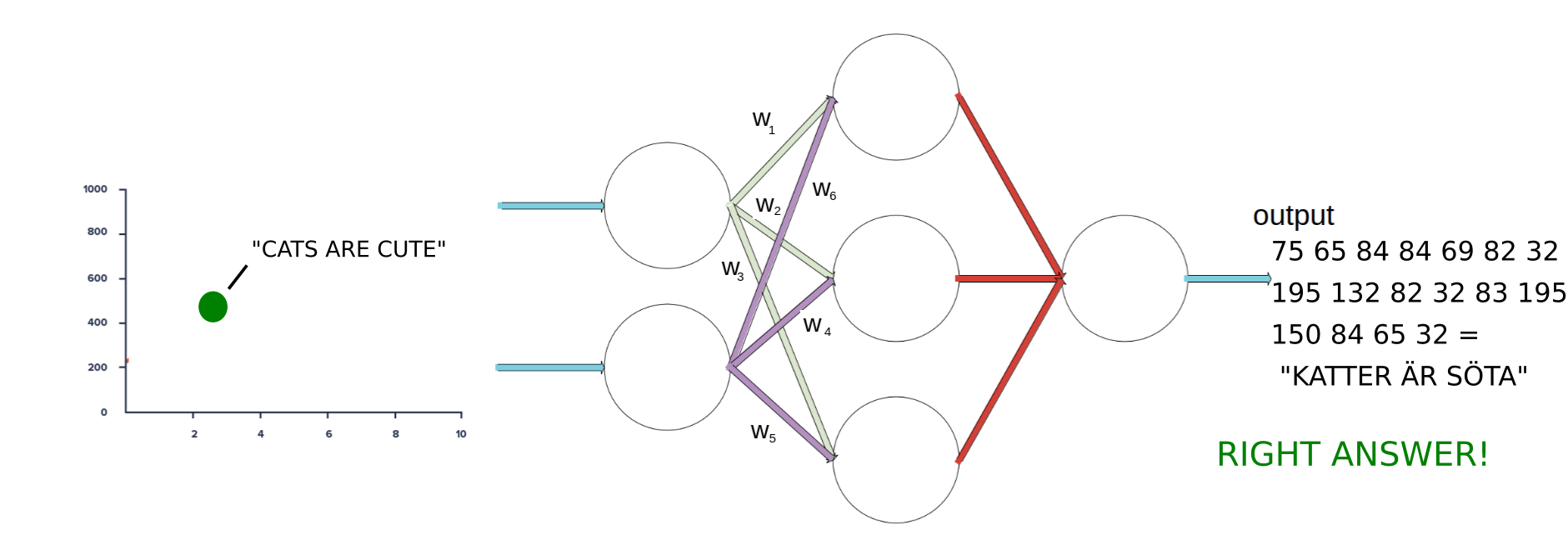
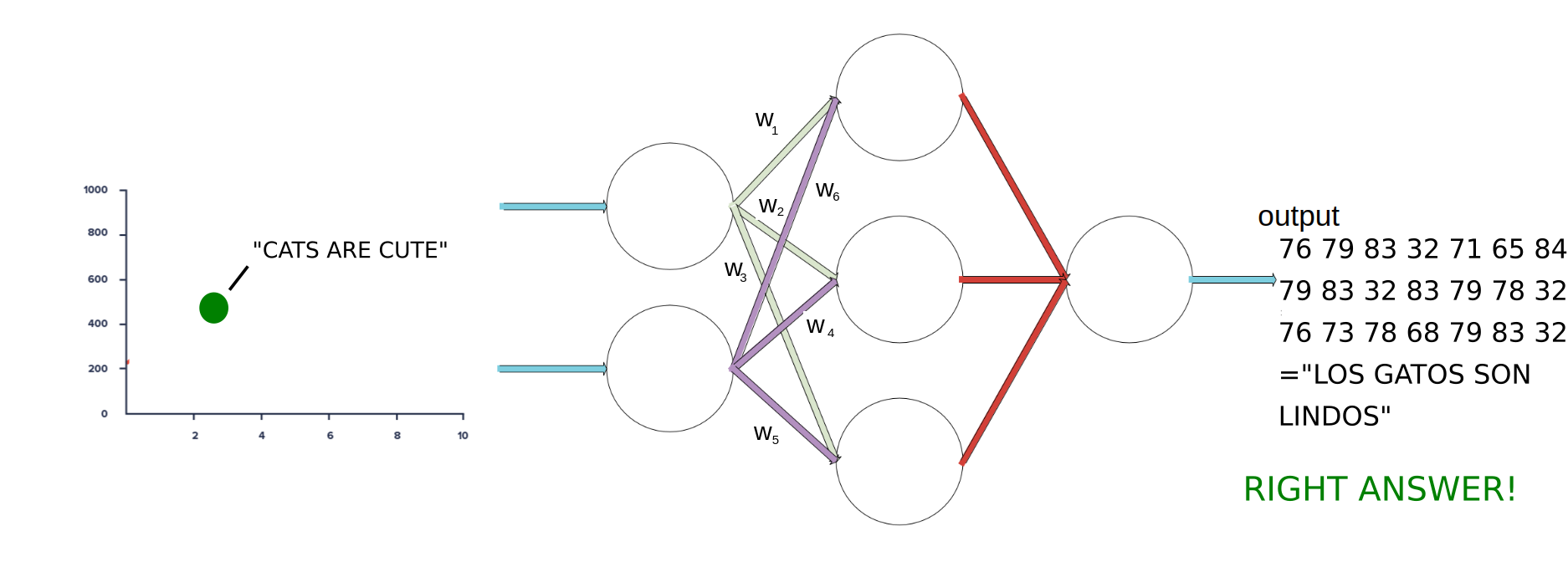
The really nice thing about this is that we can use the same intermediate representation of the sentence, but put it through another decoder model. Like this one, which will decode it into Spanish instead:
It gets even cooler when we try it with a decoder that is trained to decode into a bunch of pixel values, in other words, a picture of cute cats!
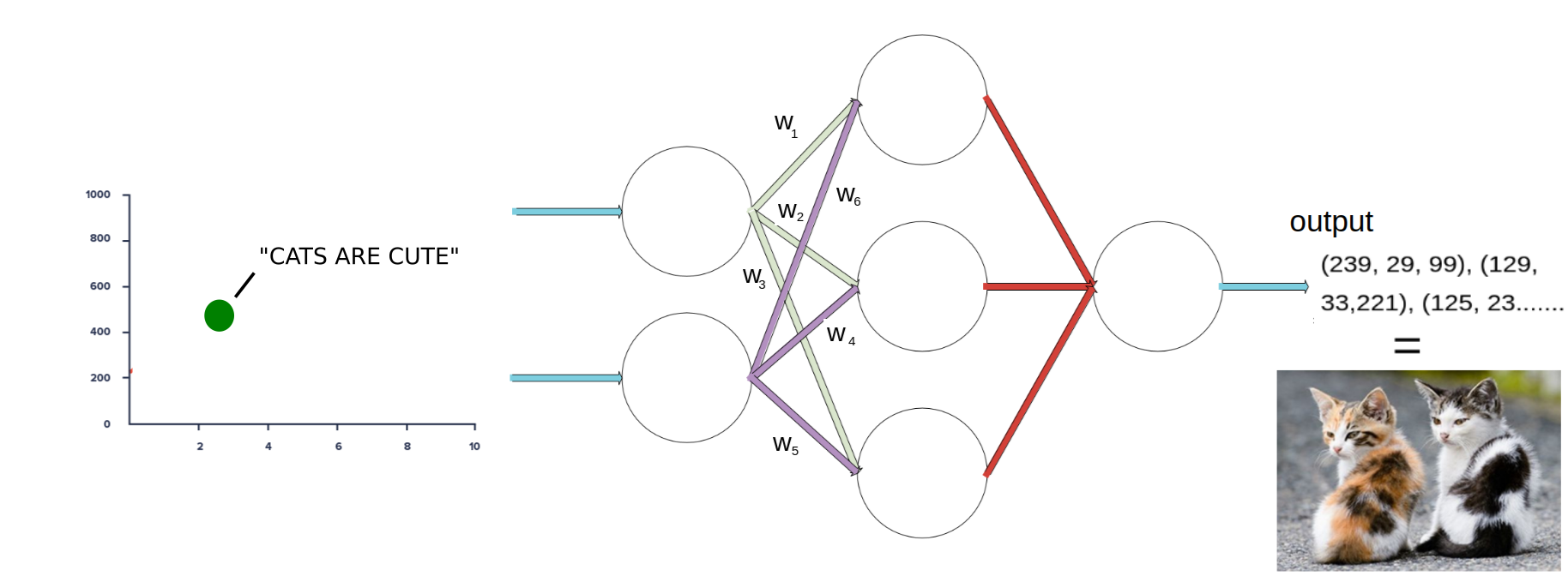
This is (kind of) how Open AI achieved their super impressive results with their DALL-E model that they recently came out with. You can read more about that on [OpenAI’s DALL-E blog post](https://openai.com/blog/dall-e/).
DALL-E, GPT-3, Alphafold are all based on a type of Deep Learning model architecture that is called Transformers. Transformer-models were invented in 2017 and have accelerated the frequency of new AI breakthroughs massively since then! Transformers-models is also what we use to power our no code AI tool here at Labelf. Labelf even lets you train a transformer model without knowing anything about code! Or deep learning for that part. But we can’t count you to that crowd now that you’ve made it all the way here!
Share this article
Copy link
[ ](https://www.linkedin.com/sharing/share-offsite/?url=https%3A%2F%2Flabelf.ai%2Fblog%2Fhow-does-deep-learning-work "Share on LinkedIn")
[](https://twitter.com/intent/tweet?url=https%3A%2F%2Flabelf.ai%2Fblog%2Fhow-does-deep-learning-work\&text=How%20Does%20Deep%20Learning%20Work%3F "Share on X")

Per Näslund
CTO & Co-Founder
## More articles
[](/blog/treat-people-as-people-at-scale)
[AI](/blog/treat-people-as-people-at-scale)
### [We Treat People as People, at Scale](/blog/treat-people-as-people-at-scale)
[One-to-one marketing was promised in the 90s and never delivered. Now AI makes it possible — not by automating away the human interaction, but by making every interaction radically smarter.](/blog/treat-people-as-people-at-scale)
[T](/blog/treat-people-as-people-at-scale)
[The Labelf Team · April 8, 2026](/blog/treat-people-as-people-at-scale)
[](/blog/youre-renting-your-customers)
[AI](/blog/youre-renting-your-customers)
### [You're Renting Your Customers — And The Price Goes Up Every Year](/blog/youre-renting-your-customers)
[While everyone celebrates the shift to self-service and automation, companies are quietly paying more and more to reach the customers they already had. There is another way.](/blog/youre-renting-your-customers)
[T](/blog/youre-renting-your-customers)
[The Labelf Team · April 2, 2026](/blog/youre-renting-your-customers)
[](/blog/nlp-techniques)
[AI](/blog/nlp-techniques)
### [NLP Techniques](/blog/nlp-techniques)
[An exploration of the most important natural language processing techniques used in modern AI, from tokenization and word embeddings to transformers and large language models.](/blog/nlp-techniques)
[F](/blog/nlp-techniques)
[Filip Sörlin · November 21, 2022](/blog/nlp-techniques)
---
# NLP Techniques
> An exploration of the most important natural language processing techniques used in modern AI, from tokenization and word embeddings to transformers and large language models.
[ Back to blog](/blog)

***
Natural language processing, commonly known as NLP, is a field of computer science and artificial intelligence concerned with the interactions between computers and human languages. Rather than requiring people to speak the rigid, structured language of machines, NLP flips the equation: it programs computers to understand *our* language — messy grammar, slang, sarcasm, and all.
At its core, NLP focuses on teaching machines to process and make sense of large volumes of text and voice data. Every time you ask a virtual assistant a question, run a spell-check, or get a suggested reply in your email, NLP is working behind the scenes. And the technology has come a remarkably long way. Modern NLP models can now perform typical reading comprehension tasks at a level that matches — and sometimes surpasses — human performance.
## Why Should You Pay Attention to NLP?
If your business deals with any form of written or spoken communication (and what business doesn’t?), NLP is directly relevant to you. Here are a few reasons it deserves your attention:
* **Task automation and cost reduction.** Repetitive language-heavy tasks — reading support tickets, categorizing feedback, extracting data from documents — can be handled by NLP models around the clock without fatigue.
* **Enhanced customer service.** Automated responses powered by NLP can resolve common inquiries instantly, freeing up human agents to focus on the issues that truly need a personal touch.
* **Better customer understanding.** By analyzing what customers actually write and say in their own words, NLP helps you uncover patterns, pain points, and opportunities that structured surveys often miss.
The techniques described below are the building blocks that make all of this possible. Understanding them gives you a practical vocabulary for evaluating which NLP capabilities matter most for your organization.
## Sentiment Analysis
Sentiment analysis is the technique of computationally determining whether a piece of text expresses a positive, negative, or neutral opinion. It answers a deceptively simple question: *How does this person feel about what they’re talking about?*
At scale, the implications are powerful. Imagine a company receiving thousands of product reviews every week. Manually reading each one is impractical, but sentiment analysis can instantly sort them into categories, surfacing the glowing praise and the harsh criticism alike.
**Practical examples:**
* **Customer feedback triage.** A support team can automatically flag messages with strongly negative sentiment and route them to senior agents, making sure dissatisfied customers get fast, attentive responses before frustration escalates.
* **Brand monitoring.** Marketing teams track sentiment across social media mentions to gauge how a product launch, campaign, or PR event is being received in real time.
* **Employee pulse surveys.** HR departments analyze open-ended survey responses to understand workforce morale without requiring someone to read every comment.
## Text Classification
Text classification is the process of assigning predefined labels or categories to a piece of text. An algorithm is trained on a set of labeled examples — for instance, emails that have already been sorted into “billing,” “technical support,” and “sales inquiry” — and then learns to apply those same labels to new, unseen text automatically.
This is one of the most widely deployed NLP techniques because the use cases are virtually endless. Any time a human is reading text and putting it into a bucket, text classification can likely do the same job faster and more consistently.
**Practical examples:**
* **Spam filtering.** Your email provider uses text classification to decide whether an incoming message belongs in your inbox or your spam folder.
* **Topic categorization.** A news aggregator automatically tags articles as “politics,” “sports,” “technology,” or “business” so readers can find what interests them.
* **Support ticket routing.** An incoming customer ticket is classified by topic and urgency, then automatically routed to the right team — no manual sorting required.
## Named Entity Recognition (NER)
Named entity recognition, or NER, is the technique of scanning text to locate and classify specific entities into predefined categories. These entities typically include person names, organizations, locations, dates, monetary values, and other structured data points hiding inside unstructured text.
Think of NER as a highlighter that reads through a document and marks every name, place, company, and date it finds, then labels each one by type.
**Practical examples:**
* **GDPR compliance and data masking.** Organizations processing customer communications can use NER to automatically detect and redact personally identifiable information — names, addresses, phone numbers — before the data is stored or shared.
* **Contract analysis.** Legal teams use NER to extract party names, effective dates, monetary amounts, and governing jurisdictions from large volumes of contracts, turning hours of manual review into seconds.
* **News intelligence.** Media monitoring platforms extract the people, companies, and locations mentioned in news articles to build knowledge graphs and track how entities are connected over time.
## Topic Modeling
While text classification assigns labels you define in advance, topic modeling discovers hidden thematic patterns in large collections of text without any predefined categories. It clusters documents into groups based on the words they share, revealing what your data is actually about — even when you don’t know what to look for.
This makes topic modeling especially valuable for exploratory analysis, where the goal is to understand the landscape of a dataset rather than to sort it into known categories.
**Practical examples:**
* **Customer feedback discovery.** A company launches a new product and collects thousands of open-ended responses. Topic modeling reveals the dominant themes — perhaps “battery life,” “ease of setup,” and “missing features” — without anyone having to read every response or guess what topics to look for in advance.
* **Research literature review.** Academics use topic modeling to survey large bodies of published papers and identify the main research themes within a field.
* **Call center analytics.** By applying topic modeling to transcribed customer calls, operations teams discover recurring conversation themes and can prioritize process improvements where they will have the greatest impact.
## Text Summarization
Text summarization is the technique of condensing a document into a shorter version that retains its most essential information and meaning. The goal is to save the reader time without sacrificing the key points.
There are two broad approaches: *extractive* summarization, which selects and stitches together the most important sentences from the original text, and *abstractive* summarization, which generates entirely new sentences that paraphrase the source material. Modern NLP models increasingly excel at the abstractive approach, producing summaries that read naturally and capture nuance.
**Practical examples:**
* **Meeting notes.** After a one-hour meeting, an NLP model generates a concise summary of decisions made, action items assigned, and topics discussed — ready to share with stakeholders who couldn’t attend.
* **Legal document review.** Lawyers receive condensed summaries of lengthy contracts, depositions, or regulatory filings, allowing them to quickly assess relevance before diving into the full text.
* **News digests.** Media platforms generate brief summaries of long-form articles, giving readers the gist so they can decide which pieces deserve a full read.
## Conclusion
Sentiment analysis, text classification, named entity recognition, topic modeling, and text summarization are five foundational NLP techniques that turn unstructured language into structured, actionable insight. Each addresses a different aspect of understanding text, and in practice they are often combined — for example, classifying support tickets by topic while simultaneously scoring them for sentiment, then summarizing the results for a weekly report.
The encouraging reality is that you no longer need a team of machine learning engineers to put these techniques to work. Modern platforms have made NLP accessible to business teams who understand their data and their problems, even if they’ve never trained a model. The key is knowing which technique fits which problem — and now you do.
Share this article
Copy link
[ ](https://www.linkedin.com/sharing/share-offsite/?url=https%3A%2F%2Flabelf.ai%2Fblog%2Fnlp-techniques "Share on LinkedIn")
[](https://twitter.com/intent/tweet?url=https%3A%2F%2Flabelf.ai%2Fblog%2Fnlp-techniques\&text=NLP%20Techniques "Share on X")

Filip Sörlin
CAIO & Co-Founder
## More articles
[](/blog/treat-people-as-people-at-scale)
[AI](/blog/treat-people-as-people-at-scale)
### [We Treat People as People, at Scale](/blog/treat-people-as-people-at-scale)
[One-to-one marketing was promised in the 90s and never delivered. Now AI makes it possible — not by automating away the human interaction, but by making every interaction radically smarter.](/blog/treat-people-as-people-at-scale)
[T](/blog/treat-people-as-people-at-scale)
[The Labelf Team · April 8, 2026](/blog/treat-people-as-people-at-scale)
[](/blog/youre-renting-your-customers)
[AI](/blog/youre-renting-your-customers)
### [You're Renting Your Customers — And The Price Goes Up Every Year](/blog/youre-renting-your-customers)
[While everyone celebrates the shift to self-service and automation, companies are quietly paying more and more to reach the customers they already had. There is another way.](/blog/youre-renting-your-customers)
[T](/blog/youre-renting-your-customers)
[The Labelf Team · April 2, 2026](/blog/youre-renting-your-customers)
[](/blog/what-is-accuracy-precision-recall-and-f1-score)
[AI](/blog/what-is-accuracy-precision-recall-and-f1-score)
### [What Is Accuracy, Precision, Recall, and F1 Score?](/blog/what-is-accuracy-precision-recall-and-f1-score)
[A clear guide to the most common classification metrics in machine learning: accuracy, precision, recall, and F1 score. Learn when to use each metric and how they relate to real-world model performance.](/blog/what-is-accuracy-precision-recall-and-f1-score)
[T](/blog/what-is-accuracy-precision-recall-and-f1-score)
[Ted Tigerschiold · November 7, 2022](/blog/what-is-accuracy-precision-recall-and-f1-score)
---
# We Treat People as People, at Scale
> One-to-one marketing was promised in the 90s and never delivered. Now AI makes it possible — not by automating away the human interaction, but by making every interaction radically smarter.
[ Back to blog](/blog)

***
One-to-one marketing has been the holy grail of business for a quarter century. Don Peppers and Martha Rogers wrote the book in 1993. Every CRM vendor since has promised to deliver it. None of them have.
What we got instead was segmentation dressed up as personalization. Your customers divided into six personas, each receiving a slightly different email template. “Dear valued customer” with a first name inserted. Recommendation engines that suggest what everyone else bought, not what *this* person actually needs.
The technology wasn’t ready. The data wasn’t connected. And the economics didn’t work — you couldn’t afford to treat every customer as an individual when that required a human being with full context for every interaction.
All three of those things just changed.
## The promise that was never kept
The idea was simple and powerful: treat every customer as a market of one. Understand their individual needs, preferences, and history. Respond accordingly. Build a relationship so strong that switching to a competitor feels like a loss, not a trade.
Instead, the industry went the opposite direction. Self-service portals replaced phone calls. Chatbots replaced agents. Every efficiency gain pulled companies further from actually knowing their customers. And with GDPR tightening, cookies dying, and digital channels getting noisier, companies know *less* about their customers today than they did a decade ago.
The data that would have powered one-to-one relationships didn’t disappear. It shifted. It’s now embedded in the conversations customers have with your support team, your sales agents, and yes — your chatbots. Every call, chat, and email contains signals about what this specific customer wants, what frustrates them, what they’d buy, and whether they’re about to leave.
The problem is that no human can read 500,000 conversations a year and connect the dots. So these signals get lost. And CMOs keep spending on Google Ads to reach the same people who called last Tuesday.
## Why it’s possible now
Three things converged to make one-to-one relationships real for the first time.
**AI that understands language, not just keywords.** Modern language models don’t search for the word “cancel” — they understand that “I’ve had enough of this” means the same thing. They read a customer saying “we just moved to a bigger house” and connect that to a broadband upgrade opportunity. They detect that an agent’s tone shifted from empathetic to dismissive halfway through a call. This isn’t keyword matching. It’s comprehension.
**The economics of scale flipped.** Training a custom model on your conversation data no longer requires a team of data scientists and six months. It requires describing what you want to know. The AI does the rest. When the cost of understanding each customer individually drops to near zero, the only question is whether you’re doing it.
**Actions, not reports.** The missing piece was always the last mile. Insight is worthless if it sits in a dashboard nobody checks. What’s changed is the ability to turn understanding into action automatically — a call list, a coaching recommendation, a product alert, a recovery plan — delivered to the person who can act on it, the moment it matters.
This is what one-to-one looks like in practice. Not a segment. Not a persona. A specific customer with specific interests, specific frustrations, and a specific opportunity — surfaced automatically from their actual conversations, delivered to the agent who can act on it today.
## What a CMO should care about
If you lead marketing, growth, or customer experience at a company with tens or hundreds of thousands of customers, here’s the question: where does your budget go?
Most organizations split their spend between acquiring new customers (ads, affiliates, telemarketing) and servicing existing ones (support, retention, loyalty programs). The first bucket gets measured obsessively — CAC, ROAS, conversion rates. The second gets treated as overhead.
But the second bucket is where the richest data lives. Your support team talks to more customers in a week than your marketing team reaches in a quarter. And those conversations contain exactly the signals that make one-to-one relationships possible:
* **Churn signals** — a customer mentioning a competitor, expressing repeated frustration, downgrading a product. These appear in conversations weeks before they show up in cancellation data.
* **Sales signals** — a life change, a product question, an expressed need that maps to something you sell. Your agents hear these every day. Most are never captured.
* **Experience signals** — what creates delight (first-call resolution, agents who remember context) and what destroys trust (transfers, repetition, broken promises).
When you aggregate these signals per customer — not per segment, per *customer* — you get something that hasn’t existed before: a living, continuously updated understanding of each individual’s relationship with your company. Their satisfaction trajectory. Their risk level. Their revenue potential. And most importantly: what to do about it.
## From cost center to growth engine
The hardest shift isn’t technological. It’s organizational. Customer service has been treated as a cost center for so long that most companies can’t imagine it contributing to revenue. But the math is straightforward.
A single support conversation where you save a churning customer is worth more than ten Google clicks. A cross-sell that happens naturally during a support call — because the agent knows the customer just moved to a bigger house — converts at five to ten times the rate of cold outreach. A proactive callback to a customer whose issue wasn’t fully resolved doesn’t just prevent churn — it creates the kind of loyalty no campaign can buy.
This is the trajectory of a single customer who was frustrated, on the verge of leaving, and recovered through a series of genuine interactions. Not a retention script. Not a generic discount code. A human being who knew the history, understood the problem, and had a plan.
The companies that figure this out don’t just retain better — they grow differently. Their customer service function becomes a source of qualified leads, product intelligence, and competitive insight. Their agents become relationship managers, not ticket closers. Their marketing spend shifts from buying attention to amplifying the attention they already have.
## The scale problem, solved differently
The objection is always scale. “We can’t treat 400,000 customers individually — we don’t have the staff.”
That’s the old frame. The new frame: AI reads every interaction, builds a profile for every customer, and generates the right action for the right person at the right time. The human only shows up where they add the most value — in the conversation itself.
This is the difference between using AI to replace human interaction and using AI to *power* human interaction. The agent doesn’t need to read a customer’s full history — the system summarizes it. The agent doesn’t need to guess what to offer — the system recommends it. The agent doesn’t need to decide who to call — the system prioritizes.
The human does what humans do best: listen, empathize, adapt, persuade. The AI does what AI does best: read millions of conversations, find patterns, generate plans, track outcomes.
Not AI instead of people. AI so that people can be better at being people.
## Industries where this matters most
One-to-one at scale isn’t equally valuable everywhere. It matters most in industries where:
* **Products are standardized** — when everyone offers more or less the same thing, the relationship is the differentiator. Telecom, utilities, retail banking.
* **Customer relationships are long** — subscription businesses where each customer represents years of recurring revenue. Insurance, SaaS, energy.
* **Switching costs are low but inertia is high** — customers don’t leave because they found something better. They leave because something went wrong and nobody fixed it. The default is to stay. The risk is in the exceptions.
In these industries, the difference between treating customers as segments and treating them as individuals compounds over years. A 2% improvement in retention rate at a large operator translates to millions in preserved revenue. A 5% lift in cross-sell conversion during support interactions creates an entirely new revenue channel from an existing cost center.
The companies that figure this out first in each vertical will set a standard their competitors have to match — and matching is always harder than leading.
## What this looks like in practice
No theory. Here’s what a company running this model actually sees on a Monday morning:
**The churn list.** 47 customers flagged as high risk this week. Each one with a risk score, the specific reasons driving it, recommended actions, and the agent best suited to make the call. Not “Segment B is churning” — “Anna Lindström mentioned switching to a competitor on Thursday. Her contract expires in 12 days. Here’s what to say.”
**The opportunity list.** 89 upsell opportunities identified from this week’s conversations. Each with the customer’s profile, the signal that triggered it, and a personalized pitch. Not “customers who bought X also bought Y” — “Erik watches hockey every weekend, his summer house has poor coverage, and he asked about streaming quality. Recommend the sports + mesh WiFi bundle.”
**The coaching feed.** Three agents whose quality scores dropped this week. For each: the specific conversations where it happened, what they did differently from top performers, and which playbook to reference in the 1:1.
**The process alerts.** A firmware update broke the self-service password reset for a specific device model. 340 calls generated so far this week, trending up. Estimated cost if unresolved for another week: $18,000. The engineering ticket was auto-created on Wednesday.
None of this required anyone to build a report, write a query, or log into an analytics tool. It was generated automatically from the conversations that happened this week, compared against everything that came before.
## The question for CMOs
The marketing industry has spent two decades optimizing for reach — how many eyeballs, how many clicks, how many impressions. And it worked, until reach became a commodity that gets more expensive every quarter.
The next decade belongs to companies that optimize for depth instead. Not how many customers you can reach, but how well you know the ones you already have. Not how many leads you can generate, but how many of the leads your customer service team hands you actually convert.
Your customers are already talking to you. Every day. In every call, chat, and email. They’re telling you what they need, what frustrates them, what they’d buy, and whether they plan to stay.
The only question is whether you’re listening — and whether you’re treating each of those conversations as what it really is: the most valuable marketing data you have.
We treat people as people, at scale. That’s not a tagline. It’s the entire business model.
[See the platform →](/platform)
Share this article
Copy link
[ ](https://www.linkedin.com/sharing/share-offsite/?url=https%3A%2F%2Flabelf.ai%2Fblog%2Ftreat-people-as-people-at-scale "Share on LinkedIn")
[](https://twitter.com/intent/tweet?url=https%3A%2F%2Flabelf.ai%2Fblog%2Ftreat-people-as-people-at-scale\&text=We%20Treat%20People%20as%20People%2C%20at%20Scale "Share on X")

The Labelf Team
Team
## More articles
[](/blog/youre-renting-your-customers)
[AI](/blog/youre-renting-your-customers)
### [You're Renting Your Customers — And The Price Goes Up Every Year](/blog/youre-renting-your-customers)
[While everyone celebrates the shift to self-service and automation, companies are quietly paying more and more to reach the customers they already had. There is another way.](/blog/youre-renting-your-customers)
[T](/blog/youre-renting-your-customers)
[The Labelf Team · April 2, 2026](/blog/youre-renting-your-customers)
[](/blog/nlp-techniques)
[AI](/blog/nlp-techniques)
### [NLP Techniques](/blog/nlp-techniques)
[An exploration of the most important natural language processing techniques used in modern AI, from tokenization and word embeddings to transformers and large language models.](/blog/nlp-techniques)
[F](/blog/nlp-techniques)
[Filip Sörlin · November 21, 2022](/blog/nlp-techniques)
[](/blog/what-is-accuracy-precision-recall-and-f1-score)
[AI](/blog/what-is-accuracy-precision-recall-and-f1-score)
### [What Is Accuracy, Precision, Recall, and F1 Score?](/blog/what-is-accuracy-precision-recall-and-f1-score)
[A clear guide to the most common classification metrics in machine learning: accuracy, precision, recall, and F1 score. Learn when to use each metric and how they relate to real-world model performance.](/blog/what-is-accuracy-precision-recall-and-f1-score)
[T](/blog/what-is-accuracy-precision-recall-and-f1-score)
[Ted Tigerschiold · November 7, 2022](/blog/what-is-accuracy-precision-recall-and-f1-score)
---
# Voice of the Customer: AI-Powered Text Analytics
> Discover how Voice of the Customer (VoC) analytics powered by AI can help businesses understand customer sentiment, identify churn drivers, and make data-driven decisions from text feedback.
[ Back to blog](/blog)

***
Voice of the Customer, commonly referred to as VoC, represents the full spectrum of what customers express about a brand, product, or service. It encompasses their expectations, their preferences, the feedback they volunteer, and the aversions they develop over time. Every interaction a customer has with your organization — whether it is a support ticket, a product review, a social media comment, or a response to a survey — contains a fragment of this voice. The challenge has never been a shortage of customer expression. It has been an organizational inability to listen at scale, to synthesize what is being said across dozens of channels, and to translate that understanding into action.
For companies that get VoC right, the payoff is significant. They can anticipate problems before they escalate, design products that align with actual demand, and build the kind of loyalty that survives competitive pressure. For those that get it wrong — or ignore it entirely — the consequences tend to surface as churn, declining satisfaction scores, and strategic decisions that feel right internally but miss the mark with the people who matter most.
## Difficulties with Interpretability of Numbers Solely
Most organizations today collect enormous amounts of data about their customers, but the data arrives in fundamentally different formats. There are behavioral metrics — click rates, session durations, purchase frequencies — and there are qualitative signals — written complaints, chat transcripts, open-ended survey responses. The trouble begins when teams try to draw conclusions from the numerical data alone, without grounding those numbers in the context that only qualitative feedback can provide.
Consider a fictional Swedish streaming service we will call Service N. Over the past two quarters, Service N has watched its subscriber base shrink steadily. This decline is puzzling to the leadership team because, by most internal measures, the service has been improving. They have expanded their content library, reduced buffering times, and launched a redesigned mobile app. The behavioral data tells them that average session length is holding steady and that new sign-ups remain healthy. Yet cancellations continue to climb, and the numbers alone offer no satisfying explanation for why.
Part of the problem is that human interpretation of numerical data is inherently inconsistent. Two analysts looking at the same churn dashboard may arrive at different conclusions depending on which metrics they prioritize and which assumptions they bring. More fundamentally, behavioral data captures what customers do but not why they do it. Service N can see that a subscriber watched fewer hours in their final month, but they cannot determine from that data point whether the customer left because of pricing, content dissatisfaction, a competitor’s offer, or a technical issue that made the experience frustrating. The connection between observable behavior and underlying motivation remains opaque when numbers are the only lens.
## Why Examine What Customers Already Told You
The answer to Service N’s puzzle is almost certainly sitting in data they already possess but have not systematically examined. Customers rarely leave in silence. They post on forums, leave reviews on app stores and aggregator platforms, reach out to support teams, and comment on social media. Each of these touchpoints contains unstructured text — language that is messy, informal, and context-dependent — but language that, when analyzed properly, reveals the precise reasons behind customer behavior.
Text mining and natural language processing make it possible to examine these qualitative data sources at scale. Rather than asking a team of analysts to manually read through thousands of reviews and support transcripts, AI can process the entire corpus and extract structured insights. Modern NLP models are capable of interpreting context, detecting sentiment, identifying recurring themes, and distinguishing between a customer who mentions pricing as a passing observation and one who cites it as the reason they are leaving. This is not keyword matching. It is genuine comprehension of what customers are communicating.
When Service N turned AI-powered text analytics on their available qualitative data — forum discussions, platform reviews, and inbound support inquiries — a clear picture emerged. The analysis identified five primary drivers of churn: pricing perceptions, content quality and catalog depth, platform navigation and user experience, customer service satisfaction, and technical compatibility across devices. Crucially, the analysis also revealed the relative weight of each driver, something that would have been impossible to determine from behavioral metrics or manual review alone. Service N now had a ranked list of problems to solve, grounded not in internal assumptions but in the actual words of the customers who were leaving.
## Finding Valuable Information From Texts
The real power of text analytics becomes apparent when you move beyond static snapshots and begin tracking sentiment and topic frequency across time. By quantifying reviews and feedback across defined timeframes, organizations can detect shifts in customer perception, correlate those shifts with specific events or decisions, and measure the impact of interventions after they are deployed.
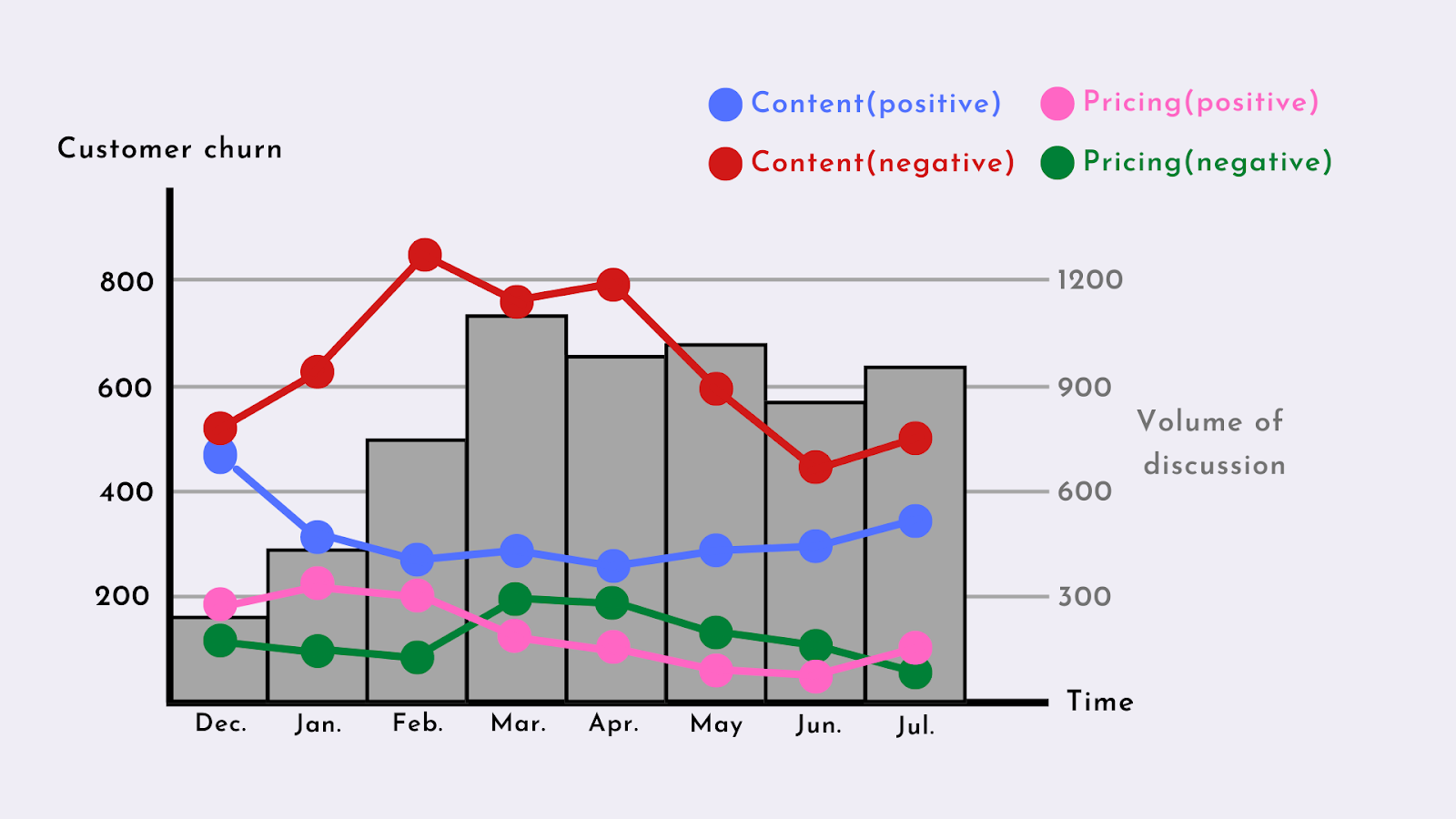
When Service N applied this temporal analysis to their data, a striking finding emerged: content quality was a significantly more influential driver of churn than pricing. While pricing complaints were present and persistent, they remained relatively stable over time. Content-related dissatisfaction, on the other hand, showed clear spikes that correlated with periods of high cancellation volume. Customers were not leaving primarily because the service cost too much. They were leaving because they felt the catalog did not justify the cost — a subtle but strategically important distinction.
The temporal view also surfaced an anomaly worth investigating. In March, pricing complaints showed a noticeable uptick that did not correspond to any change in Service N’s own pricing structure. Further analysis suggested this increase correlated with competitor activity — specifically, a rival service had launched a promotional campaign offering a lower entry price. This kind of insight is invisible in aggregate satisfaction scores or monthly churn rates, but it becomes actionable when you can trace the shift back to specific language in customer feedback. Service N could now decide whether to respond with a pricing adjustment, a value communication campaign, or a targeted retention offer for the customer segment most influenced by the competitive move.
## Exploiting AI Benefits in Text Analysis
The lesson from Service N’s experience — and from the growing body of evidence across industries — is that organizations which rely exclusively on quantitative metrics are working with an incomplete picture. Numbers tell you that something is happening. Text tells you why it is happening. The most effective Voice of the Customer programs are those that incorporate both, using behavioral data to identify where to look and text analytics to understand what they find.
AI-powered text analysis does not replace human judgment. It amplifies it. By processing qualitative feedback at a scale and speed that no human team can match, it surfaces the patterns, themes, and sentiment shifts that inform better decisions. It transforms unstructured data — the sprawling, inconsistent, often contradictory mass of things customers say — into structured, actionable intelligence. For organizations willing to invest in this capability, the result is a VoC program that goes beyond measurement and becomes a genuine driver of strategic advantage.
The path forward is clear: stop treating text data as a secondary source and start treating it as the primary window into customer intent. The voice of your customers is already there, captured in every review, every support conversation, every comment thread. The question is whether you have the tools and the commitment to listen.
Share this article
Copy link
[ ](https://www.linkedin.com/sharing/share-offsite/?url=https%3A%2F%2Flabelf.ai%2Fblog%2Funderstand-the-voice-of-the-customers-through-optimizing-text-analytics "Share on LinkedIn")
[](https://twitter.com/intent/tweet?url=https%3A%2F%2Flabelf.ai%2Fblog%2Funderstand-the-voice-of-the-customers-through-optimizing-text-analytics\&text=Voice%20of%20the%20Customer%3A%20AI-Powered%20Text%20Analytics "Share on X")

Antony Lu
Contributor
## More articles
[](/blog/every-team-needs-a-different-dashboard)
[Use cases](/blog/every-team-needs-a-different-dashboard)
### [Every Team Needs a Different Dashboard — Here's How to Build Yours](/blog/every-team-needs-a-different-dashboard)
[Your Head of Ops needs cost data. Your team leads need agent scores. Your process developers need root cause alerts. One dashboard can't serve them all. Dashboard Studio can.](/blog/every-team-needs-a-different-dashboard)
[T](/blog/every-team-needs-a-different-dashboard)
[The Labelf Team · June 9, 2023](/blog/every-team-needs-a-different-dashboard)
[](/blog/deploy-automated-ticket-routing-for-exceptional-customer-support)
[Use cases](/blog/deploy-automated-ticket-routing-for-exceptional-customer-support)
### [AI-Powered Ticket Routing for Customer Support](/blog/deploy-automated-ticket-routing-for-exceptional-customer-support)
[Learn how AI-powered automated ticket routing can improve response times, accuracy, and operational efficiency in customer support, with context-based analysis that understands multiple languages.](/blog/deploy-automated-ticket-routing-for-exceptional-customer-support)
[A](/blog/deploy-automated-ticket-routing-for-exceptional-customer-support)
[Antony Lu · July 6, 2022](/blog/deploy-automated-ticket-routing-for-exceptional-customer-support)
[](/blog/treat-people-as-people-at-scale)
[AI](/blog/treat-people-as-people-at-scale)
### [We Treat People as People, at Scale](/blog/treat-people-as-people-at-scale)
[One-to-one marketing was promised in the 90s and never delivered. Now AI makes it possible — not by automating away the human interaction, but by making every interaction radically smarter.](/blog/treat-people-as-people-at-scale)
[T](/blog/treat-people-as-people-at-scale)
[The Labelf Team · April 8, 2026](/blog/treat-people-as-people-at-scale)
---
# What Is Accuracy, Precision, Recall, and F1 Score?
> A clear guide to the most common classification metrics in machine learning: accuracy, precision, recall, and F1 score. Learn when to use each metric and how they relate to real-world model performance.
[ Back to blog](/blog)

***
When building a machine learning classification model, choosing the right evaluation metric is just as important as choosing the right algorithm. Accuracy, precision, recall, and F1 score are the four most commonly used metrics, and each tells you something different about how well your model is performing. Understanding the distinction between them is critical for making informed decisions about model quality, especially in domains where errors have real consequences.
To make these concepts concrete, let’s imagine we work at “Aarons Animal Classifiers Inc.” Our job is to evaluate four different classification models. Each model is given the same set of six test images and must predict whether each image is an **animal** or **not an animal**. Three of the images are animals (a barn owl, a chihuahua, and a sheepdog) and three are not (a mop, a muffin, and a pineapple). Our goal is to figure out which model performs best — and to do that, we need to understand accuracy, precision, recall, and F1 score.
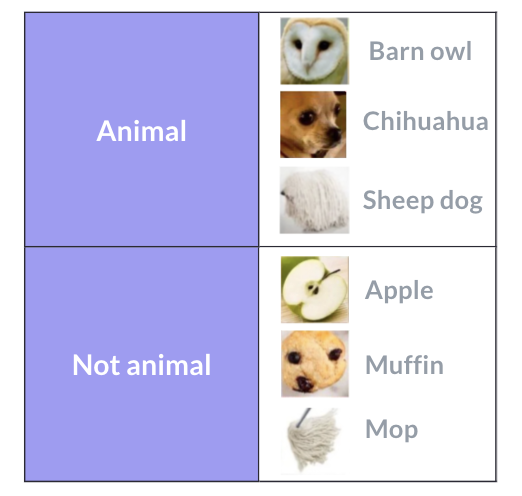
## The fundamental concepts: True/False and Positive/Negative
Before we can calculate any metric, we need to understand the **confusion matrix** — the foundation that all classification metrics are built on. Every single prediction a model makes falls into one of four categories:
* **True Positive (TP):** The model predicted “animal” and it actually was an animal. The model got it right.
* **True Negative (TN):** The model predicted “not animal” and it actually was not an animal. The model got it right.
* **False Positive (FP):** The model predicted “animal” but it was actually not an animal. The model was wrong — it raised a false alarm.
* **False Negative (FN):** The model predicted “not animal” but it was actually an animal. The model was wrong — it missed one.
The key to remembering these is simple: **True/False** tells you whether the model was correct or not. **Positive/Negative** tells you what the model predicted. A “False Positive” means the model incorrectly predicted positive.
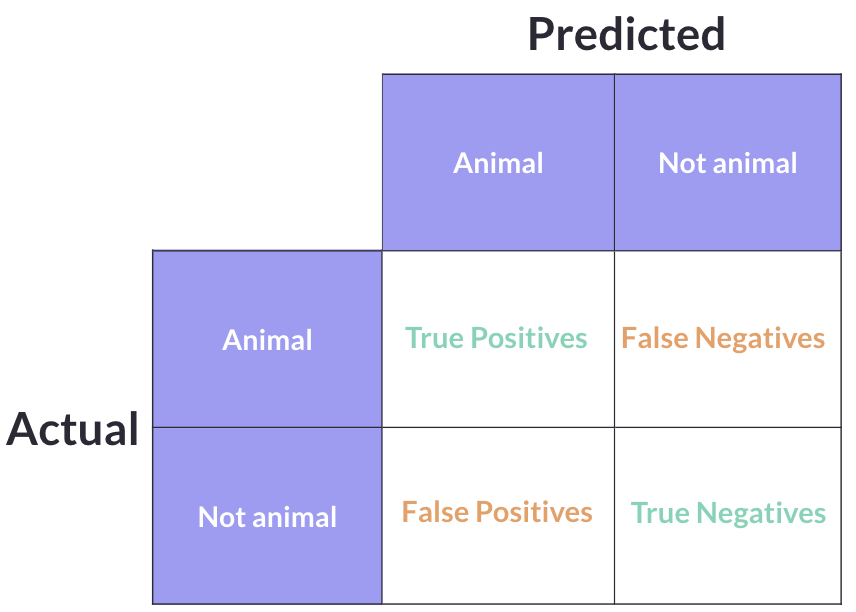
If a model were perfect — correctly identifying all three animals as animals and all three non-animals as non-animals — the confusion matrix would show 3 True Positives and 3 True Negatives, with zero False Positives and zero False Negatives.
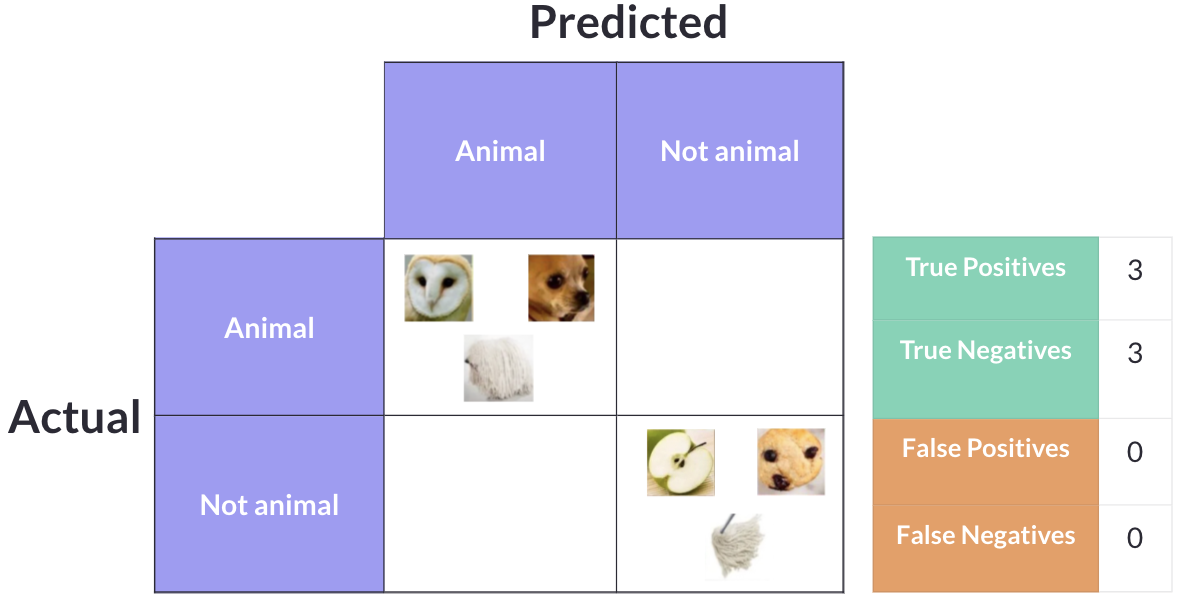
In practice, models make mistakes. A model might correctly identify two animals but miss the third, while also incorrectly labeling the mop as an animal. That would give us 2 True Positives, 2 True Negatives, 1 False Positive, and 1 False Negative.
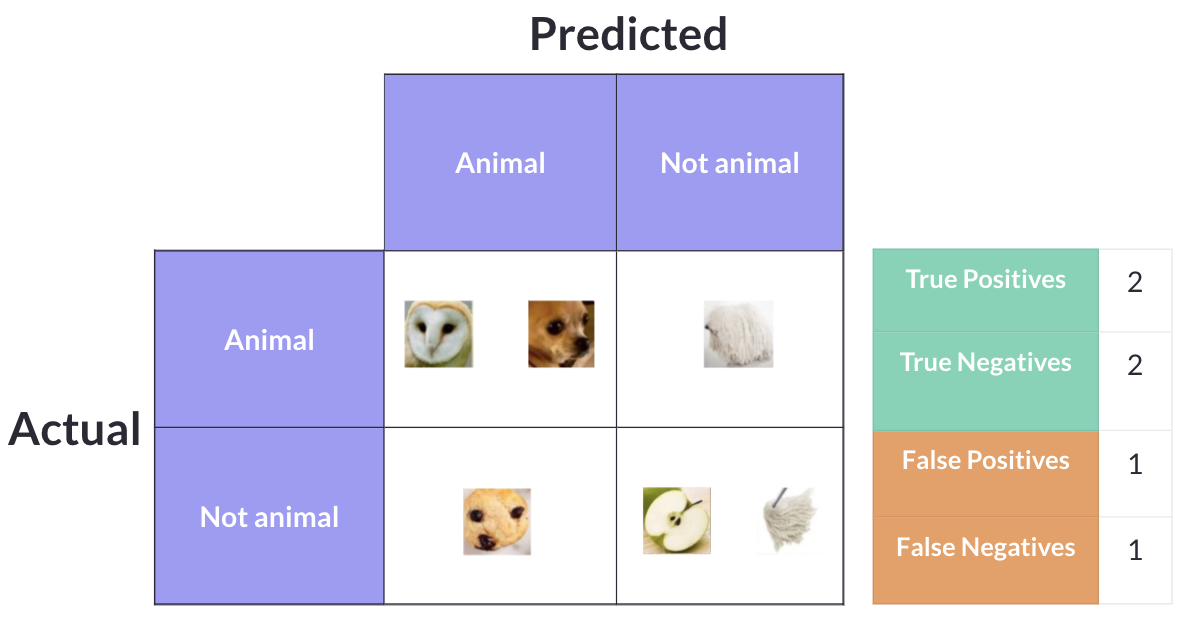
Now that we understand these four categories, we can define each metric.
## Accuracy
**“Out of all predictions made, how many were correct?”**
Accuracy is the simplest and most intuitive metric. It counts up all the correct predictions (both True Positives and True Negatives) and divides by the total number of predictions:
**Accuracy = (TP + TN) / (TP + TN + FP + FN)**
In our animal example, if a model correctly classifies 5 out of 6 images, it has an accuracy of 5/6 = 83.3%.
While accuracy is easy to understand, it can be deeply misleading when classes are **imbalanced**. Imagine a dataset with 950 non-animals and 50 animals. A model that blindly predicts “not animal” for every single image would achieve 95% accuracy — but it would be completely useless at the actual task of finding animals. This is why accuracy alone is never enough.
## Precision
**“Out of all positive predictions made, how many were actually correct?”**
Precision focuses exclusively on the predictions the model labeled as positive. Of all the times the model said “this is an animal,” how often was it right?
**Precision = TP / (TP + FP)**
High precision means the model rarely cries wolf — when it says something is an animal, you can trust it. Low precision means the model is labeling too many non-animals as animals (lots of false positives).
Precision is the metric to prioritize when **false positives are expensive**. For example, a spam filter should have high precision because flagging a legitimate email as spam (a false positive) could mean a user misses something important.
## Recall
**“Out of all data points that should be predicted as positive, how many did we correctly predict?”**
Recall looks at the problem from the other direction. Of all the images that actually are animals, how many did the model successfully identify?
**Recall = TP / (TP + FN)**
High recall means the model rarely misses a positive case — it catches almost everything. Low recall means the model is letting too many actual positives slip through (lots of false negatives).
Recall is the metric to prioritize when **false negatives are expensive**. For example, a medical screening test for cancer should have high recall because missing an actual case (a false negative) could cost someone their life.
Precision and recall are often in tension with each other. A model can trivially achieve 100% recall by predicting everything as positive — but its precision would plummet. Conversely, a model can achieve near-perfect precision by only predicting positive when it is extremely confident — but it will miss many actual positives, tanking recall.
## F1 Score
The F1 score resolves the tension between precision and recall by combining them into a single number using the **harmonic mean**:
**F1 = 2 × (Precision × Recall) / (Precision + Recall)**
Why the harmonic mean instead of a simple average? Because the harmonic mean **penalizes extreme values**. If a model has 100% precision but 10% recall, a simple average would give 55% — which sounds decent. The harmonic mean gives 18.2% — which more accurately reflects how poor the model really is. The F1 score is only high when both precision and recall are reasonably high.
The F1 score is especially useful when you do not have a clear reason to favor precision over recall or vice versa, and you want a single balanced metric to compare models.
## Evaluating the four models
Now let’s put these metrics to work and evaluate our four animal classification models.
### Model 1: Predict everything as “animal”
Model 1 takes the simplest possible approach — it classifies every single image as an animal. The three actual animals are correctly identified (3 True Positives), but the mop, muffin, and pineapple are all incorrectly labeled as animals too (3 False Positives). There are zero True Negatives and zero False Negatives.
* **Accuracy:** (3 + 0) / 6 = **50%**
* **Precision:** 3 / (3 + 3) = **50%**
* **Recall:** 3 / (3 + 0) = **100%**
* **F1 Score:** 2 × (0.5 × 1.0) / (0.5 + 1.0) = **66.7%**
This model has perfect recall — it never misses an animal — but that is meaningless because it calls everything an animal. It is like a fire alarm that never stops ringing. Sure, it will catch every fire, but it is useless.
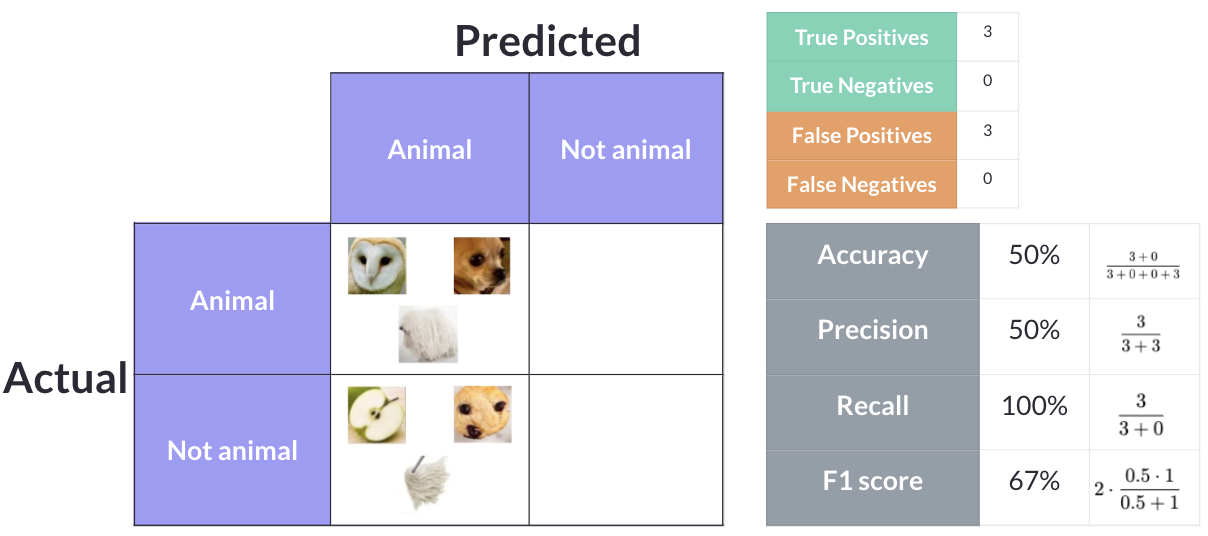
### Model 2: Predict everything as “not animal”
Model 2 is the opposite extreme — it classifies every image as not an animal. The three non-animals are correctly classified (3 True Negatives), but all three actual animals are missed (3 False Negatives). There are zero True Positives and zero False Positives.
* **Accuracy:** (0 + 3) / 6 = **50%**
* **Precision:** 0 / (0 + 0) = **undefined (0%)**
* **Recall:** 0 / (0 + 3) = **0%**
* **F1 Score:** **0%**
Interestingly, this model has the same 50% accuracy as Model 1, even though it behaves in the exact opposite way. This is a perfect example of why accuracy alone can be misleading — two models with identical accuracy can have completely different behaviors. With 0% recall and 0% F1, this model is clearly useless for finding animals.
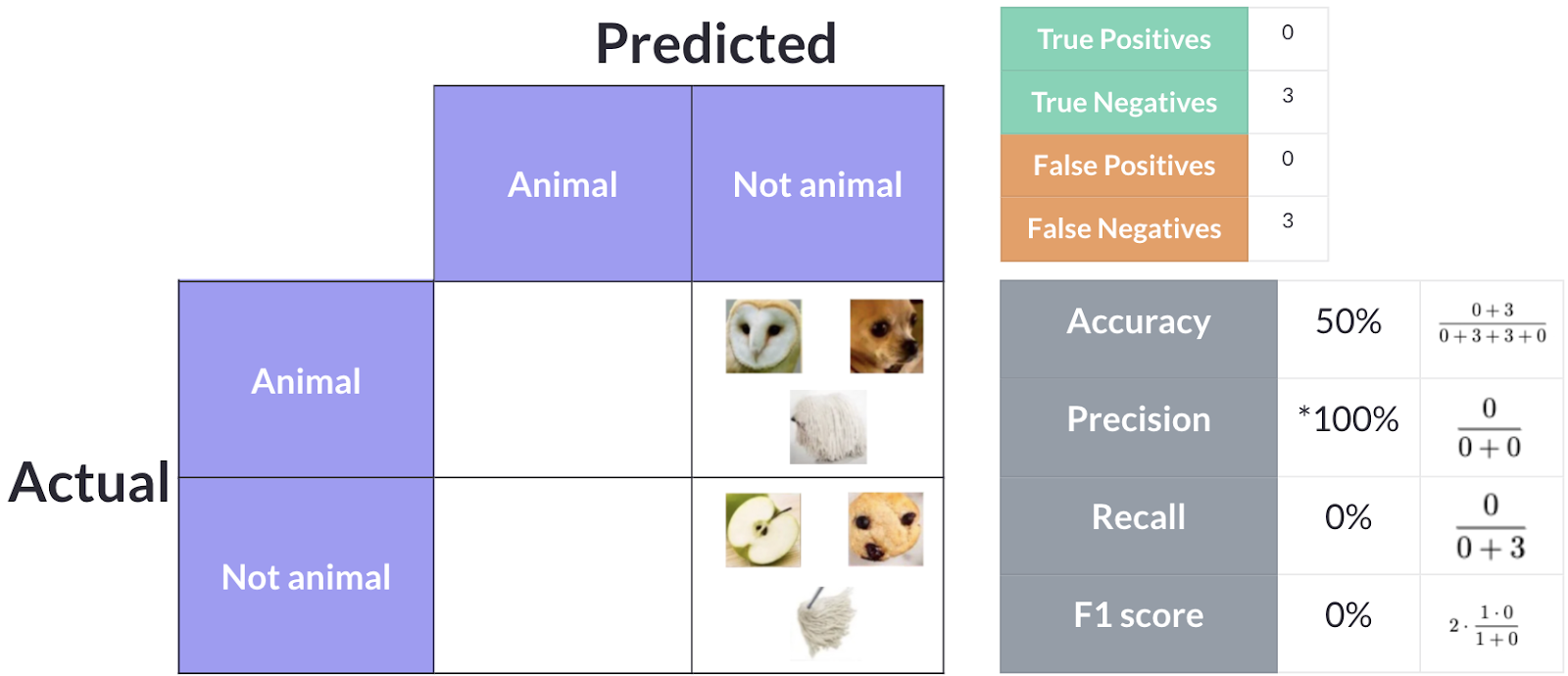
### Model 3: Overpredicts non-animals
Model 3 is more conservative — it only labels something as an animal when it is very confident. It correctly identifies one animal and correctly classifies all three non-animals, but it misses two of the actual animals. This gives us 1 True Positive, 3 True Negatives, 0 False Positives, and 2 False Negatives.
* **Accuracy:** (1 + 3) / 6 = **66.7%**
* **Precision:** 1 / (1 + 0) = **100%**
* **Recall:** 1 / (1 + 2) = **33.3%**
* **F1 Score:** 2 × (1.0 × 0.333) / (1.0 + 0.333) = **50%**
This model has perfect precision — every time it says “animal,” it is correct. But it achieves this by being overly cautious, missing two out of three animals. If you absolutely cannot tolerate false positives, this model might work, but it misses most of the actual animals.
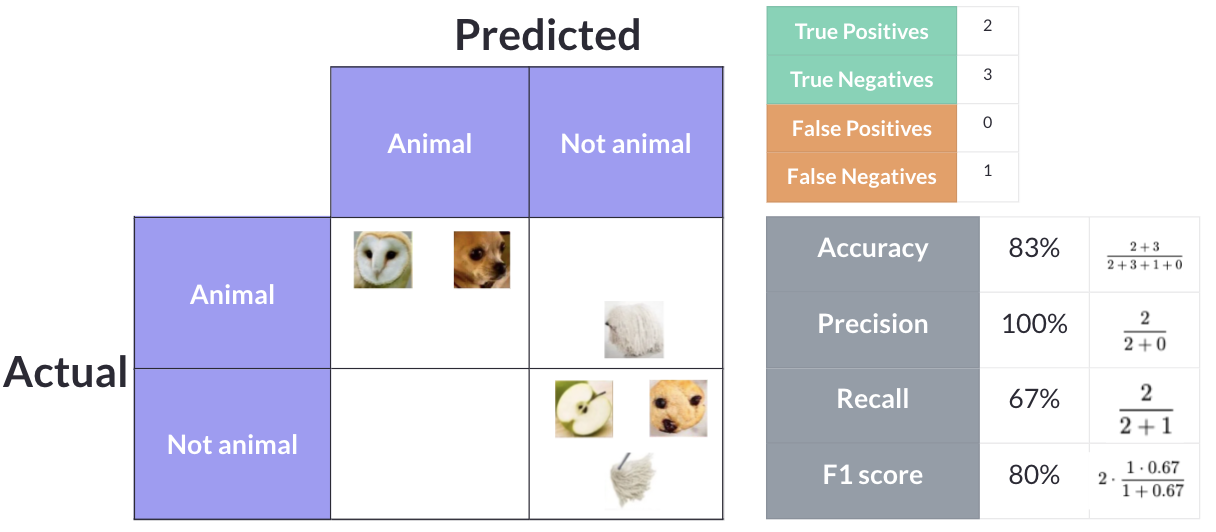
### Model 4: Overpredicts animals
Model 4 leans the other way — it is more aggressive about predicting animals. It correctly identifies all three animals and two of the non-animals, but incorrectly classifies one non-animal as an animal. This gives us 3 True Positives, 2 True Negatives, 1 False Positive, and 0 False Negatives.
* **Accuracy:** (3 + 2) / 6 = **83.3%**
* **Precision:** 3 / (3 + 1) = **75%**
* **Recall:** 3 / (3 + 0) = **100%**
* **F1 Score:** 2 × (0.75 × 1.0) / (0.75 + 1.0) = **85.7%**
Model 4 achieves the highest accuracy (83.3%), the highest F1 score (85.7%), and perfect recall (100%). It catches every single animal, with the trade-off of one false positive. For most use cases, this is the best model of the four.
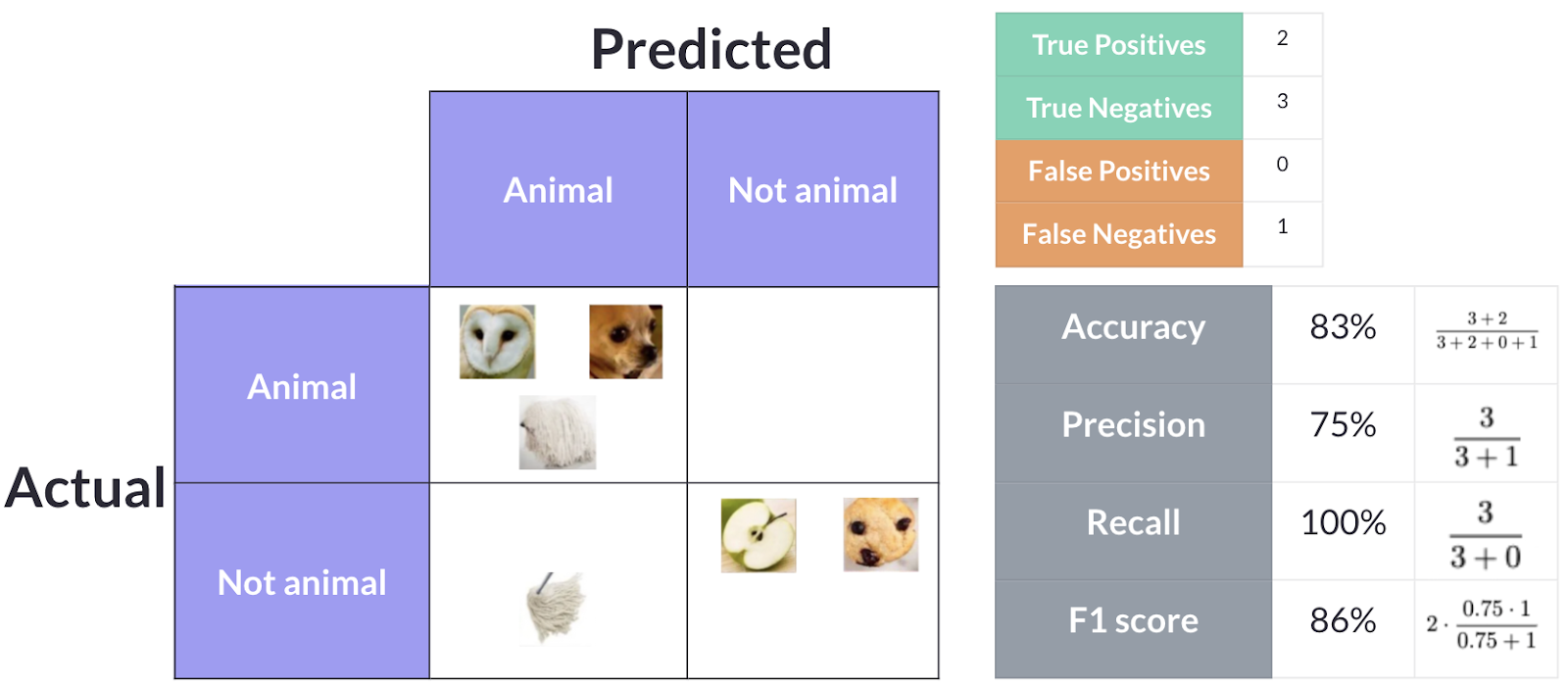
## Conclusion
So which model is the “best”? It depends entirely on the use case.
* If missing an animal is unacceptable (e.g., detecting dangerous wildlife on a hiking trail), you want **high recall** — Model 4 is your best choice.
* If false alarms are unacceptable (e.g., flagging content for manual review where reviewer time is expensive), you want **high precision** — Model 3 would be preferred.
* If you want a single balanced metric, the **F1 score** gives you the best of both worlds — and Model 4 wins with 85.7%.
* **Accuracy** is a useful starting point, but as we saw with Models 1 and 2, two models can have identical accuracy while being wildly different in actual usefulness.
The key takeaway: never rely on a single metric. Understand what each metric measures, consider what kind of errors matter most in your specific context, and choose accordingly.
Share this article
Copy link
[ ](https://www.linkedin.com/sharing/share-offsite/?url=https%3A%2F%2Flabelf.ai%2Fblog%2Fwhat-is-accuracy-precision-recall-and-f1-score "Share on LinkedIn")
[](https://twitter.com/intent/tweet?url=https%3A%2F%2Flabelf.ai%2Fblog%2Fwhat-is-accuracy-precision-recall-and-f1-score\&text=What%20Is%20Accuracy%2C%20Precision%2C%20Recall%2C%20and%20F1%20Score%3F "Share on X")

Ted Tigerschiold
COO & Co-Founder
## More articles
[](/blog/treat-people-as-people-at-scale)
[AI](/blog/treat-people-as-people-at-scale)
### [We Treat People as People, at Scale](/blog/treat-people-as-people-at-scale)
[One-to-one marketing was promised in the 90s and never delivered. Now AI makes it possible — not by automating away the human interaction, but by making every interaction radically smarter.](/blog/treat-people-as-people-at-scale)
[T](/blog/treat-people-as-people-at-scale)
[The Labelf Team · April 8, 2026](/blog/treat-people-as-people-at-scale)
[](/blog/youre-renting-your-customers)
[AI](/blog/youre-renting-your-customers)
### [You're Renting Your Customers — And The Price Goes Up Every Year](/blog/youre-renting-your-customers)
[While everyone celebrates the shift to self-service and automation, companies are quietly paying more and more to reach the customers they already had. There is another way.](/blog/youre-renting-your-customers)
[T](/blog/youre-renting-your-customers)
[The Labelf Team · April 2, 2026](/blog/youre-renting-your-customers)
[](/blog/nlp-techniques)
[AI](/blog/nlp-techniques)
### [NLP Techniques](/blog/nlp-techniques)
[An exploration of the most important natural language processing techniques used in modern AI, from tokenization and word embeddings to transformers and large language models.](/blog/nlp-techniques)
[F](/blog/nlp-techniques)
[Filip Sörlin · November 21, 2022](/blog/nlp-techniques)
---
# You're Renting Your Customers — And The Price Goes Up Every Year
> While everyone celebrates the shift to self-service and automation, companies are quietly paying more and more to reach the customers they already had. There is another way.
[ Back to blog](/blog)

***
Here’s a number most CMOs don’t want to look at too closely: customer acquisition cost has roughly doubled in the past five years across telecom, banking, insurance, and retail. Not because markets got smaller. Because you’re paying to reach people who were already your customers.
Think about that for a moment. You had a relationship with these people. They called you, they walked into your stores, they emailed your support team. You knew their names, their problems, their preferences. And then you optimized it all away.
## How we got here
The shift to self-service felt like the right call at the time. Every contact deflected was money saved. Fewer agents meant lower overhead. The digital transformation playbooks all pointed the same direction: reduce human touchpoints, increase automation, drive customers online.
It worked — for the cost line. But nobody ran the full equation.
What you saved on customer service, you now spend on Google. What you gained in operational efficiency, you lost in customer intelligence. Every interaction you deflected was also a data point you surrendered, a relationship signal you’ll never see again. And with GDPR tightening, cookies dying, and digital channels getting noisier by the quarter, you know less about your customers today than you did five years ago.
The irony is almost too clean: companies spent a decade minimizing customer contact, and now they spend fortunes trying to buy it back. Retargeting ads, affiliate programs, telemarketing campaigns — all of it is just renting access to people who once talked to you for free.
The numbers speak for themselves. For a typical mid-size operator, the monthly revenue at risk from churn alone dwarfs what most companies spend on customer acquisition. The customers you’re losing were already talking to you — and telling you exactly why they were about to leave.
## The false choice
The industry’s current answer makes this worse, not better. The pitch from every AI vendor at every conference goes something like this: “Replace your remaining agents with bots. Full automation. Zero cost per interaction.”
And sure, there are interactions that should be automated. Password resets. Delivery tracking. Simple FAQ lookups. Nobody needs a human for those.
But something strange happens when you automate the easy stuff away. The remaining human interactions don’t become less important — they become more important. They’re the ones where a customer is frustrated enough to demand a real person. Where someone is considering leaving. Where there’s an upsell opportunity buried in a complaint. Where the relationship is actually at stake.
These interactions are now scarce. And like anything scarce, their value has gone up.
Yet the industry treats them as a cost to be eliminated rather than an asset to be maximized. CMOs are forced into what feels like a binary choice: slash customer service for cost advantage, or keep human agents and accept the overhead. Automate everything, or fall behind.
That’s a false choice.
## The contrarian bet
We believe the opposite. We think the companies that will dominate the next decade in telecom, banking, insurance, and utilities are not the ones that eliminated customer interaction — they’re the ones that figured out how to make every interaction count.
Consider the math. A single customer service conversation where you save a churning customer is worth what — ten Google clicks? Twenty? A cross-sell that happens naturally during a support call converts at five to ten times the rate of a cold outreach. An agent who knows a customer’s history, frustration, and product usage before the call even starts doesn’t just resolve faster — they build the kind of loyalty no ad campaign can buy.
This is what it looks like when a company treats every interaction as an investment in the relationship rather than a cost to minimize. A frustrated customer becomes a promoter — not through a marketing campaign, but through a series of genuine human interactions where someone actually cared.
The data backs this up. In industries with standardized products — where everyone offers more or less the same thing — the customer relationship is the last real differentiator. Not the product, not the price, not the brand. The experience of being treated like a person who matters.
And here’s what’s changed: AI now makes it possible to do this at scale. Not by replacing the human interaction, but by making every human interaction radically better. Knowing who’s at risk before they call. Having the full picture of a customer’s journey before the conversation starts. Coaching agents in real time on what works. Generating proactive outreach — “call this customer about this, right now” — based on signals nobody could spot manually across millions of interactions.
The patterns are clear. The things that create lasting customer value — first-call resolution, agents who remember context, proactive follow-ups — are all fundamentally human. The things that destroy it — transfers, repetition, dead ends — are all symptoms of systems that treat interactions as tickets to be closed rather than relationships to be built.
This isn’t about spending more on customer service. It’s about recognizing that the conversations you’re already having are the most valuable asset sitting on your books — and treating them accordingly.
## The question
If you’re a CMO, here’s what I’d want to know: how much of your budget goes toward buying back access to customers you already had? And how much goes toward maximizing the value of the customers who are already talking to you?
Most organizations spend aggressively on acquisition and almost nothing on making existing interactions count. They rent attention from Google and Meta while ignoring the organic attention they get for free every time a customer picks up the phone.
The rent keeps going up. The attention you already have is free. The gap between those two numbers is either your biggest liability or your biggest opportunity.
You get to choose which one.
Share this article
Copy link
[ ](https://www.linkedin.com/sharing/share-offsite/?url=https%3A%2F%2Flabelf.ai%2Fblog%2Fyoure-renting-your-customers "Share on LinkedIn")
[](https://twitter.com/intent/tweet?url=https%3A%2F%2Flabelf.ai%2Fblog%2Fyoure-renting-your-customers\&text=You're%20Renting%20Your%20Customers%20%E2%80%94%20And%20The%20Price%20Goes%20Up%20Every%20Year "Share on X")

The Labelf Team
Team
## More articles
[](/blog/treat-people-as-people-at-scale)
[AI](/blog/treat-people-as-people-at-scale)
### [We Treat People as People, at Scale](/blog/treat-people-as-people-at-scale)
[One-to-one marketing was promised in the 90s and never delivered. Now AI makes it possible — not by automating away the human interaction, but by making every interaction radically smarter.](/blog/treat-people-as-people-at-scale)
[T](/blog/treat-people-as-people-at-scale)
[The Labelf Team · April 8, 2026](/blog/treat-people-as-people-at-scale)
[](/blog/nlp-techniques)
[AI](/blog/nlp-techniques)
### [NLP Techniques](/blog/nlp-techniques)
[An exploration of the most important natural language processing techniques used in modern AI, from tokenization and word embeddings to transformers and large language models.](/blog/nlp-techniques)
[F](/blog/nlp-techniques)
[Filip Sörlin · November 21, 2022](/blog/nlp-techniques)
[](/blog/what-is-accuracy-precision-recall-and-f1-score)
[AI](/blog/what-is-accuracy-precision-recall-and-f1-score)
### [What Is Accuracy, Precision, Recall, and F1 Score?](/blog/what-is-accuracy-precision-recall-and-f1-score)
[A clear guide to the most common classification metrics in machine learning: accuracy, precision, recall, and F1 score. Learn when to use each metric and how they relate to real-world model performance.](/blog/what-is-accuracy-precision-recall-and-f1-score)
[T](/blog/what-is-accuracy-precision-recall-and-f1-score)
[Ted Tigerschiold · November 7, 2022](/blog/what-is-accuracy-precision-recall-and-f1-score)
---
# Book a demo
> See Labelf in action. Book a personalized demo to learn how AI interaction analytics can reduce churn and grow revenue.
See how Labelf can transform your customer interactions into actionable insights.
---
# Let's talk.
> Get in touch with the Labelf team. Questions about the platform, need a demo, or want to discuss a partnership — we're here.
Contact

Viktor Alm
CEO & Co-Founder
[ ](mailto:viktor@labelf.ai?subject=Interest%20in%20Labelf%20\(Website\))[](https://www.linkedin.com/in/viktoralm/)

Niklas Cumzelius
Sales
[ ](tel:+46709218154)[ ](mailto:niklas@labelf.ai?subject=Interest%20in%20Labelf%20\(Website\))[](https://www.linkedin.com/in/niklas-cumzelius-098542/)

Ted Tigerschiold
Operations
[ ](mailto:ted@labelf.ai?subject=Interest%20in%20Labelf%20\(Website\))[](https://www.linkedin.com/in/ted-tigerschiold/)
---
# From raw conversations to business results.
> From raw conversations to business results. Explore Labelf's AI platform for interaction analytics, custom models, and dashboards.
The Platform
Labelf reads every customer interaction, trains custom AI models to understand them, and turns that understanding into actions — churn saves, sales leads, coaching plans, and process fixes. All measured in dollars.
[Book a Demo ](/book-a-demo)

## From description to production in minutes.
Describe what you want to classify. The model starts working immediately. No data science required.
[See model training →](/platform/model-training)
## Label smarter, not harder.
The system finds the examples that matter most — edge cases, rare patterns, your mistakes. 200 smart labels beat 2,000 random ones.
[See active learning →](/platform/model-training)
## Search by meaning, not keywords.
Type a question. Find matching conversations across millions of interactions — even when the words are completely different.
[See AI search →](/platform/ai-search)
## Ask anything. Get answers in seconds.
The AI Agent queries your data, reads transcripts, builds charts, and suggests actions — all from a single question.
[See the AI agent →](/platform/ai-agent)
## From insight to action. Automatically.
When the AI finds a pattern — it writes the playbook, cites real conversations, and tracks whether agents follow it.
[See playbooks and alerts →](/platform/playbooks)
## See everything. Build anything.
25+ chart types, custom metrics, real-time filters. Every model you train becomes a dashboard dimension.
[See Dashboard Studio →](/platform/dashboards)
## Every customer. Full picture.
Churn risk, upsell score, interaction history, AI-generated actions — all in one view per customer.
[See customer profiles →](/platform/customer-profiles)
## Deploy anywhere. Trust everything.
Cloud, private cloud, or on-premise. 90+ integrations. GDPR compliant. EU-based. Your data never leaves your control.
[Integrations](/platform/integrations)
[90+ tools — CRM, ticketing, call center, BI, data lakes. API-first.](/platform/integrations)
[Explore integrations →](/platform/integrations)
[Security & Privacy](/platform/security)
[Cloud, private cloud, or on-premise. GDPR. EU AI Act. No US jurisdiction.](/platform/security)
[Explore security & privacy →](/platform/security)
[Transcription](/platform/transcription)
[100+ languages. Speaker separation. Custom vocabulary. Fine-tunable.](/platform/transcription)
[Explore transcription →](/platform/transcription)
[Data & Export](/platform/data-export)
[CSV, API, webhooks. Your data, always. Zero vendor lock-in.](/platform/data-export)
[Explore data & export →](/platform/data-export)
## Deep dives into every capability.
[AI Search → ](/platform/ai-search)[Model Training → ](/platform/model-training)[Model Evaluation → ](/platform/model-evaluation)[Auto-categorization → ](/platform/auto-categorization)[AI Agent → ](/platform/ai-agent)[Playbooks & Alerts → ](/platform/playbooks)[Dashboards & Studio → ](/platform/dashboards)[Customer Profiles →](/platform/customer-profiles)
## We're ready, are you?
[Book a Demo ](/book-a-demo)
---
# Ask anything. Get answers.
> Ask anything about your customers and get instant answers. Labelf's AI agent reads every conversation so your team doesn't have to.
AI Agent
You have a question about your customers. Ask in plain language and get an answer in seconds — with charts, citations, and recommended actions.
[Book a Demo ](/book-a-demo)

See it in action
## All of Labelf's power in one conversation
The agent has access to every model, every metric, every conversation. It writes SQL, reads transcripts, builds charts, and suggests actions — all from a single question.
Superpowers
## A research agent that can read every conversation.
It has read every call, every chat, every ticket. Ask why customers leave, what your best agents do differently, or where your process breaks — and get answers backed by real conversations.
Queries your data
Writes and executes SQL against your analytics database. Self-corrects if a query fails.
Reads conversations
Pulls actual transcripts and quotes specific customer statements with dates and context.
Builds charts
Generates bar charts, line charts, tables — whatever best tells the story of the data.
Cross-references models
Uses all your trained models as dimensions. "Show frustrated billing customers on mobile."
Suggests actions
Recommends playbooks, process alerts, and next steps based on what it finds.
Multi-step reasoning
Breaks complex questions into steps. Plans, executes, and assembles a complete answer.
What you can ask
## Any question about your customer interactions.
"Why is churn up this month?"
Investigation
"Which agents handle billing disputes best?"
Benchmarking
"Show me the top 10 cost drivers this quarter"
Reporting
"What do customers say about our new pricing?"
Conversation analysis
"Create a coaching plan for Johan based on his calls"
Coaching
"How does team Alpha compare to team Beta on FCR?"
Comparison
"What happened with TV app calls last Tuesday?"
Spike analysis
"Show me customers who mentioned a competitor this week"
Search
"What's the ROI of our retention playbook?"
Impact measurement
## Connected to everything. Grounded in your data.
The agent doesn't make things up. Every number comes from a SQL query you can inspect. Every quote comes from an actual conversation you can read. Every chart is built from your real data.
Data Layer
SQL queries against your analytics database with self-correction on errors
Conversation Layer
Reads full transcripts from search index with anti-hallucination safeguards
Model Layer
All your trained models become queryable dimensions and filter criteria
Action Layer
Generates charts, playbooks, process alerts, and dashboard filters as output
## The agent is only as smart as the intelligence behind it.
Every model you [train](/platform/model-training), every category the system [discovers](/platform/auto-categorization), every pattern in the [dashboards](/platform/dashboards) — the agent uses them all. The more you build, the smarter it gets.
## Days of analysis. Seconds to answer.
What used to require an analyst, a SQL expert, and a week of work — the agent does in one conversation.
5
Steps per investigation
<30 s
Average answer time
0
Answers without source data
## We're ready, are you?
[Book a Demo ](/book-a-demo)
---
# Find what you mean.
> Search conversations by meaning, not keywords. Labelf's semantic search finds interactions that matter, even when the words differ.
AI Search
[Book a Demo ](/book-a-demo)
The problem
Keyword search finds what you type. But customers don't use your terminology. They say **"I've had enough"** — not **"service cancellation"**. Labelf finds what you mean, across millions of conversations, in seconds.

See it in action
## Search by meaning, not keywords
Type a question, a description, or even a feeling. Labelf understands the intent and finds matching conversations — even when the words are completely different.
Three search modes
## Keywords when you need precision. Meaning when you don't.
Labelf automatically switches between search modes based on your query. Short and specific? Exact match. Longer and descriptive? Semantic understanding. You don't have to think about it.
Keyword
1-3 words. Exact match with wildcard support. \*stream\* finds streaming, livestream, mainstream.
Semantic
4+ words. Meaning-based. "unhappy with delivery" finds "package never arrived" and "where is my order?".
Hybrid
Combine both. "\*competitor\* unhappy switching" — exact brand match with semantic intent.
Why it matters
## Not just search. Discovery.
When you have 5 million conversations, you can't read them. You need a way to ask questions and get answers. AI Search is your entry point into the data.
Needle in the haystack
Find 200 fraud cases in 5 million conversations. Search by behavior pattern, not just keywords.
Cross-language
Search in English, find results in Swedish, Norwegian, German — any of 100+ languages. The meaning transfers.
Context-aware
Understands full conversations, not isolated messages. The meaning of "I'm done" depends on what came before it.
Feed into models
Search results become training data. Find 200 examples of a pattern, label them, train a custom model. Search is step one.
## Search is how you explore. Models are how you scale.
Every search is a hypothesis. When you find a pattern, Labelf helps you turn it into a custom model that runs automatically on every new interaction — no manual work, no data science team required.
* Search → Find → Label → Train Use search results as training examples. The model learns from what you find.
* No data science required Your domain experts search, label, and train. The platform handles the rest — zero-shot, active learning, fine-tuning.
* From ad-hoc to automated What starts as a search query becomes a deployed model classifying every interaction in real-time.
## Search is step one. Training is step two.
AI Search helps you explore and discover. When you find a pattern worth tracking, [Custom Model Training](/platform/model-training) turns it into an automated classifier. Together, they form the intelligence engine behind every Labelf solution.
## Stop reading. Start finding.
Your conversations contain every answer your business needs. You just couldn't search them properly — until now.
100 +
Languages supported
5 M+
Conversations searchable
<3 s
Average search time
## We're ready, are you?
[Book a Demo ](/book-a-demo)
---
# Find what you didn't know to look for.
> Automatically categorize every customer interaction with AI. Discover contact reasons and patterns you didn't know to look for.
Auto-categorization
Auto-categorization reads all your interactions and discovers categories for you — no training, no labels, no instructions. It finds the patterns you didn't know existed.
[Book a Demo ](/book-a-demo)

See it in action
## Point it at your data. Get categories back.
The AI reads every conversation, finds recurring patterns, names them, ranks them by volume and cost, and flags what's new. No setup required.
Two approaches, one platform
## Auto-discover and custom-train. Together.
Auto-categorization finds what's happening. Custom models classify it your way. The two work side by side — the AI discovers patterns you didn't expect, and your trained models enforce the structure you need.
Auto-categorization
AI reads everything and groups it. No instructions, no labels. Finds what you didn't know to look for. Best for exploration, discovery, and finding blind spots.
Custom models
You define the categories. Train with examples. Get production-grade accuracy. Best for KPIs, dashboards, playbooks, and anything that needs to be precise.
What it discovers
## The things you didn't know were costing you money.
Auto-categorization doesn't confirm what you already know. It finds what nobody noticed — because no one was looking for it.
Recurring micro-issues
"Router won't connect after restart" is 12% of tech support — but it was buried inside "broadband issues" in your old categories.
Seasonal spikes
Summer house internet setup calls spike 340% in May. Visible only when the AI separates it from general "new service" requests.
Process breakdowns
"App crashes on firmware v3.2" — the AI found it in 1,200 calls. Your old keyword search missed it because customers said "freezes", "stops working", "black screen".
Competitor mentions
The AI discovered a cluster of 1,400 calls mentioning a competitor's new pricing — before marketing knew about the campaign.
Billing confusion patterns
2,100 calls about "wrong amount on invoice" — but 60% are actually about VAT changes, not billing errors. Completely different fix needed.
Hidden churn signals
"Just checking my contract end date" — seems innocent, but the AI found these customers churn at 4x the normal rate within 30 days.
From discovery to action
## Found something interesting? Make it permanent.
When auto-categorization discovers a pattern worth tracking, you can turn it into a custom model with one click. The auto-discovered examples become your initial training data.
1
Auto-categorization discovers a pattern
"Router won't connect after restart" — 2,847 occurrences found
2
You promote it to a custom model
Auto-discovered examples become training data. Refine with Active Learning.
3
It runs in production, feeds dashboards and alerts
From "we didn't know this existed" to "we track it in real-time" — in hours.
## Discovery feeds everything.
Auto-categorization is the first step. What it finds flows into [Custom Model Training](/platform/model-training) for precision, [Dashboards](/platform/dashboards) for monitoring, and [Contact Reasons](/solutions/contact-reasons) for the full breakdown.
## You can't fix what you don't know exists.
Auto-categorization eliminates blind spots. It reads everything and tells you what's really happening — without assumptions, without bias, without missing anything.
247
Categories auto-discovered
0
Labels required
30 d
Average integration window
## We're ready, are you?
[Book a Demo ](/book-a-demo)
---
# Every customer. Full picture.
> See every customer's full history — sentiment trends, risk signals, and opportunities in one actionable view. Built automatically.
Customer Profiles
Your CRM shows what they bought. Your ticketing system shows what they asked. But no one shows the full relationship — every conversation, every frustration, every opportunity, every risk signal — aggregated into one actionable view.
[Book a Demo ](/book-a-demo)

See it in action
## Click any customer. Know everything.
Churn risk, upsell score, CSAT trend, product portfolio, interaction history, AI-generated actions — all in one view, updated with every new conversation.
360-degree view
## Built from conversations, not forms.
Most customer profiles are what you manually entered. Labelf profiles are built from what actually happened — every call, every chat, every ticket, analyzed and aggregated automatically.
Churn risk score
AI-scored from conversation signals, not just tenure
Upsell opportunity
Product gaps, expressed interests, timing signals
Satisfaction trajectory
CSAT over time — trending up, down, or volatile?
Full interaction history
Every call, chat, ticket — with agent, outcome, and conversation link
Product portfolio
What they have, what they don't, and what they've asked about
AI-generated actions
Specific next steps — retention, upsell, or resolution
Everywhere you need them
## Profiles power every solution.
[Churn risk list](/solutions/churn-reduction)
[Click any at-risk customer to see their full profile — why they're at risk and what to do about it.](/solutions/churn-reduction)
[Sales opportunity list](/solutions/sales-opportunities)
[Click any lead to see their interests, product gaps, and a personalized pitch recommendation.](/solutions/sales-opportunities)
[Agent coaching](/solutions/agent-coaching)
[See which customers a specific agent has handled — their outcomes, CSAT, and what went well or badly.](/solutions/agent-coaching)
[AI Agent answers](/platform/ai-agent)
["Tell me about customer Erik Lindqvist" — the agent pulls the full profile and answers in context.](/platform/ai-agent)
[Dashboard drill-down](/platform/dashboards)
[Click any data point in a dashboard to see the customers behind it — not just aggregated numbers.](/platform/dashboards)
[Playbook tracking](/platform/playbooks)
[See which customers were handled with which playbook — and whether it worked.](/platform/playbooks)
## The customer is the center of everything.
Every [model](/platform/model-training) prediction, every [dashboard](/platform/dashboards) metric, every [playbook](/platform/playbooks) action connects back to a customer. Profiles are where all the intelligence converges into one actionable view.
## Treat every customer as someone you know.
At scale. Automatically. Updated with every new interaction.
360 °
Customer view
0
Manual data entry
30 d
Average integration window
## We're ready, are you?
[Book a Demo ](/book-a-demo)
---
# See everything. Build anything.
> Build custom dashboards from any data point in your conversations. Drag, drop, and share real-time insights across your organization.
Dashboards & Studio
Every team needs different views. Labelf's Dashboard Studio lets you build exactly what each stakeholder needs — from templates or from scratch.
[Book a Demo ](/book-a-demo)

See it in action
## KPIs, charts, tables — all live
Real-time dashboards powered by your models. Every dimension is a filter. Every metric has a target. Every alert has a cost.
Build anything
## Templates to start. Studio to customize.
Start with a pre-built template — Churn, Sales, Contact Reasons, Agent Performance. Then customize: add charts, change metrics, adjust filters. Or build from scratch with the full Studio editor.
25+ chart types
Line, bar, pie, gauge, treemap, radar, funnel, tables, KPI cards
Custom metrics
Sum, count, average, ratio, percentile — with targets and alerts
Metric alerts
Set targets, get alerted when metrics go off track
Every dimension is a filter
Product, team, agent, category, time — filter and slice instantly
Drill down to conversations
Click any data point to see the actual interactions behind it
Templates for fast start
Pre-built dashboards for churn, sales, contact reasons, agents
Every role, every view
## Different people need different dashboards.
Head of Operations
Cost trends, AHT, volume spikes, top issues, waste anatomy. Ranked by business impact.
Team Leader
Team vs org comparison, per-agent performance, coaching priorities, playbook adherence.
Head of Sales
Conversion rates, revenue per agent, campaign performance, upsell pipeline.
Process Developer
Root cause deep dives, process alerts, deflection opportunities, trend monitoring.
## Two data layers. Infinite views.
Every dataset generates two analytics tables: conversation-level and utterance-level. Dashboards can query either — aggregated KPIs from conversations, or detailed analysis from individual speaker turns.
Conversation level
One row per interaction. All model predictions, metadata, KPIs, and outcomes aggregated. Perfect for dashboards and trends.
Utterance level
One row per speaker turn. What did the agent say? What did the customer say? Per-utterance sentiment and classification.
Model columns
Every model you train becomes a queryable column. Clusters, tags, scores — all available as chart dimensions and filters.
## Dashboards show what the models find.
Every [custom model](/platform/model-training) you train becomes a dashboard dimension. The [AI Agent](/platform/ai-agent) can set dashboard filters from chat. And [Playbooks](/platform/playbooks) track their impact right here.
## Your data. Your dashboards. Your way.
No more waiting for the BI team. Build the view you need, with the metrics that matter, filtered to the slice you care about.
25 +
Chart types available
∞
Filter combinations
30 d
Average integration window
## We're ready, are you?
[Book a Demo ](/book-a-demo)
---
# Your data. Always.
> Export enriched interaction data to any BI tool or data warehouse. Your data stays yours — always accessible, fully portable.

Data & Export
Every classification, every score, every transcript — it's **your data**. Export it anytime, in any format. Push it to your data lake. Pull it via API. We enrich your data, we don't hold it hostage.
[Book a Demo ](/book-a-demo)
Get your data out
## Every way you could want it.
CSV / Excel Export
Download any dataset, any dashboard, any model output as CSV or Excel. Filter first, export the slice you need.
REST API
Full programmatic access. Push data in, pull classifications out, trigger training, query dashboards. Everything the UI does, the API does.
Webhooks
Get notified when classifications complete, models deploy, or alerts trigger. Push results to Slack, Teams, or your own systems in real-time.
Data Lake Integration
Push enriched data directly to your Snowflake, BigQuery, Redshift, or S3 bucket. Labelf becomes a data enrichment layer in your pipeline.
Scheduled Reports
Set up automated exports on a schedule — daily, weekly, monthly. Delivered to email, SFTP, or cloud storage.
Batch Processing
Upload historical data in bulk. Process millions of records. Get classifications back as enriched datasets ready for your BI tools.
What you get
## Not just raw data. Enriched data.
When you export from Labelf, you don't get what you put in — you get what you put in plus everything Labelf added. Every model prediction, every score, every cluster, every tag.
Enriched export example
| Original | + Labelf adds |
| --------------- | ----------------------------- |
| Call transcript | Speaker-separated, anonymized |
| Customer ID | Churn risk score (0-100) |
| Agent name | Performance metrics per model |
| Duration | Category (L1/L2/L3) |
| Date | Root cause classification |
| CSAT score | Sentiment analysis |
| | Sales opportunity score |
| | Playbook adherence |
| | Cluster assignments |
Data retention
## You decide how long we keep it.
Set retention policies per data type. Keep transcripts forever, delete audio after 30 days, purge everything after a year. Your compliance team sets the rules, Labelf enforces them automatically.
Audio files
Delete after transcription, keep 30/90/365 days, or retain indefinitely
Transcripts
Anonymized or raw. Keep as long as you need them for model training and analysis
Classifications
Model predictions and scores. Typically retained for dashboard and trend analysis
Training data
Labels and examples. Retained as long as models are active. Exportable anytime
## Zero lock-in. Full portability.
If you ever want to leave — take everything with you. Every model, every classification, every transcript, every label. We believe you stay because the product is good, not because your data is trapped.
Export all data
One click. Everything. CSV, JSON, or via API.
Export models
Your training data and configurations. Fully portable.
Export labels
Every label your team created. Your work, your intellectual property.
Delete on request
Full GDPR-compliant data deletion. Everything wiped, confirmed in writing.
## We enrich your data. We don't own it.
Full data sovereignty. Export everything, delete everything, integrate with everything. Your data, your rules, always.
6
Export formats
0
Vendor lock-in
100 %
Data portability
## We're ready, are you?
[Book a Demo ](/book-a-demo)
---
# Connects to everything you already use.
> Connect Labelf to your existing stack in minutes. Native integrations with Zendesk, Salesforce, Genesys, and 50+ platforms.
Integrations
Labelf sits on top of your existing systems. We connect to them, read the data, add intelligence, and push actions back. API-first, always.
[Book a Demo ](/book-a-demo)

Contact Center 15
 Genesys  NICE CXone  Five9  Talkdesk  Avaya  Cisco Webex CC  Amazon Connect  Vonage  RingCentral  8x8  Dialpad  Aircall  CloudTalk  Puzzel  Mitel
CRM 7
 Salesforce  HubSpot  Microsoft Dynamics 365  Zoho CRM  Pipedrive  Freshsales  SugarCRM
Ticketing & Helpdesk 10
 Zendesk  Freshdesk  ServiceNow  Jira Service Management  Intercom  Front  Help Scout  Kayako  LiveAgent  Dixa
Survey / NPS / CSAT / VoC 11
 Medallia  Qualtrics  SurveyMonkey  Typeform  Nicereply  AskNicely  Delighted  Wootric  CustomerGauge  GetFeedback  InMoment
Workforce Management 6
 Calabrio  Verint  NICE WFM  Assembled  Playvox  Teleopti
Cloud & Data Lake 11
 AWS S3  AWS Redshift  Google BigQuery  Google Cloud Storage  Azure Blob  Azure Synapse  Snowflake  Databricks  Apache Kafka  PostgreSQL  OpenSearch
Communication 4
 Microsoft Teams  Slack  Zapier  Make (Integromat)
BI & Analytics 7
 Tableau  Power BI  Looker  Apache Superset  Grafana  Qlik  Metabase
Data Formats 7
CSV JSON Excel (XLSX) XML REST API Parquet Avro
90+ tools across 9 categories
And anything else via API
API-first
## Don't see your tool? We have an API.
Every feature in Labelf is accessible via REST API. Push data in, pull insights out, trigger actions, export results. Build any integration your setup requires.
Push data in
Upload conversations, tickets, CSAT data via API. Real-time or batch.
Pull insights out
Get classifications, scores, and predictions programmatically.
Trigger actions
Webhooks, Salesforce tags, Teams messages — push results back to your systems.
## Data in. Intelligence out.
Labelf sits between your data sources and your action systems. We read from everything on the left, add intelligence in the middle, and push results to everything on the right.
Data Sources
Call recordings
Chat transcripts
Email tickets
CSAT surveys
CRM data
IVR logs
Labelf Intelligence
Transcription
Classification
Scoring
Analysis
Recommendations
Playbooks
Action Outputs
CRM tags & scores
Dashboard KPIs
Agent coaching
Process alerts
Teams/Slack
Data lake export
## Keep what works. Add what's missing.
No migration. No disruption. Labelf adds intelligence to your existing stack — you keep everything you already have.
90 +
Tools supported
0
Systems to replace
30 d
Average integration window
## We're ready, are you?
[Book a Demo ](/book-a-demo)
---
# Trust what you deploy.
> Measure AI accuracy before you deploy. Validate, compare, and trust your models with full transparency — per class, per example.

Model Evaluation & Trust
AI that you can't explain is AI you can't trust. Labelf shows you **exactly** where your models are right, where they're wrong, and where they're uncertain — per class, per confidence level, per example.
[Book a Demo ](/book-a-demo)
See it in action
## Every class. Every metric.
Not just an overall accuracy number. See which categories the model nails, which ones need more examples, and which ones it confuses with each other.
Full transparency
## No black boxes. No blind trust.
Every model in Labelf comes with full evaluation tools. You decide when a model is good enough. You see where it struggles. And the system helps you fix it.
Confusion matrix
See which classes get mixed up, click into examples
Confidence threshold
Slide to trade precision for recall — find the right balance
Check labeling
The system flags when it disagrees with your labels
Per-class metrics
F1, precision, recall for every category individually
Click into errors
See the actual conversations the model got wrong
Weak class alerts
Flags classes that need more examples or clearer boundaries
Drill down
## Click any error. See why.
The confusion matrix shows where the model mixes up classes. Click any cell to see the actual conversations, who labeled them, the model's confidence — and relabel, flag for discussion, or undo right there.
Confidence control
## You decide how certain the model must be.
Set the confidence threshold. High confidence means fewer classifications but almost no errors. Low confidence means more coverage but more uncertainty. You control the tradeoff.
High confidence (90%+)
Almost never wrong. Classifies 70% of interactions. The rest get flagged for human review. Perfect for compliance-critical models.
Balanced (70%+)
Good accuracy with broad coverage. Classifies 90% of interactions. Typical production setting for analytics and dashboards.
Exploratory (50%+)
Maximum coverage, more noise. Classifies 99% of interactions. Use when finding patterns matters more than precision.
## Trust is the foundation. Actions follow.
When you trust your models, you can trust everything built on top of them. [Custom Model Training](/platform/model-training) builds the models. Evaluation proves they work. And they power your [Dashboards](/platform/dashboards), [Playbooks](/platform/playbooks), and every solution.
## If you can't explain it, don't deploy it.
Full transparency at every level. Your stakeholders see the numbers. Your team sees the errors. Everyone trusts the output.
5
Metrics per class
0
Black boxes
30 d
Average integration window
## We're ready, are you?
[Book a Demo ](/book-a-demo)
---
# Your business. Your models.
> Train AI models on your own data without writing code. Active learning workflows build custom classifiers from your conversations.
Custom Model Training
Generic AI models don't understand your business. Labelf lets your domain experts — not data scientists — train models that learn your language, your categories, your edge cases.
[Book a Demo ](/book-a-demo)

See it in action
## From description to production in minutes
Describe what you want to find. The model starts working. Deploy it. Watch the KPIs move. All in one flow.
Three modes
## Start instantly. Improve continuously.
Begin with zero-shot classification — no examples needed. As you refine, the model gets sharper. No data science team required at any stage.
Active Learning
## Label smarter, not harder.
You don't randomly label examples. Labelf analyzes the model's weaknesses and recommends exactly which examples will improve it the most. Label 200 smart examples instead of 2,000 random ones.
It finds edge cases, flags your mistakes, balances classes, discovers rare patterns — so your model learns what matters, fast.
Training Advisor
## The system tells you what to fix next.
Prioritized actions: which classes need more data, which confuse each other, which are star performers. With level progression so you always know how close you are to the next quality tier.
No data science required
## The people who know the business train the models.
QA analysts, team leads, process developers — the people who actually understand your customers. They click buttons, not write code. Labelf handles the AI.
QA Analyst
Labels examples at 200-400/hr. Finds patterns in conversations. Validates model output.
Team Lead
Defines categories based on how the team actually works. Sets edge case rules. Reviews model accuracy.
Process Developer
Designs the classification hierarchy. Connects models to dashboards. Builds reporting workflows.
Labelf
Handles model architecture, training, deployment, scaling, and active learning. Zero infrastructure for you.
Team performance
## Know who labels well — and who needs help.
See every labeler's volume, pace, agreement rate, corrections received, and accuracy trend over time.
## From description to production in minutes.
Traditional ML projects take months. With Labelf, you describe what you want, the model starts working, and you refine it with your team until it's production-ready. The platform handles everything else.
* Describe → Classify instantly Write what you're looking for in plain language. Zero-shot classification starts immediately.
* Label → Refine with Active Learning The system recommends what to label next. 200 smart examples beat 2,000 random ones.
* Deploy → Run on everything One click deploys the model. Every new interaction is classified automatically. Feeds dashboards, alerts, and playbooks.
Unlimited depth
## Go as deep as you need.
Build unlimited hierarchies within a single dimension. Each level trains a dedicated model on just the subset that matters. The deeper you go, the more specific the intelligence gets.
Customer Interest 3 levels deep · trained from conversations
L1 Streaming 22% of customers
L2 Sports 14%
L3 Hockey 78% convert on TV Premium
L3 F1 65% convert
L3 Football 41% convert
Skiing · Tennis · ...
L2 Fantasy & Sci-fi 5%
Documentaries · Kids · ...
L1 Summer house 8%
Travel · Remote work · Gaming · ...
Full conversations or single utterances
"Was the customer retained?" needs the full conversation. "Is this a billing question?" needs one message. Choose per model. Include surrounding context when needed.
Contact Reason 3 levels deep · root cause drill-down
L1 Invoice $42K/mo
L2 Perceived wrong information $28K/mo
L3 Wrong price $12K/mo
L3 Wrong date $9K/mo
L3 Wrong services $5K/mo
Product mismatch · VAT · ...
L2 Missing invoice $8K/mo
Payment failed · Refund request · ...
L1 Service $31K/mo
Order · Cancellation · ...
Each level is its own model
Level 1 runs on all interactions. Level 2 trains only on "Invoice Issues" — a focused model that's better because it's specialized. Level 3 goes deeper still. Each model is simple. The hierarchy creates the depth.
Bucketeering
## Cross everything against everything.
Every model you train creates a new dimension. Every dimension gets crossed against every KPI — CSAT, AHT, churn, sales, resolution, cost, transfer rate. Thousands of buckets. In those buckets, you find the patterns that no one could see before.
Dimensions × KPIs
2,000+ categories × 18 KPIs = 36,000+ data points
Your dimensions
ProductRoot CauseCustomer NeedSentimentAgentTeamResolutionSales AttemptChurn SignalChannelLanguageTime of Day + every model you add
Crossed against
CSATAHTChurn RateSales ConversionResolution RateTransfer RateFCRCostVolumeNPS + custom metrics
What pops out
"Billing disputes about wrong price" has 3× higher churn than "wrong date"
Root Cause × Churn Rate · 4,200 interactions
Churn risk
Agent Sarah resolves router issues in 4 min — average is 12 min
Agent × Product × AHT · What does she do differently?
Best practice
Hockey fans without streaming convert at 78% — but no one is pitching them
Customer Interest × Product × Sales Conversion · $240K/yr opportunity
Revenue
Tuesday evenings: TV app calls spike 340% — firmware v3.2 only
Time of Day × Product × Root Cause × Volume · $18K/mo in agent time
Process issue
Every model adds a dimension
Train a new model and it instantly creates new cross-references with every existing KPI and dimension. The more models, the richer the picture.
Anomalies surface automatically
The system monitors all buckets continuously. When a combination spikes or trends, it flags it. You don't search for problems — they find you.
Filter, slice, drill down
Every dimension is a filter. Every KPI is a sort. Start broad, narrow down, find the specific bucket that costs you $18K/month. Then fix it.
## Models are the engine. Everything else follows.
Every model you train powers the rest of the platform. [AI Search](/platform/ai-search) helps you find the training examples. [Model Evaluation](/platform/model-evaluation) shows you where it's right and wrong. And the models feed directly into [Dashboards](/platform/dashboards), [Playbooks](/platform/playbooks), and every solution.
## Built for domain experts, not data scientists.
The people who know your business best should be the ones training your AI. Labelf makes that possible.
400
Labels per hour by domain experts
0
Lines of code required
30 d
Average integration window
> In an operation of our scale, moving from data noise to decisive action is paramount. Labelf cuts through millions of interactions, providing the clear signals we need. Letting us act faster and with greater confidence on what truly matters, creating a better customer experience.

Nicklas Hellström
Head of Customer Operations Business Improvement, Telia Sweden
## We're ready, are you?
[Book a Demo ](/book-a-demo)
---
# From insight to action.
> Turn conversation insights into automatic actions. Alerts, workflows, and playbooks trigger when the right patterns appear.
Playbooks & Alerts
Insights without actions are just interesting facts. Labelf closes the loop — when the AI finds a pattern, it generates a playbook for agents or a process alert for the team who can fix it. With cost attached. Automatically.
[Book a Demo ](/book-a-demo)

Two output types
## Change behavior. Fix systems.
### Playbooks
Change how people handle a situation. "If X happens — don't do this — do this instead." Born from real conversation data, cited with examples, and tracked for adherence.
Agents Coaches Team Leaders Head of Ops
### Process Alerts
Fix the system, not the agent. Bug reports with a price tag — routed to the team who can fix it. Cost-quantified, prioritized, and tracked to resolution.
App Team Network IVR/Telephony Logistics
Playbook in action
## Cited. Tracked. Measured in dollars.
Every playbook comes with real conversation citations showing what works and what doesn't. Custom ML models track whether agents follow it. The cost of non-adherence is calculated automatically.
Process Alert in action
## Bug reports with a price tag.
When the system is broken, agents can't fix it — but someone can. Process alerts go straight to the owning team with evidence, cost, and a companion playbook for agents in the meantime.
The full loop
## Detect. Recommend. Distribute. Measure. Repeat.
Other tools stop at insight. Labelf goes all the way — from detecting a pattern to distributing the playbook, training a model to track adherence, and measuring the business impact in dollars. Automatically.
AI detects pattern
During normal analysis or agent chat
Playbook created
With real conversation citations
Distributed to agents
Via Teams, email, or in-app
Custom ML tracks adherence
Trained from the playbook definition
ROI measured in dollars
Adherence × cost-per-miss = savings
Continuous monitoring
New patterns trigger new playbooks
## Only Labelf can measure if people actually follow the playbook.
Other tools can distribute playbooks. Only Labelf can train a custom ML model from real conversation data that automatically detects whether agents follow them — and quantifies the cost of non-adherence.
Detect → Recommend
AI finds patterns and creates playbooks — everyone can do this
Distribute → Track
Push to agents and measure adherence with custom ML — only Labelf
Measure → Prove ROI
Adherence rate × cost-per-miss = actual dollars saved — the full loop
## Playbooks connect everything.
The [AI Agent](/platform/ai-agent) discovers patterns. Playbooks turn them into actions. [Custom models](/platform/model-training) track adherence. And the results show up in [Dashboards](/platform/dashboards) and every [Solution](/solutions).
## From insight to action. From action to proof.
The complete loop. Detect, recommend, distribute, track, measure. No other tool does all five.
78 %
Average playbook adherence
$34 K
Avg monthly impact per playbook
30 d
Average integration window
## We're ready, are you?
[Book a Demo ](/book-a-demo)
---
# Your data. Your rules.
> Enterprise security with EU data residency and full data ownership. Your customer conversations stay under your control.

Security & Privacy
We process sensitive customer conversations for some of the largest companies in the Nordics. Security isn't a feature — it's the **foundation**. EU-hosted, GDPR-compliant, with on-premise deployment for organizations that need full control.
[Book a Demo ](/book-a-demo)
Deployment
## Cloud, private cloud, or on-premise. You choose.
### Cloud
Fast setup, automatic updates, managed infrastructure. Choose your region — EU, US, or other. We handle everything.
Choose your data region
Automatic updates & scaling
Managed backups & monitoring
SOC 2 readiness
No hardware to manage
### Private Cloud
Deployed in your own cloud account — AWS, Azure, or GCP. You own the infrastructure. We manage the application.
Your cloud account
Your network, your VPC
We manage the application
Custom scaling policies
Full infrastructure visibility
### On-premise
Deployed inside your own data center. Full control over every byte. For organizations with the strictest requirements.
Your hardware, your network
Data never leaves your building
Custom GPU allocation
Air-gapped option available
Kubernetes or Docker
Privacy & Compliance
## Built for regulated industries.
Banks, telecom, insurance, government — our customers operate in heavily regulated environments. Labelf is designed to meet the strictest requirements from day one.
GDPR compliant
Full compliance with EU data protection regulation
EU AI Act ready
Transparent AI with full audit trails and explainability
PII anonymization
Automatic detection and masking of personal data in conversations
Role-based access
Granular permissions — who can see, label, train, deploy, and export
Full audit trail
Every model change, every label, every deployment — logged and traceable
Data retention control
Set retention periods — auto-delete audio, transcripts, or all data after X days
Anonymization
## Personal data detected and masked automatically.
Names, phone numbers, addresses, personal IDs, credit card numbers — detected in transcripts and masked before analysis. Configurable whitelists for product names and prices you need to keep.
Anonymization example
Before
"Hi, my name is Erik Lindqvist and I'm calling about my account. My phone number is 073-482 19 55 and I live at Storgatan 14, Stockholm."
After
"Hi, my name is \[PERSON] and I'm calling about my account. My phone number is \[PHONE] and I live at \[ADDRESS]."
Detected: NamesPhone numbersAddressesPersonal IDsCredit cardsEmail addressesBank accounts
## European company. European values.
Labelf is a Swedish company. Our team, our code, and our cloud infrastructure are in Europe. We're not subject to the US CLOUD Act or FISA. Your data stays where you put it.
Swedish company
Incorporated and headquartered in Sweden
EU data centers
Cloud infrastructure within EU borders only
No US jurisdiction
Not subject to CLOUD Act, FISA, or Patriot Act
Own AI models
Trained and deployed on our infrastructure — no third-party API calls with your data
## Security you can prove to your board.
Not just promises — full documentation, audit trails, and deployment flexibility that satisfies the most demanding compliance teams.
EU
Data residency
100 %
GDPR compliant
0
Third-party data sharing
## We're ready, are you?
[Book a Demo ](/book-a-demo)
---
# Every call. Every word.
> Transcribe every customer call with high accuracy. Turn voice into searchable, analyzable text with speaker separation.
Transcription
Everything Labelf does with voice data starts with transcription. If the transcript is wrong, every model trained on it is wrong. That's why we built our own — fine-tunable per customer, with speaker separation and industry vocabulary support.
[Book a Demo ](/book-a-demo)

See it in action
## High-precision transcription with speaker separation.
Call Transcript · 6m 42s · Nov 14, 2024
98.4% accuracy Swedish
A
Agent
Hi, welcome to customer service, you're speaking with Sandra. How can I help you?
C
Caller
Hi, yeah I'm calling about my router. It stopped working since Monday. I have a ProBox 500 and it just keeps blinking red.
A
Agent
I understand, that sounds frustrating. I can see here that you have broadband 500 Mbit with a ProBox 500 router. Have you tried restarting it by unplugging the cable for 30 seconds?
C
Caller
Yeah I've done that like five times now. It doesn't help. My neighbor switched to another provider and has no issues at all, so I'm starting to wonder if I should do the same.
Detected in this transcript
Competitor mention Product: ProBox 500 Broadband 500 Mbit Troubleshooting attempted
What makes it different
## Not a generic model. Yours.
Generic transcription models don't know your product names, your brand terms, or your industry jargon. Labelf's transcription can be fine-tuned to learn your specific vocabulary — "ProBox 500" instead of "pro box five hundred", "StreamPlus" instead of "the streaming add-on".
Speaker separation
Agent and caller identified and labeled automatically
100+ languages
Swedish, Norwegian, Danish, German, English, Arabic, and more
Custom vocabulary
Fine-tune for your product names, brand terms, and industry jargon
PII anonymization
Personal data detected and masked in the transcript automatically
Batch & real-time
Process historical recordings in batch or transcribe live calls
Audio retention control
Keep the transcript, delete the audio — or delete both after X days
Vocabulary fine-tuning
## Teach it your language.
Every industry has jargon. Every company has product names. Generic models get them wrong. Labelf learns yours.
Before vs After fine-tuning
pro box five hundred ProBox 500 Product name
broad band five hundred megabit Broadband 500 Mbit Service
sim card SIM card Technical term
my broadband app MyBroadband App name
the streaming add on StreamPlus add-on Product name
Continuous improvement
## Correct it once. It learns forever.
When you spot a transcription error, fix it right in the conversation view. Those corrections feed back into the model — it learns from every edit and gets better over time. Word Error Rate is calculated automatically so you always know exactly how accurate it is.
### Edit in conversation view
See a wrong word? Click it, fix it, done. No export, no separate tool. Corrections happen right where you're already working — in the conversation browser.
### Model retrains on corrections
Every correction becomes training data. The transcription model learns your vocabulary, your accents, your audio environment. It gets better with every edit your team makes.
### WER tracked automatically
Word Error Rate is calculated from your corrections. Watch it drop over time as the model learns. Know exactly how accurate your transcriptions are — not a guess, a measurement.
## Bad transcription poisons everything.
Every model you train reads the transcript. If "ProBox 500" is transcribed as "pro box five hundred", your product classification model learns the wrong thing. If "StreamPlus" becomes "the streaming add-on", your search can't find it. Transcription quality is the foundation of everything.
Transcription
Wrong transcript = wrong training data = wrong model = wrong insights = wrong actions
Search
Can't search for "TeliaVox" if it was transcribed as "tele vox" — semantic search helps but exact terms matter
Classification
Models learn from what they read — garbage in, garbage out. High-precision transcription is non-negotiable
## Every word matters. We get them right.
High-precision transcription is the foundation. Everything else — classification, search, coaching, playbooks — depends on getting the words right.
100 +
Languages supported
98 %
Accuracy after fine-tuning
30 d
Average integration window
## We're ready, are you?
[Book a Demo ](/book-a-demo)
---
# Unlock your Insights
> Transparent pricing for AI interaction analytics. From mid-market to enterprise — choose the plan that fits your volume and needs.
Pricing
TL;DR
## Choose the plan that fits your business needs.

### Business Suite
For medium sized customer interaction operations ready to deploy quickly in the cloud

### Enterprise Suite
Built for the highest flexibility regarding deployment and integrations for larger enterprises with sophisticated needs
#### Business
[Get started](/book-a-demo)
#### Enterprise
[Get started](/book-a-demo)
Labelf engine
Custom AI Models for Interaction classification


Hierarchies for classification


Tailored for your business lingo and dynamics


Custom prompting and summaries of interactions


Sentiment Analysis


100+ Interaction Languages supported


Real-time Analytics
Issue spike detection and analysis


Root cause analysis


LLM for customer interaction analytics


AI-powered reporting & insights


Fully customizable real-time dashboards


Support and Success
Help center


Support portal


Success Workshops

Standard SLA


Custom SLA

Dedicated Success Manager

Product Roadmap Roundtables

Interaction Types
Tickets


Chats


Emails


Customer Surveys


Voice Calls


Voice call transcription


Omnichannel connectivity
Telia Ace


Zendesk


Genesys


Salesforce


ServiceNow


Trustpilot


Custom CX Integrations

Data Warehouse integration

API enrichment of interaction data

Privacy & Security
User role & permission management


Customizable anonymization


Customizable data retention


SSO SAML

Deployment
Cloud


Private Cloud

On premise

[Get started](/book-a-demo)
[Get started](/book-a-demo)
## Frequently Asked Questions
How long does it take to get started with Labelf?
Most deployments are live within 30 days. You connect your data sources, train your first models, and start seeing insights immediately. No data science team required.
Do I need a data science team to use Labelf?
No. Labelf is designed for domain experts — QA analysts, team leads, process developers. You describe what you want to find in plain language, and the AI builds the model. No code, no ML expertise needed.
What languages does Labelf support?
Labelf supports 100+ languages for both transcription and analysis. You can search in one language and find results in another — the semantic understanding transfers across languages.
Can Labelf be deployed on-premise?
Yes. Labelf offers cloud, private cloud, and full on-premise deployment. Your data never has to leave your infrastructure. We are EU-based with no US jurisdiction.
How does pricing work?
Pricing is based on conversation volume and deployment model. Both Business and Enterprise plans include unlimited users and models. Contact us for a custom quote based on your specific needs.
What data sources can Labelf connect to?
Labelf integrates with 90+ tools including CRM systems, ticketing platforms, call center software, BI tools, and data lakes. We also offer a full REST API for custom integrations.
---
# From quantified insight to prioritized action.
> How a global D2C sportswear retailer used Labelf to classify support tickets, reduce handling times, and uncover product improvement opportunities.
Customer Case
[Book a Demo ](/book-a-demo)
The challenge
A global D2C sportswear brand selling across 100+ markets knew from external sources like Trustpilot that customer experience needed improvement — but lacked the **depth of insight to know what to fix first**, and the **data quality to trust the numbers**.
The result
90%+
AI accuracy after just hours of training
80%+
automation of sub-categories within two months
5 min
to install via standard Zendesk integration
The problem
## Data they couldn't trust.
Agents were manually tagging every closed ticket — a process that was both time-consuming and notoriously imprecise. The categorization hierarchy needed for real insight was too complex for agents to apply consistently, leading to significant differences between teams.
The result: they were burdening agents with a task that produced data they couldn't trust enough to make strategic decisions.
Ineffective reporting
Manual, time-consuming, and insufficient for decisions — no automation or necessary detail level.
Missing deep analysis
No cluster analysis of reviews, no correlation between ticket types and satisfaction scores.
Unclear CSAT picture
No unified view of customer satisfaction linked to specific ticket types or root causes.
Static dashboards
No interactivity for deep dives, trend analysis, or filtering by date, market, or order number.
The solution
## From simple tags to hierarchical intelligence.
The technical implementation was straightforward — Labelf's standard Zendesk integration was installed in about five minutes. After installation, a scoped training dataset was imported for the AI models, defined in close collaboration with Labelf's implementation consultant.
The company could now leave their previous flat structure behind and establish a fine-grained, hierarchical categorization for deeper insights.
* Bootstrapped from existing data The first model was trained on agents' historical tagging — then Labelf's quality control surfaced suspected errors for efficient correction.
* 90%+ accuracy in hours Just a few hours of data quality review was enough for the first model to reach production-grade accuracy.
* Confidence-based automation Sub-category models used confidence thresholds — only auto-tagging when certain, and routing uncertain tickets to agents for continuous training.
* Self-improving over time Uncertain cases became training data. Sub-category models reached 80%+ automation within two months — improving continuously.
What was enabled
## Insight they could finally trust.
For the first time, the company had a detailed, unified, and current picture of what customers are reaching out about — and how each category impacts key KPIs.
### Cross-functional reporting
Trends and insights across markets and products — enabling faster, more precise actions across the entire organization, with measurable follow-up on the actual impact.
### Market comparison
With a distributed support team speaking different languages, a cross-market overview was previously impossible. They quickly identified that product returns were driving volume and lower satisfaction specifically in one market — and could compare root causes across geographies.
### Reliable data for decisions
Interactive dashboards with trustworthy data — including cluster analysis of product reviews — that enabled better decisions aimed at improving customer satisfaction, response time, and handling time.
## Stop burdening agents with work the AI should do.
Manual categorization was consuming agent time while producing data nobody trusted. With Labelf, the same categorization is done automatically, at higher accuracy, with a hierarchical depth that was previously impossible to maintain.
The models start working from day one and get smarter over time. Uncertain predictions become training data. Within two months, what started as a handful of manually trained sub-categories reached 80%+ automation.
From unreliable tags to trusted intelligence.
## Quantified Insight. Prioritized Action.
Higher accuracy, deeper categorization, cross-market visibility, and trusted data — transforming customer service from a cost center into a strategic intelligence source.
90 %+
AI accuracy in hours
80 %+
Sub-category automation in 2 months
30 d
Average integration window
## We're ready, are you?
[Book a Demo ](/book-a-demo)
---
# Scaling multilingual support across 2,000% growth.
> How a global ride-hailing service used Labelf to analyze driver and rider feedback at scale, improving safety scores and operational efficiency.
Customer Case
[Book a Demo ](/book-a-demo)
The challenge
A fast-growing ride-hailing service expanding across multiple markets needed to **route tickets to the right agents**, **prioritize critical incidents**, and handle a growing number of languages — without slowing down.
The result
Days
from kickoff to live AI-powered ticket routing
100+
languages handled — fully language-agnostic
2,000%
growth in daily trips since 2020 — supported by Labelf
"Labelf AI Team is fantastic! They are really, really helpful and patient in setting up the AI platform to match our needs. Highly recommended for others who need AI assistance in categorizing tickets!"
Head of Customer Support Systems
Global Ride-Hailing Service
Background
## Rapid growth, global complexity.
With daily trips growing over 2,000% since 2020 and expansion into new markets, the customer support team needed to scale fast — without losing control over quality or response times.
Route to the right agent
Automatically assign tickets based on content so specialized agents handle the right issues.
Prioritize critical incidents
Flag vehicle incidents and safety issues for immediate handling — no manual triage.
Handle any language
Operate across multiple markets with regional languages and dialects — without separate models per language.
The solution
## Live in days, not months.
The implementation was led by the company's support systems lead in close collaboration with a Labelf implementation consultant. Together they built a categorization structure that optimized routing logic — reusing existing categories and adding a handful of new ones in Labelf's annotation environment.
The work was completed in just a few days, after which the models were progressively activated in the live support environment.
* Standard integration Connected to their existing ticketing system via Labelf's standard integration — no custom development needed.
* Automatic routing rules Incoming tickets are automatically routed to specific queues based on content. Priority incidents are flagged instantly.
* Flexible model structure Easy to add, merge, or restructure categories as the business evolves — no downtime, no starting over.
What was enabled
## Efficiency that scales with growth.
From competence-based teams to compliance-ready incident handling — all powered by AI categorization.
### Competence-based teams
Agents now work in skill-based groups. Tickets are automatically routed to the team with the right expertise, significantly reducing handling time.
### Seamless market expansion
As the company expanded into new markets, the increased ticket volume and regional language complexity were handled without adding operational overhead. Labelf's language-agnostic models scaled effortlessly.
### Compliance-ready incident handling
An unexpected strategic win: categorization models now instantly identify and prioritize traffic incidents with potential police involvement. These critical cases are immediately escalated to the compliance team — previously they risked getting stuck in the backlog.
## Built for change, not just for today.
A key benefit the company has valued over the years is Labelf's flexibility. Categories can be added, merged, or restructured at any time — without starting over or requiring downtime.
What started as ticket routing became the foundation for compliance, quality assurance, and market expansion — all from the same AI categorization models.
One platform. Every market. Every language.
## From Startup to Global Scale.
Faster response times, smarter routing, and regulatory compliance across every market — powered by AI that understands any language.
100 +
Languages supported
0
Custom integrations needed
30 d
Average integration window
## We're ready, are you?
[Book a Demo ](/book-a-demo)
---
# From weeks to hours: data noise to actionable insights.
> How a leading Scandinavian telecom reduced churn and improved agent performance by analyzing millions of customer conversations with Labelf.
Customer Case
[Book a Demo ](/book-a-demo)
The challenge
With hundreds of thousands of customer interactions per month, the simple questions had already been handled. What remained were **increasingly complex and deep-seated problems**, leading to increases in both time spent and cost per case.
The result
500
fewer calls per week from a single process fix
2M+
SEK annual savings from one identified issue
Hours
instead of weeks to identify customer trends
"In an operation of our size, it is crucial to move from data noise to decisive actions. Labelf sorts millions of interactions and gives us the clear signals we need. This allows us to act faster and with greater confidence on what truly matters, creating a better customer experience."
Head of Customer Operations Business Improvement
Leading Scandinavian Telecom
Background
## When the easy wins were already taken.
Historically, they had succeeded in pressing down costs and raising customer satisfaction through continuous improvements. But they needed the next step — deeper insights into **why** customers contact them, not just **that** they do.
Improve the customer meeting
See which calls succeed, where coaching has great effect, and create personal development for employees.
Cut costs and prioritize
Move from reactive to quickly identifying root causes and acting on what yields the greatest business value.
Evaluate GenAI/LLM
Understand intent, topic, and context in every customer dialogue — replacing inefficient legacy technology.
Concrete example
## From frustration to "plug and play"
By analyzing customer calls, a complicated login process for customers with new digital TV boxes was identified as creating major frustration and a call volume of hundreds of cases every week.
By changing the process and sending out pre-logged-in boxes, the number of calls decreased by **500 per week**, corresponding to an annual saving of over **2 million SEK** and a significantly improved start to the customer journey.
500 fewer calls / week
2M+ SEK saved annually
A new era of customer understanding
## Insights that flow to the people who can act.
The journey began with a test where thousands of calls could be transcribed and categorized in real-time. Every call was analyzed with high precision, giving a detailed understanding of customers' needs, challenges, and wishes.
Instead of valuable feedback stopping at customer service, it now flows directly to the people who can act.
Product Owners
See exactly which products and services create frustration or joy and make data-driven decisions for adaptation.
Process Owners
Immediately identify bottlenecks and inefficient moments in the customer journey — inside and outside customer service.
Marketing
Deeper understanding of customers' drivers and needs for more accurate campaigns that fulfill expressed needs.
What was enabled
## Real-time intelligence, real impact.
From coaching metrics that agents can actually influence, to trend identification in hours instead of weeks.
### Fair and effective coaching
Instead of only measuring "hit-rate" (sales per call), they now measure "offer-rate" — a fair metric employees can influence. Team leaders give specific coaching and see the effect the very next day.
### Immediate trend identification
Analyses that previously took weeks now happen in hours. Both acute spikes and smaller recurring problems are captured — making it possible to quickly quantify the size, impact, and cost of any issue.
### Smarter quality assurance
Inefficiencies like unnecessary transfers were automatically identified, while the calls that best exemplify high customer satisfaction were surfaced — providing insights to lower AHT and strengthen QA with data-driven examples.
## Technology is only half the journey.
Real value cannot be created by new technology alone, but by how it is integrated into business processes. The biggest gains come from the ability to systematically identify and fix dozens of smaller problems that were previously invisible.
Interaction analysis is no longer a project — it is a fundamental capability that makes operations faster, smarter, and more customer-centric.
And this is only the beginning.
## From Data Noise to Decisive Action.
Reduced operating costs, increased customer satisfaction, and the identification of new revenue opportunities through deeper customer insights.
500
Fewer calls per week from one fix
2 M+
SEK annual savings
30 d
Average integration window
## We're ready, are you?
[Book a Demo ](/book-a-demo)
---
# Build on Labelf.
> REST API for text classification, multi-model inference, and text similarity. Classify any text in 5 minutes.
API Documentation
https\://api.labelf.ai/v2 REST + JSON Bearer Auth
Labelf exposes a comprehensive REST API for classification, model management, text similarity, dashboards, and data pipelines. Everything the platform does, the API does — classify a single utterance, score every interaction in a contact center, or feed real-time churn signals into your CRM.
<50ms
Avg latency
100+
Languages
99.9%
Uptime SLA
8
Texts per request
## Classification Levels
Customer interactions are not flat. A single phone call contains dozens of utterances, belongs to an errand that may span multiple channels, and sits within the full history of a customer relationship. Labelf classifies at every level — giving you the resolution you need, from individual statements to organization-wide patterns.
U
Utterance level
Classify individual messages or statements within a conversation. Identify the moment a customer mentions churn, a competitor, or a specific pain point — even inside a 40-minute call transcript.
C
Conversation level
Classify the entire call, chat session, or email thread. Determine the overall intent, outcome, and sentiment of each interaction as a whole.
E
Errand / Ticket level
Classify the full customer case across multiple interactions. A billing dispute that starts in chat, moves to phone, and resolves via email is one errand — Labelf sees it as one.
P
Customer level
Aggregate classifications across all interactions for a single customer. Surface patterns like repeated cancellation attempts, escalating frustration, or emerging cross-sell signals over time.
A
Agent level
Analyze agent behavior patterns across all their conversations. Identify coaching opportunities, measure retention-save techniques, and surface which agents excel at turning detractors into promoters.
The same `/inference` endpoint handles all levels. The difference is what text you pass — a single utterance, a full transcript, or a concatenated case history. Your models learn from whichever level you train on.
## Language Support
The same endpoint handles 100+ languages without configuration. No language parameter is needed — detection is automatic. Train a model on English examples and it generalizes across languages. Or train on mixed-language data from your actual contact center.
Request — Swedish
```
{
"texts": ["Jag vill säga upp mitt abonnemang"]
}
```
Response
```
{
"predictions": [
{ "label": "Cancellation", "confidence": 0.92 }
],
"text_language": "sv",
"processing_time_ms": 41
}
```
Labels are always returned in the language they were defined in during training. A Swedish customer saying *"Jag vill säga upp mitt abonnemang"* returns the same `Cancellation` label as an English customer saying *"I want to cancel my subscription."*
## Quick Start
Classify your first text in under 5 minutes. Get an API key from your Labelf dashboard, then:
curl Python Node.js Copy
```
curl -X POST https://api.labelf.ai/v2/models/42/inference \
-H "Authorization: Bearer $LABELF_API_KEY" \
-H "Content-Type: application/json" \
-d '{"texts": ["I want to cancel my subscription"]}'
```
```
import requests
response = requests.post(
"https://api.labelf.ai/v2/models/42/inference",
headers={"Authorization": f"Bearer {API_KEY}"},
json={"texts": ["I want to cancel my subscription"]}
)
print(response.json())
```
```
const res = await fetch("https://api.labelf.ai/v2/models/42/inference", {
method: "POST",
headers: {
"Authorization": `Bearer ${process.env.LABELF_API_KEY}`,
"Content-Type": "application/json",
},
body: JSON.stringify({ texts: ["I want to cancel my subscription"] }),
});
const data = await res.json();
```
Response:
```
{
"predictions": [
{ "label": "Cancellation", "confidence": 0.94 },
{ "label": "Billing Issue", "confidence": 0.03 },
{ "label": "Technical Support", "confidence": 0.02 }
],
"model_id": 42,
"text_language": "en",
"processing_time_ms": 38
}
```
## Next Steps
[Authentication →](/resources/developers/authentication)
[Generate API keys, understand workspace roles, and set up Bearer tokens](/resources/developers/authentication)
[Classification →](/resources/developers/classification)
[Full reference for the inference endpoint — multi-language, confidence thresholds, hierarchical models](/resources/developers/classification)
[Text Similarity →](/resources/developers/similarity)
[Compare sets of texts by meaning — score conversations against known examples, find duplicates, build training sets](/resources/developers/similarity)
[Models →](/resources/developers/models)
[List, inspect, and manage your deployed models — versions, performance metrics, and training status](/resources/developers/models)
[Multi-Model →](/resources/developers/multi-model)
[Run hierarchical classification in a single request — product, issue type, and root cause in one call](/resources/developers/multi-model)
[Errors & Limits →](/resources/developers/errors)
[HTTP status codes, rate limiting, and troubleshooting common integration issues](/resources/developers/errors)
---
# Authentication
> Generate API keys, configure Bearer tokens, and set up OAuth2 for service-to-service integrations.
API Documentation
https\://api.labelf.ai/v2 REST + JSON Bearer Auth
All API requests require authentication. Labelf uses Bearer tokens scoped to a workspace, so every request is tied to a specific team and its permissions. Generate API credentials from your workspace settings in the Labelf dashboard.
```
Authorization: Bearer lbl_sk_7f3a9b2c...
```
## How to Get a Key
Four steps, under a minute:
1
Open Workspace Settings
In your Labelf dashboard, click the gear icon in the sidebar.
2
Navigate to API Credentials
Under the workspace settings menu, select **API Credentials**.
3
Create API Key
Click **Create API Key**. Give it a descriptive name (e.g. "CRM Integration Prod").
4
Copy and Store Securely
Copy the key immediately — it is only shown once. Store it in your secrets manager or environment variables.
## Token Types
Labelf supports two authentication mechanisms. Choose based on your integration pattern.
BEARER
API Key
Static key prefixed with `lbl_sk_`. Best for server-to-server integrations, batch pipelines, and scripts. No expiry — rotate manually.
```
-H "Authorization: Bearer lbl_sk_7f3a..."
```
OAUTH2
JWT Token
Short-lived JWT tokens issued via OAuth2 client credentials flow (backed by Ory Hydra). Best for micro-service architectures and environments that require token rotation and audit trails.
```
-H "Authorization: Bearer eyJhbGci..."
```
## Workspace Roles
API keys inherit the permissions of the workspace role they are created under. Assign the minimum role needed for each integration.
| Role | Classify | Train Models | Manage Data | Manage Users |
| ------------------ | -------- | ------------ | ----------- | ------------- |
| `api-user` | Yes | — | — | — |
| `labeler` | Yes | — | Label only | — |
| `viewer` | Yes | — | Read only | — |
| `dashboard_editor` | Yes | — | Dashboards | — |
| `member` | Yes | Yes | Yes | — |
| `admin` | Yes | Yes | Yes | Yes |
| `owner` | Yes | Yes | Yes | Yes + Billing |
For production inference pipelines, use the `api-user` role. It can classify text but cannot modify models, datasets, or workspace settings — the principle of least privilege.
## Key Properties
Scoped per workspace
Each key is tied to a workspace and inherits its role-based permissions. One workspace can have multiple keys for different services.
Rotate without downtime
Create a new key before revoking the old one. Both remain active during the transition window. Zero-downtime rotation.
Audit trail
Every API call is logged with the key identity. Track which integration made which request for compliance and debugging.
## On-Premise Deployments
For on-premise and private cloud deployments, the entire authentication stack runs within your infrastructure. API keys are issued by your local Labelf instance, tokens never leave your network, and there is no dependency on external identity providers.
Self-contained auth
The on-prem Labelf instance manages its own Hydra instance, user database, and key storage. No outbound auth calls.
SAML / OIDC federation
Integrate with your existing identity provider (Azure AD, Okta, etc.) via SAML 2.0 or OpenID Connect for single sign-on.
## Security
Labelf is built for regulated industries — telecom, banking, insurance — where customer data is sensitive and compliance is not optional.
EU data residency
All cloud data is stored and processed within the EU. No data crosses EU borders unless you explicitly configure an on-prem deployment elsewhere.
GDPR compliant
Data processing agreements, right-to-deletion support, and purpose limitation built into the platform. We are the processor; you are the controller.
PII handling
Optional PII anonymization at ingestion. Classify the intent without storing the personal data. Configurable per workspace.
TLS everywhere
All API traffic is encrypted with TLS 1.2+. No plaintext endpoints. Certificate pinning available for on-prem.
Rate limiting
Per-key rate limits prevent abuse and protect shared infrastructure. Limits are configurable for enterprise plans.
On-prem isolation
For maximum control, deploy Labelf entirely within your own infrastructure. Air-gapped deployments supported.
For a complete overview of Labelf's security posture, see the [Security page](/platform/security).
## Example Request
A simple authenticated request to list your models:
```
curl -X GET https://api.labelf.ai/v2/models \
-H "Authorization: Bearer $LABELF_API_KEY"
```
Response:
```
{
"models": [
{
"id": 42,
"name": "Contact Reason - Mobile",
"label_count": 24,
"training_samples": 12847,
"status": "deployed"
},
{
"id": 43,
"name": "Root Cause - Billing",
"label_count": 18,
"training_samples": 8421,
"status": "deployed"
}
]
}
```
[← Overview ](/resources/developers)[Classification →](/resources/developers/classification)
---
# Classification
> Classify text against trained models. Returns labels with confidence scores. Up to 8 texts per request.
API Documentation
https\://api.labelf.ai/v2 REST + JSON Bearer Auth
POST `/v2/models/{model_id}/inference`
Classify one or more texts against a deployed model. Returns labels sorted by confidence. Up to 8 texts per request, any language, sub-50ms typical latency. This is the core endpoint that powers everything from real-time call tagging to overnight batch classification of millions of interactions.
## Request Body
| Parameter | Type | Description |
| ----------------- | --------- | --------------------------------------------------------------------------------------------------------------------------------------------- |
| `texts` | string\[] | Required Texts to classify. Max 8 per request. Each text can be up to 10,000 characters. |
| `max_predictions` | integer | Max labels to return per text. Omit to return all labels with their scores. Set to 1 for top-match only. |
| `label_filter` | string\[] | Only return scores for these specific labels. Useful when you only care about a subset of the model's labels (e.g. churn-related categories). |
## Response
Returns an array of predictions for each input text, sorted by confidence descending. Each prediction includes the label name and a score between 0 and 1. The response also includes the detected language and processing time.
| Field | Type | Description |
| -------------------- | ------------ | ------------------------------------------------------------------------------------------------------------------ |
| `predictions` | object\[]\[] | Outer array maps 1:1 to input texts. Inner array contains label/confidence pairs, sorted by confidence descending. |
| `model_id` | integer | The model used for classification. |
| `text_language` | string | Detected ISO 639-1 language code of the input text. |
| `processing_time_ms` | integer | Server-side processing time in milliseconds. Typically 20–50ms. |
## Classification Levels
The same endpoint classifies at any level of granularity. The difference is what you pass as text — a single customer message, a full conversation transcript, or an aggregated case history.
### Utterance Level
Classify a single customer message. This is the highest-resolution classification — identify the exact moment a customer mentions a specific issue.
Request
```
curl -X POST https://api.labelf.ai/v2/models/42/inference \
-H "Authorization: Bearer $LABELF_API_KEY" \
-H "Content-Type: application/json" \
-d '{"texts": ["I can'\''t log in to my account"]}'
```
Response
```
{
"predictions": [[
{ "label": "Login Issue", "confidence": 0.96 },
{ "label": "Account Access", "confidence": 0.02 },
{ "label": "Password Reset", "confidence": 0.01 }
]],
"model_id": 42,
"text_language": "en",
"processing_time_ms": 31
}
```
### Conversation Level
Pass the entire conversation transcript as a single text. The model classifies the overall intent and outcome of the interaction.
Request — full transcript
```
{
"texts": [
"Agent: Thank you for calling, how can I help?\nCustomer: Hi, I've been having issues with my broadband for a week now. It keeps dropping out every evening.\nAgent: I'm sorry to hear that. Let me check your connection...\nCustomer: I've already called twice about this. If it's not fixed I'm switching to another provider.\nAgent: I understand your frustration. Let me escalate this to our network team..."
],
"max_predictions": 3
}
```
Response
```
{
"predictions": [[
{ "label": "Technical Issue - Broadband", "confidence": 0.91 },
{ "label": "Churn Risk", "confidence": 0.87 },
{ "label": "Repeat Contact", "confidence": 0.79 }
]],
"model_id": 42,
"text_language": "en",
"processing_time_ms": 44
}
```
### Using max\_predictions
Control how many labels are returned per text. Set to `1` when you only need the top match for routing. Omit to get the full confidence distribution across all labels — useful for analytics and dashboard visualization.
### Using label\_filter
When you only care about specific outcomes, use `label_filter` to restrict the response. This is common in churn monitoring: you want to know *if* a conversation is about cancellation, not what else it might be about.
Request — filter to churn-related labels
```
{
"texts": ["I want to switch to a competitor"],
"label_filter": ["Cancellation", "Churn Risk", "Competitor Mention"]
}
```
Response
```
{
"predictions": [[
{ "label": "Competitor Mention", "confidence": 0.93 },
{ "label": "Churn Risk", "confidence": 0.88 },
{ "label": "Cancellation", "confidence": 0.71 }
]],
"model_id": 42,
"text_language": "en",
"processing_time_ms": 29
}
```
## Hierarchical Classification
Real contact center analytics requires multiple classification dimensions. A single interaction often needs to be tagged with a product, an issue type, and a root cause. Labelf handles this by running multiple specialized models in sequence — or in parallel via the [Multi-Model endpoint](/resources/developers/multi-model).
A typical hierarchy for a telecom:
1
Product Model
Mobile, Broadband, TV, Fixed Line, Bundled
2
Issue Type Model
Billing, Technical, Delivery, Cancellation, Upgrade
3
Root Cause Model
Wrong charge, Payment failed, Invoice unclear, Coverage issue, Speed complaint
Each model is trained independently on its own label set. You can call them individually or use the [multi-model endpoint](/resources/developers/multi-model) to run all three in a single request:
Multi-model request — single call, three models
```
POST /v2/multi-model/inference
{
"model_ids": [42, 43, 44],
"texts": ["I was charged twice for my mobile bill last month"],
"max_predictions": 1
}
```
Response
```
{
"results": {
"42": { "predictions": [[{ "label": "Mobile", "confidence": 0.97 }]] },
"43": { "predictions": [[{ "label": "Billing", "confidence": 0.95 }]] },
"44": { "predictions": [[{ "label": "Wrong charge", "confidence": 0.91 }]] }
},
"processing_time_ms": 52
}
```
## Confidence Thresholds
Every prediction includes a confidence score between 0 and 1. How you use that score depends on the cost of getting it wrong. Here is a typical strategy used by enterprise customers:
\>0.9
High confidence
Auto-tag and route. Feed directly into your CRM, ticketing system, or real-time dashboard. No human review needed.
0.7–0.9
Medium confidence
Tag but flag for review. The classification is likely correct, but a human should verify before triggering high-stakes actions (e.g. retention offers).
<0.7
Low confidence
Route to a human for manual classification. These uncertain predictions become training data — this is how customers bootstrap and continuously improve their models.
This pattern creates a virtuous cycle: the model handles the easy cases, humans handle the edge cases, and the edge cases become training data that makes the model better. Over time, the low-confidence bucket shrinks as the model learns from your specific data.
## Multi-Language Classification
Labelf's models are multilingual by default. The same endpoint handles 100+ languages — no language parameter needed, no separate models per language. Train on English, classify in Swedish, Arabic, or Japanese. Labels are always returned in the language they were defined during training.
Swedish
```
{
"texts": ["Jag vill säga upp mitt abonnemang"]
}
```
Response
```
{ "label": "Cancellation", "confidence": 0.92 }
"text_language": "sv"
```
Arabic
```
{
"texts": ["أريد إلغاء اشتراكي"]
}
```
Response
```
{ "label": "Cancellation", "confidence": 0.89 }
"text_language": "ar"
```
Japanese
```
{
"texts": ["サブスクリプションを解約したいです"]
}
```
Response
```
{ "label": "Cancellation", "confidence": 0.87 }
"text_language": "ja"
```
All three requests return the same English label `Cancellation` despite being in different languages. No language parameter, no per-language model, no configuration. This is particularly valuable for multinational operators or contact centers that handle multiple markets from a single platform.
## Full Example
Classify two texts, return top 3 predictions
```
POST /v2/models/42/inference
Authorization: Bearer your-api-key
Content-Type: application/json
{
"texts": [
"I want to cancel my subscription",
"How do I update my payment method?"
],
"max_predictions": 3
}
```
Response
```
{
"predictions": [
[
{ "label": "Cancellation", "confidence": 0.94 },
{ "label": "Billing Issue", "confidence": 0.03 },
{ "label": "Technical Support", "confidence": 0.02 }
],
[
{ "label": "Billing Issue", "confidence": 0.91 },
{ "label": "Account Management", "confidence": 0.05 },
{ "label": "Technical Support", "confidence": 0.02 }
]
],
"model_id": 42,
"text_language": "en",
"processing_time_ms": 38
}
```
[← Authentication ](/resources/developers/authentication)[Multi-Model →](/resources/developers/multi-model)
---
# Dashboards & Analytics
> Dashboard and analytics API — charts, metrics, SQL queries, and embeddable dashboards.
API Documentation
https\://api.labelf.ai/v2 REST + JSON Bearer Auth
The full analytics engine — custom charts, metrics, SQL queries, an AI analytics agent, and embeddable dashboards. Turn classified interaction data into decisions your team acts on today.
## Dashboard Types
Different roles need different views. A contact center manager checking queue health at 9 AM needs different data than a VP reviewing quarterly churn metrics with the board.
### Operational
Real-time KPIs for contact center managers — live call volume, queue depth, churn alerts firing right now, CSAT trend over the last 4 hours. Refreshes every 60 seconds.
### Analytical
Trends over time for team leads and analysts — contact reason shifts week-over-week, seasonal patterns, the impact of a pricing change on complaint volume. Built for weekly and monthly reviews.
### Executive
Summary metrics for leadership — churn saved this quarter, upsell revenue attributed to agent recommendations, NPS by segment. One screen, no drill-down required.
### Embedded
White-labeled dashboards embedded in your own tools via iframe. Guest access tokens, theme-matched to your brand, no Labelf branding visible. Your team sees insights without leaving their existing workflow.
## Chart Types
Every chart pulls from your classified datasets. Drag-and-drop builder for non-technical users, raw SQL for analysts who want full control.
| Chart | What it shows |
| ------------------------ | ----------------------------------------------------------------------------------------------------------------------------------------------------------------- |
| Volume over time | Track interaction counts by day, week, or month — broken down by category, channel, or team. Spot spikes before they become incidents. |
| Category breakdown | Pie or stacked bar showing the distribution of contact reasons, churn signals, or sentiment across your customer base. |
| Agent comparison heatmap | Compare agent performance across categories — who handles billing complaints best, who converts upsell opportunities, where coaching is needed. |
| Root cause tree | Hierarchical drilldown from top-level categories to specific sub-issues. "Billing" breaks into "Invoice confusion", "Payment failed", "Price increase objection". |
| CSAT correlation | Scatter plots and trend lines showing how classification categories correlate with satisfaction scores. Find which issues drive low CSAT. |
| AHT by category | Average handle time segmented by contact reason. Identify which topics take longest and where knowledge base improvements would save the most time. |
## SQL Engine
Every classification, every metadata field, every timestamp is queryable via standard SQL. Analysts write custom queries against their classified data — no ETL pipeline, no data engineering team required. Results render as tables or charts directly in the dashboard.
```
SELECT
classification AS contact_reason,
COUNT(*) AS volume,
AVG(handle_time_sec) AS avg_aht,
AVG(csat_score) AS avg_csat
FROM classified_interactions
WHERE created_at >= '2025-10-01'
AND channel = 'phone'
GROUP BY classification
ORDER BY volume DESC
```
This query answers: "What are our top phone contact reasons this quarter, and how do they correlate with handle time and satisfaction?" — a question that typically requires a data team and a week of work.
## AI Analytics Agent
Ask questions in plain language. The AI agent translates your question into SQL, runs it against your classified data, and returns a visualization with an explanation. No SQL knowledge required.
"What drove the call spike last Tuesday?"
The agent identifies that Tuesday's volume was 2.3x the daily average, driven by a 340% increase in "Service outage" classifications concentrated in the Nordics region between 08:00-12:00 — and presents this as a time-series chart with the anomaly highlighted.
"Which agents have the highest upsell conversion on fiber plans?"
Returns a ranked bar chart of agents by upsell success rate on fiber-tagged interactions, with handle time comparison — so you can see whether top performers are also faster or if they invest more time per conversation.
## Embeddable Dashboards
Generate guest access tokens and embed dashboards via iframe in your own internal tools, customer portals, or executive reporting pages. Dashboards inherit your brand theming — colors, typography, logo — so they look native to your platform.
```
```
## Studio API
For teams that want to build dashboards programmatically — the Studio API lets you create charts, define metrics, assemble dashboards, and manage guest tokens through code. Useful for multi-tenant setups where each client gets their own branded analytics view.
## Common Use Cases
Teams typically use dashboards to monitor churn risk in real time, track upsell opportunities across customer segments, measure agent quality scores by category, identify emerging issues before they escalate, and share weekly reports with stakeholders — all powered by the same classified data your models produce.
### Available on Request
The full Dashboards & Studio API is available to enterprise customers. This includes programmatic dashboard creation, SQL query execution, AI agent access, embedding with guest tokens, and scheduled report delivery. Contact us to enable these endpoints for your workspace.
Create custom dashboards
Build charts & metrics
Execute SQL queries
Embed dashboards (iframe)
AI-powered analytics agent
Template library
Churn & upsell scoring views
Guest access tokens
Scheduled email reports
Programmatic chart creation
[Talk to us →](/contact)
[← Datasets](/resources/developers/datasets) [Integrations →](/resources/developers/integrations)
---
# Datasets
> Dataset management API — upload, search, cluster, and manage your interaction data.
API Documentation
https\://api.labelf.ai/v2 REST + JSON Bearer Auth
Datasets are where your interaction data lives — tickets, calls, chats, CSAT responses, CRM metadata. They support the full data lifecycle: ingestion, enrichment, search, and discovery.
## Data Structure
Each record in a dataset represents a unit of customer interaction — an individual utterance, a full conversation, or an entire errand. The text column holds the content your models classify. Everything else is metadata: who handled it, when, which queue, what product, and any custom fields your team tracks.
| Property | Description |
| ------------------ | ----------------------------------------------------------- |
| id | Unique dataset identifier (UUID) |
| name | Human-readable dataset name |
| text\_column | The primary text field used for classification |
| metadata\_columns | Structured fields — dates, agent IDs, scores, custom fields |
| row\_count | Total number of records in the dataset |
| created\_at | ISO 8601 timestamp of dataset creation |
| last\_ingested\_at | When the most recent record was added |
| integration\_id | Connected data source (null for manual uploads) |
## Record Example
A single dataset record with text and metadata fields. When models classify this record, the predictions are stored alongside the original data — making everything queryable in dashboards and exports.
```
{
"text": "I've been waiting 3 weeks for a replacement router and no one has called me back",
"agent_id": "agent_4821",
"customer_id": "cust_90312",
"queue": "technical_support",
"channel": "phone",
"product": "fiber_100",
"csat_score": 2,
"handle_time_sec": 487,
"created_at": "2025-11-14T09:22:00Z"
}
```
## Data Sources
Labelf ingests data from every channel where customers interact with your team. Tickets, calls, chats, emails, CSAT/NPS surveys, and CRM metadata — all flow into datasets with full metadata preserved.
### Zendesk
Tickets & chats
Pull tickets from Support and chat transcripts from Zendesk Chat. Tags, custom fields, and satisfaction ratings included.
### Freshdesk
Tickets
Import tickets with full conversation threads, SLA data, and custom fields.
### ServiceNow
Incidents & requests
Ingest incidents, service requests, and knowledge articles with assignment group metadata.
### Intercom
Chats & conversations
Stream live chat conversations, bot handoff events, and user attributes in real-time.
### Genesys
Call transcripts
Receive call transcripts and interaction metadata — AHT, disposition codes, and queue data.
### Salesforce
Cases & interactions
Sync Service Cloud cases, email-to-case threads, and customer contact history.
Call transcripts can be imported from your existing transcription provider or transcribed directly through Labelf's built-in speech-to-text pipeline.
## Ingestion Methods
Four ways to get data in, from real-time streaming to bulk historical imports.
### Real-time API push
POST individual records or small batches as they happen. Ideal for live classification pipelines where every interaction is scored the moment it ends.
### Scheduled batch refills
Configure hourly, daily, or weekly syncs from connected integrations. Labelf pulls new records automatically — no cron jobs required.
### File upload
Upload CSV or JSON files through the dashboard or API. Supports files up to 500 MB with automatic schema detection and column mapping.
### Direct integrations
One-click OAuth connections to Zendesk, Freshdesk, ServiceNow, Intercom, Genesys, and Salesforce. Data flows in with full metadata preserved.
## Search Within Datasets
Every dataset is fully searchable. Combine semantic search (find conversations *similar* to a query, regardless of exact wording), keyword search (exact term matching), and metadata filters — date ranges, agent, team, product, channel, CSAT score — to zero in on exactly the interactions you need.
This is how quality teams audit thousands of calls efficiently: search for *"mentioned competitor"* across all calls this quarter, filtered to the retention queue, sorted by churn risk score.
## Auto-Clustering & Discovery
Not sure what categories exist in your data? Labelf's auto-clustering analyzes your dataset and automatically discovers groupings — no predefined labels required. It finds patterns humans miss: a telecom might discover that 12% of "billing" calls are actually about a confusing invoice redesign, or that a specific product SKU drives 3x the complaint volume.
Clusters become the starting point for your classification models. Instead of guessing what labels you need, you let the data tell you.
## Data Lifecycle
The typical flow:
1. **Create** a dataset with a schema — define the text column and any metadata fields
2. **Connect** a data source or upload historical data (CSV, JSON, API push)
3. **Discover** — run auto-clustering to understand what topics exist in your data
4. **Apply** models for classification — every record gets scored automatically
5. **Query** results via the API, dashboards, or exports to your data warehouse
6. **Refill** — scheduled syncs keep the dataset current without manual uploads
### Available on Request
The full Datasets API is available to enterprise customers. This includes programmatic dataset creation, schema management, bulk ingestion endpoints, search APIs, and clustering configuration. Contact us to enable these endpoints for your workspace.
Create & configure datasets
Upload (CSV, JSON, API)
Scheduled refills from integrations
Semantic & keyword search
Metadata filtering & facets
Auto-clustering & discovery
Conversation threading
Transcription management
Custom field definitions
Data retention policies
[Talk to us →](/contact)
[← Models](/resources/developers/models) [Dashboards →](/resources/developers/dashboards)
---
# Errors & Rate Limits
> HTTP status codes, error responses, and rate limits for the Labelf API.
API Documentation
https\://api.labelf.ai/v2 REST + JSON Bearer Auth
Standard HTTP status codes, predictable error responses, and transparent rate limits. Every error returns JSON with enough context to debug without guessing.
## Error Response Format
All error responses follow the same JSON structure. The `status` field mirrors the HTTP status code, and `message` describes what went wrong in plain English.
```
{
"status": 400,
"message": "texts field is required",
"error_code": "MISSING_REQUIRED_FIELD",
"request_id": "req_7f3a9b2c"
}
```
The `request_id` is useful for debugging — include it when contacting support. The `error_code` is a machine-readable identifier you can match on in your error handling logic.
## Status Codes
| Status | Meaning | Description |
| ------ | ----------------- | ------------------------------------------------------------------------------- |
| 200 | Success | The request completed successfully. |
| 400 | Bad Request | Invalid parameters, missing required fields, or malformed JSON. |
| 401 | Unauthorized | Missing or invalid API key. Check your Authorization header. |
| 403 | Forbidden | Valid API key but insufficient permissions or quota exceeded. |
| 404 | Not Found | The requested resource (model, dataset, etc.) does not exist. |
| 409 | Conflict | Resource state conflict — e.g. uploading to a dataset that is still processing. |
| 429 | Too Many Requests | Rate limit exceeded. Back off and retry using the Retry-After header. |
| 500 | Internal Error | Something went wrong on our end. Retry with exponential backoff. |
## Common Error Scenarios
These are the errors you will hit most often during integration, with specific debugging steps for each.
400 `Model is archived`
The model you are calling has been archived. Archived models cannot serve inference requests.
**Fix:** Redeploy the model from the dashboard, or switch to a different active model. Check available models via GET /v2/models.
400 `texts field is required`
The request body is missing the texts array, or it was sent as a different type.
**Fix:** Ensure your request body contains a "texts" key with an array of strings. Even for a single text, wrap it in an array.
403 `Quota exceeded`
Your workspace has used all classification requests for the current billing period.
**Fix:** Check your plan limits in Workspace Settings. Upgrade your plan or wait for the next billing cycle to reset your quota.
404 `No deployed model found`
The model ID exists but the model has not been deployed yet. Only deployed models can serve inference.
**Fix:** Deploy the model from the Labelf dashboard first. Once deployed, the model endpoint becomes active within seconds.
409 `Empty texts array`
The texts array was provided but contains no elements, or all elements are empty strings.
**Fix:** The texts array must contain at least one non-empty string. Remove any empty strings before sending.
429 `Rate limit exceeded`
You have sent too many requests in a short window.
**Fix:** Read the Retry-After header for how many seconds to wait. Implement exponential backoff. Consider batching texts (up to 8 per request) to reduce call volume.
## Rate Limits
Rate limits protect service stability and are set per workspace. If you exceed a limit, the API returns `429 Too Many Requests` with headers telling you when to retry.
| Limit | Value | Note |
| -------------------------------- | ------------ | -------------------------------------------------------------- |
| Max texts per inference request | 8 | Batch up to 8 texts in a single call to minimize request count |
| Max texts per similarity request | 200 | Larger batches for embedding-based comparison |
| Requests per minute — Starter | 60 | Suitable for low-volume integrations and testing |
| Requests per minute — Growth | 300 | Production workloads with moderate volume |
| Requests per minute — Enterprise | Custom | Dedicated capacity, no shared rate limits |
| Monthly classification quota | Plan-based | Resets on billing cycle date |
| Burst capacity | 2x sustained | Short bursts up to 2x your per-minute limit for 10 seconds |
## Rate Limit Headers
Every API response includes rate limit headers so you can monitor usage proactively, not just react to 429s.
| Header | Description |
| --------------------- | ---------------------------------------------------------- |
| Retry-After | Seconds to wait before retrying. Present on 429 responses. |
| X-RateLimit-Limit | Your per-minute request limit for the current plan. |
| X-RateLimit-Remaining | Requests remaining in the current window. |
| X-RateLimit-Reset | Unix timestamp when the current rate limit window resets. |
## Retry Strategy
Not all errors should be retried. Follow these rules to build a resilient integration.
### Retry: 5xx errors
Server errors are transient. Use exponential backoff: 1s, 2s, 4s, 8s. Max 3 retries. If the error persists after retries, the issue is on our side — contact support with the `request_id`.
### Retry: 429 rate limits
Wait for the duration specified in the `Retry-After` header, then retry. Consider batching texts (up to 8 per request) to reduce call volume.
### Do not retry: 4xx errors
Client errors (400, 401, 403, 404, 409) indicate a problem with your request. Retrying the same request will produce the same error. Fix the request parameters, check your credentials, or verify the resource exists.
### Idempotency
Classification and similarity requests are inherently idempotent — the same input always produces the same output. Safe to retry without side effects.
## Example: Retry Logic
A recommended retry pattern for production integrations:
```
# Attempt 1: normal request
curl -X POST https://api.labelf.ai/v2/models/42/inference \
-H "Authorization: Bearer $LABELF_API_KEY" \
-H "Content-Type: application/json" \
-d '{"texts": ["I want to cancel my subscription"]}'
# If 429 → read Retry-After header, wait, retry
# If 5xx → wait 1s, retry. Then 2s, then 4s. Max 3 retries.
# If 4xx (not 429) → do not retry, fix the request
# Response headers on every request:
# X-RateLimit-Limit: 300
# X-RateLimit-Remaining: 247
# X-RateLimit-Reset: 1700000060
```
## Pagination
List endpoints (models, datasets, records) support offset-based pagination. Use the `offset` and `limit` query parameters to page through results.
```
GET /v2/models?offset=20&limit=10
# Response includes pagination metadata
{
"data": [...],
"total": 47,
"offset": 20,
"limit": 10,
"has_more": true
}
```
[← Integrations](/resources/developers/integrations) [Overview →](/resources/developers)
---
# Integrations
> Pre-built connectors for Zendesk, Salesforce, ServiceNow, and more.
API Documentation
https\://api.labelf.ai/v2 REST + JSON Bearer Auth
Labelf sits on top of your existing systems as the intelligence layer. No system replacement, no migration. Connect your data sources and start classifying in minutes — your team keeps their tools, your data stays where it lives.
## How It Works
Each integration connects via OAuth or API key, pulls data on a schedule you define, and feeds it into a Labelf dataset. From there, your models classify every record automatically. Results flow back to the source system as tags, custom fields, or scores — or forward to downstream tools via webhooks.
Your CRM / helpdesk → Labelf classifies → Results flow back
Standard connectors take about 5 minutes to configure. The typical full integration — including model training and dashboard setup — takes about 30 days from kickoff to production.
## Available Connectors
### Zendesk
Tickets & chats
Pull tickets from Support and chat transcripts from Zendesk Chat. Tags, custom fields, and satisfaction ratings included.
### Salesforce
Cases & CRM
Sync Service Cloud cases, email-to-case threads, and push enriched contact data back to Salesforce.
### ServiceNow
Incidents & ITSM
Ingest incidents, service requests, and knowledge articles with assignment group and CI metadata.
### Genesys
Call transcripts
Stream call transcripts and interaction data in real-time. AHT, disposition codes, and queue metadata included.
### Freshdesk
Tickets
Import tickets and customer conversations with SLA data, custom fields, and satisfaction scores.
### Intercom
Chats & bots
Connect chat conversations, bot handoff events, and support threads with user attributes and tags.
Looking for a connector not listed here? See the [full integrations list](/platform/integrations) or [contact us](/contact) to discuss custom connectors.
## Deep Dive: Top Integrations
These three integrations cover 80% of enterprise deployments. Each goes far beyond "pull data in" — they create closed-loop intelligence between Labelf and your operational systems.
### Zendesk
* Auto-tag tickets with classification results — no manual tagging, no stale taxonomy
* Routing rules based on classification: "Network outage" goes to Tier 2, "Billing question" stays in general
* CSAT correlation: see how satisfaction scores vary by classified topic, agent, and resolution time
* Bi-directional sync: Labelf reads tickets, classifies them, and writes tags and custom fields back
* Historical backfill: import your last 12 months of tickets for trend analysis on day one
### Salesforce
* Push upsell leads to campaigns — when a call is classified as "upgrade interest", the customer enters a targeted campaign automatically
* Enrich contact records with interaction insights: last 5 contact reasons, churn risk score, lifetime CSAT trend
* Campaign triggers: classification-based rules fire Salesforce flows or Process Builder automations
* Service Cloud case classification: every case gets a machine-assigned category with confidence score
* Reporting: Labelf classifications appear as custom fields in Salesforce reports and dashboards
### ServiceNow
* Incident classification: incoming incidents are categorized by Labelf models before an agent touches them
* Knowledge base routing: match incidents to relevant KB articles based on semantic similarity
* Assignment group optimization: route to the right team based on classification, not keyword matching
* Change request analysis: classify change requests by risk level and affected service area
* CMDB enrichment: correlate incident categories with configuration items to identify problem hardware or services
## Custom Integrations
For platforms not covered by standard connectors, Labelf's REST API and webhook system handle anything. Push data in via the API, receive classification results via webhooks, and build any workflow you need. The same API that powers the standard connectors is available for your custom integrations.
```
# Push a record to a dataset via the REST API
curl -X POST https://api.labelf.ai/v2/datasets/ds_7f3a/records \
-H "Authorization: Bearer $LABELF_API_KEY" \
-H "Content-Type: application/json" \
-d '{"text": "Customer wants to upgrade to fiber 500", "agent_id": "a_42"}'
```
## On-Premise Deployment
For regulated industries — banking, insurance, telecom with strict data residency requirements — Labelf runs entirely within your infrastructure. Same product, same API, same integrations. Your data never leaves your network. Deployable on Kubernetes, compatible with air-gapped environments.
### Available on Request
The full Integrations API is available to enterprise customers. This includes connector management, OAuth token lifecycle, custom field mapping, bi-directional sync configuration, and on-premise deployment packages. Standard connector setup takes about 5 minutes. Contact us to get started.
One-click OAuth connectors
Bi-directional sync
Custom field mapping
Historical backfill
Scheduled & real-time ingestion
Custom REST API integration
On-premise deployment
SSO & SAML support
[Talk to us →](/contact)
[← Dashboards](/resources/developers/dashboards) [Errors →](/resources/developers/errors)
---
# Models
> List and inspect trained models. Full lifecycle API available on request.
API Documentation
https\://api.labelf.ai/v2 REST + JSON Bearer Auth
List your deployed models, fetch details including labels, accuracy metrics, and configuration. Models are the core of Labelf — everything from zero-shot prototypes to production fine-tuned classifiers.
GET `/v2/models`
List all deployed models in your workspace. Returns model IDs, names, types, and status.
GET `/v2/models/{model_id}`
Get full details for a specific model — labels, type, training status, and accuracy metrics.
## Model types
Labelf supports a progression of model types, from instant prototypes to production-grade classifiers. Each type builds on the previous, letting you start classifying immediately and improve accuracy as you gather data.
ZERO-SHOT
### Describe and classify
Define your categories in plain text — the model starts classifying immediately with no training data. Ideal for prototyping: describe what "Billing complaint" or "Churn risk" means, deploy, and start getting predictions within minutes. Accuracy is typically 70-85% depending on task complexity.
FEW-SHOT
### Active Learning
Label 50–200 examples per class and the model learns your specific domain. Labelf's Active Learning system recommends which examples to label next — it finds model weaknesses and edge cases so each labeled example has maximum impact. Accuracy typically reaches 85–93%.
FINE-TUNED
### Custom model
Full custom model trained on your data. Learns domain-specific vocabulary, jargon, and patterns that generic models miss. A telecom fine-tuned model knows that "Hemma Bredband" is a product name, not a description. Highest accuracy (90–97%) and fastest inference latency.
LLM
### Prompt-tuned
For generative tasks that go beyond classification: summarization, entity extraction, reasoning, and structured output. Uses large language models with custom prompts and guardrails. Ideal for extracting action items from calls, generating ticket summaries, or answering "why did the customer churn?"
## Model evaluation
Every model in Labelf comes with built-in evaluation metrics. You see exactly how well your model performs, per class, before deploying to production.
| Metric | What it tells you |
| -------------------- | --------------------------------------------------------------------------------------------------------------------------------------------------------------------------------------------- |
| Confusion matrix | Where the model gets confused — e.g. it mislabels "Billing" as "Cancellation" 12% of the time. Shows you exactly which categories overlap. |
| Precision | When the model says "Churn risk", how often is it right? High precision = fewer false alarms. |
| Recall | Of all actual churn-risk conversations, how many does the model catch? High recall = fewer missed cases. |
| F1 score | Harmonic mean of precision and recall. The single number that tells you overall per-class performance. |
| Confidence threshold | Tune the cutoff per model. Higher threshold = more precise but fewer predictions. Lower = broader coverage but more noise. Labelf shows how each threshold affects your metrics in real time. |
## Response example
A model object includes its configuration, label set, training type, deployment status, and accuracy metrics.
```
{
"id": 42,
"name": "Contact Reason v3",
"type": "fine-tuned",
"status": "deployed",
"labels": [
"Billing",
"Technical",
"Cancellation",
"Upgrade",
"General inquiry",
"Complaint"
],
"metrics": {
"accuracy": 0.94,
"f1_macro": 0.92,
"per_class": {
"Billing": { "precision": 0.96, "recall": 0.93, "f1": 0.94 },
"Technical": { "precision": 0.91, "recall": 0.95, "f1": 0.93 },
"Cancellation": { "precision": 0.93, "recall": 0.89, "f1": 0.91 },
"Upgrade": { "precision": 0.95, "recall": 0.92, "f1": 0.93 },
"General inquiry": { "precision": 0.88, "recall": 0.91, "f1": 0.89 },
"Complaint": { "precision": 0.90, "recall": 0.87, "f1": 0.88 }
}
},
"training_examples": 4280,
"last_trained": "2026-03-15T09:14:00Z",
"confidence_threshold": 0.65
}
```
## Active Learning
Labeling data is expensive. Active Learning makes every labeled example count by recommending which examples to label next. Instead of randomly sampling from your dataset, the system:
* **Finds model weaknesses** — surfaces examples where the model is least confident, targeting the decision boundaries between confusable classes
* **Samples for diversity** — ensures you label examples from different clusters, not just the same type of edge case over and over
* **Surfaces rare classes** — actively seeks out underrepresented categories that would otherwise take thousands of random samples to find
* **Prioritizes impact** — ranks examples by expected accuracy gain so each labeling session moves the needle as much as possible
In practice, a skilled annotator can label 200–400 examples per hour using the Labelf UI. With Active Learning, 200 well-chosen examples often outperform 2,000 randomly labeled ones. This means you can go from zero-shot prototype to production-grade model in a single afternoon.
### Full lifecycle API — Available on request
The read-only model API documented above is available to all customers. The full lifecycle API — programmatic model creation, training, deployment, retraining, and evaluation — is available to enterprise customers.
Create models via API
Zero-shot, few-shot, fine-tuning, prompt-tuned
Programmatic deploy and retrain
Active Learning recommendations
Confusion matrix and per-class metrics
Confidence threshold tuning
Model versioning and rollback
Training job webhooks
[Talk to us →](/contact)
[← Text Similarity ](/resources/developers/similarity)[Datasets →](/resources/developers/datasets)
---
# Multi-Model Inference
> Run multiple models against the same texts in a single request for hierarchical classification.
API Documentation
https\://api.labelf.ai/v2 REST + JSON Bearer Auth
POST `/v2/models/inference`
Run multiple models against the same texts in a single request. Every model executes in parallel — total latency is roughly the same as a single model call. This is the backbone of hierarchical classification.
### Real-world scenario
A customer calls about their mobile broadband bill. From a single transcript, you need to know: which product? what issue? what root cause? what sentiment? With multi-model inference, you run 4 models in one request and get all four answers back in the time it takes to run one.
Product
Mobile Broadband
Issue type
Billing
Root cause
Incorrect charge
Sentiment
Frustrated
## Hierarchical classification
Most real-world use cases require multiple classification dimensions. A single customer interaction carries signal about the product, the issue, the root cause, and the customer's emotional state. Instead of chaining sequential API calls, multi-model inference lets you define all models upfront and get every dimension classified in a single round-trip.
Each model in the `model_settings` array is independent — it sees the same input texts but applies its own labels and confidence thresholds. You control how many predictions each model returns and which labels to filter for.
## Request body
| Parameter | Type | Description |
| ---------------- | --------- | -------------------------------------------------------------------------------------------------------------------------------------------------------------------------------------------------------------------------------------------------------------------------------------------------------------------------------------------------------------------- |
| `texts` | string\[] | Required Texts to classify. Max 8 per request. |
| `model_settings` | object\[] | Required Array of model configurations. Each object accepts:- `model_id` (integer, required) — the deployed model to run
- `max_predictions` (integer, optional) — cap the number of labels returned per text. Omit for all labels.
- `label_filter` (string\[], optional) — only return scores for these specific labels. Useful when you only care about a subset. |
## Per-model settings
Each model in the array can be configured independently. This is important because different classification tasks have different requirements:
`max_predictions`
Controls how many labels are returned per text. Set to `1` for single-label tasks like sentiment, or `3` for multi-label tasks where a conversation might touch several topics. Omit to get all labels with their scores.
`label_filter`
Restricts the response to specific labels. A sentiment model might have 5 labels (Very positive, Positive, Neutral, Negative, Very negative), but your workflow only needs Positive vs. Negative. Filtering reduces payload size and simplifies downstream logic.
## Request example
Classify a single transcript across four models — product, issue type, root cause, and sentiment — in one call.
```
POST /v2/models/inference
Authorization: Bearer your-api-key
Content-Type: application/json
{
"texts": [
"Hi, I'm calling about my mobile broadband. I was charged 349 kr this month but my plan is supposed to be 199 kr. This has happened two months in a row and I'm really frustrated. I've been a customer for six years and I'm starting to think about switching."
],
"model_settings": [
{
"model_id": 42,
"max_predictions": 1
},
{
"model_id": 87,
"max_predictions": 2
},
{
"model_id": 156,
"max_predictions": 3
},
{
"model_id": 201,
"label_filter": ["Frustrated", "Angry", "Neutral", "Satisfied"]
}
]
}
```
| Model ID | Name | Purpose | Labels (subset) |
| -------- | ---------- | -------------------------------------------- | -------------------------------------------------- |
| 42 | Product | Which product is the customer calling about? | Mobile Broadband, Fixed Line, TV, ... |
| 87 | Issue type | What category of issue is raised? | Billing, Technical, Cancellation, Upgrade, ... |
| 156 | Root cause | What caused the issue? | Incorrect charge, System error, Policy change, ... |
| 201 | Sentiment | How does the customer feel? | Frustrated, Angry, Neutral, Satisfied |
## Response
The response groups results by model. Each model returns an array of predictions per input text, sorted by confidence descending.
```
{
"results": [
{
"model_id": 42,
"model_name": "Product",
"predictions": [
[
{ "label": "Mobile Broadband", "score": 0.94 }
]
]
},
{
"model_id": 87,
"model_name": "Issue Type",
"predictions": [
[
{ "label": "Billing", "score": 0.91 },
{ "label": "Cancellation", "score": 0.38 }
]
]
},
{
"model_id": 156,
"model_name": "Root Cause",
"predictions": [
[
{ "label": "Incorrect charge", "score": 0.88 },
{ "label": "Recurring billing error", "score": 0.72 },
{ "label": "Price plan mismatch", "score": 0.45 }
]
]
},
{
"model_id": 201,
"model_name": "Sentiment",
"predictions": [
[
{ "label": "Frustrated", "score": 0.82 },
{ "label": "Angry", "score": 0.14 },
{ "label": "Neutral", "score": 0.03 },
{ "label": "Satisfied", "score": 0.01 }
]
]
}
]
}
```
## Performance
⚡
All models run in parallel
Total latency is approximately equal to the slowest individual model, not the sum of all models. Running 4 models takes roughly the same time as running 1. This makes multi-model inference the recommended approach for any production pipeline that needs multiple classification dimensions.
## When to use multi-model
**Contact center analysis** — Classify every call by product, issue, root cause, sentiment, and churn risk in one pass. Feed results into dashboards and retention workflows.
**Chat/ticket triage** — Route incoming tickets to the right team by combining urgency, topic, and language detection in a single request.
**Quality assurance** — Score agent performance across multiple dimensions (empathy, resolution, compliance) from one transcript.
**Batch processing** — Classify up to 8 conversations across all your models per request. For higher throughput, send requests concurrently.
[← Classification ](/resources/developers/classification)[Text Similarity →](/resources/developers/similarity)
---
# Text Similarity
> Compare one set of texts against another. Every pair gets a similarity score by meaning — across languages, regardless of phrasing.
API Documentation
https\://api.labelf.ai/v2 REST + JSON Bearer Auth
POST `/v2/similarity`
Compare one set of texts against another by meaning. Every text you send is scored against every reference text, and the API returns the matches ranked by similarity — across languages, regardless of phrasing. Up to 200 texts per request, both sets combined.
## How it works
You send two sets of texts in a single request. `base_texts` is the reference set — the pool you want to match against. `compare_to_texts` holds the texts you want matches for.
1
### Two sets of texts
Both sets are objects of **id → text** pairs, so every score maps back to your own identifiers. The reference set can be anything: known churn complaints, last week's tickets, a handful of hand-picked examples.
2
### Every pair is scored
Each compared text is scored against every reference text. Scores run **0 to 1** and are weighted toward meaning — texts are embedded with multilingual models — with a smaller weight on surface-level text overlap.
3
### Ranked matches per text
The response lists, for every compared text, the reference texts ranked by similarity. Use `top_n` to cap how many matches come back per text.
## Cross-language matching
Because similarity is scored on meaning, it works across languages. A text in English will match relevant texts in Swedish, German, Arabic, or any other language in your sets. This is particularly valuable for Nordic companies with multilingual customer bases — compare conversations across markets without translating anything first.
**Example:** The text `"customer was promised a callback but never received one"` matches a Swedish conversation containing *"Jag blev lovad att någon skulle ringa tillbaka men ingen har hört av sig"* — with a high similarity score — because the meaning is the same.
## Request body
| Parameter | Type | Description |
| ------------------ | ------- | ------------------------------------------------------------------------------------------------------------- |
| `base_texts` | object | Required The reference set, as id → text pairs. Every compared text is scored against every text in this set. |
| `compare_to_texts` | object | Required The texts you want matches for, as id → text pairs. The response is keyed by these ids. |
| `top_n` | integer | Number of matches to return per compared text. Defaults to all reference texts, ranked by similarity. |
A single request can hold up to **200 texts** — `base_texts` and `compare_to_texts` combined. For larger jobs, batch your reference pool across multiple requests.
## Request example
Find the conversations most similar to a known churn complaint. The reference pool holds five conversations in Swedish, English, and German; the compared text is in English.
```
POST /v2/similarity
Authorization: Bearer your-api-key
Content-Type: application/json
{
"base_texts": {
"conv_4821": "Jag har varit kund i tio år men nu får det vara nog. Priset har höjts tre gånger på två år.",
"conv_4822": "Can you help me upgrade my plan to the 100 Mbit package?",
"conv_4823": "I want to cancel my subscription. I've found a better deal elsewhere and your retention offer wasn't enough.",
"conv_4824": "The internet has been dropping every evening for two weeks.",
"conv_4825": "Ich bin seit fünf Jahren Kunde und die Preise steigen ständig. Ich denke über einen Wechsel nach."
},
"compare_to_texts": {
"churn_example": "I've been a customer for 8 years but I'm seriously considering switching to another provider. The price keeps going up and support takes forever."
},
"top_n": 3
}
```
## Response
The response is keyed by your `compare_to_texts` ids. Each id holds the reference texts ranked by similarity score (0 to 1), capped at `top_n`. Notice that the Swedish and German churn conversations rank highest despite being in different languages.
```
{
"churn_example": [
{ "id": "conv_4823", "similarity": 0.91 },
{ "id": "conv_4821", "similarity": 0.87 },
{ "id": "conv_4825", "similarity": 0.84 }
]
}
```
## Use cases
Find churn patterns
Score batches of recent conversations against a known churn complaint. The ranked matches show how widespread a specific complaint is — across languages, channels, and time periods — before it shows up in your churn metrics.
Detect duplicate tickets
Compare incoming tickets against the ones already open. A Swedish complaint and an English complaint about the same issue match by meaning — de-duplicate across languages and surface recurring issues that span multiple markets.
Match against known patterns
Describe a pattern in plain language: *"customer was promised a callback but never received one"*. Score conversations against that description and the matches surface, regardless of how the customer or agent phrased it.
Build training sets for new models
Need examples of "broken promise" complaints to train a new classifier? Score a batch of conversations against a handful of known examples, review the top matches, and you have a curated training set in minutes instead of days.
[← Multi-Model ](/resources/developers/multi-model)[Models →](/resources/developers/models)
---
# Banking is built on trust. Every interaction either strengthens or erodes it.
> AI-powered conversation analytics for banks and fintechs — detect fraud signals, reduce complaint handling times, and improve regulatory compliance.
Banking & Fintech
[Book a Demo ](/book-a-demo)
The reality
Customers trust you with their money, their mortgages, and their futures. When a promise is broken — a wrong charge, a missed callback, a misquoted rate — the damage isn't a bad review. It's a **lost relationship and a regulatory risk**. Labelf helps you keep every promise at scale.
The challenge
High
customer lifetime value — every lost customer costs years of revenue
100%
compliance required — every conversation is a potential audit trail
Zero
tolerance for broken promises — a misquoted rate or missed follow-up is a trust event
Why banking is different
## Trust is the product. Honesty is the differentiator.
In banking, a customer interaction is never just a support ticket. It's a moment where trust is tested. Did the advisor deliver on a promise? Was the customer misled? Is there a fraud signal buried in the conversation? Banks need to know — not from a sample, but from every single interaction.
Promise tracking
Did the advisor promise a callback? A rate review? A fee waiver? Was it delivered? Labelf tracks promises across every conversation.
Fraud & suspicious activity
Unusual transaction patterns, social engineering attempts, impersonation language — flagged from customer dialogues in real-time.
Regulatory compliance
MiFID, GDPR, consumer protection — ensure advisors follow mandatory disclosures and procedures in every interaction.
Cross-sell with integrity
A mortgage customer without pension savings. A card holder asking about investing. Real needs surfaced from real conversations — not cold campaigns.
Complaint escalation
Detect escalating frustration, regulatory complaints, and ombudsman language early — before they become formal disputes.
Advisor quality
Did the advisor identify the customer correctly? Follow KYC procedures? Provide accurate information? Verified across every call.
What we do for banking
## Verify trust. Detect fraud. Deliver on every promise.
Labelf reads every customer interaction — calls, chats, emails, complaints — and structures it into intelligence that compliance, operations, and commercial teams can all act on. Not sampling. Not spot checks. Every single conversation, analyzed in real-time.
When an advisor promises a customer something, Labelf knows. When a follow-up is missed, Labelf flags it. When a conversation contains fraud indicators, compliance is notified immediately.
* Promise detection and follow-up Automatically detect commitments made during conversations — rate reviews, callbacks, fee waivers, documentation — and track whether they were fulfilled.
* Fraud and social engineering detection Flag conversations with suspicious patterns — impersonation, pressure tactics, unusual transaction requests — in real-time for immediate review.
* Compliance verification at scale Verify mandatory disclosures, KYC procedures, and regulatory language across 100% of interactions — not 2% spot checks.
* Honest cross-sell from real needs Surface genuine financial needs from conversations — pension gaps, insurance needs, investment interest — and deliver them as qualified leads with full context.
Solutions for banking
## Trust verified. Compliance proven. Revenue earned.
The same AI engine protects your customers, verifies your advisors, detects fraud, and surfaces revenue — from every conversation.
### [Quality & Compliance](/solutions/quality-assurance)
[Verify every interaction against regulatory requirements. Catch compliance gaps before auditors do.](/solutions/quality-assurance)
### [Churn Prevention](/solutions/churn-reduction)
[Detect trust erosion before customers switch banks. Broken promises, unresolved complaints, and competitor mentions — all tracked.](/solutions/churn-reduction)
### [Needs-Based Selling](/solutions/sales-opportunities)
[Mortgage without insurance. Cards without savings. Real financial needs surfaced with context — not cold product pushes.](/solutions/sales-opportunities)
### [Advisor Coaching](/solutions/agent-coaching)
[Coach advisors on empathy, accuracy, and procedure adherence — with specific examples from their own conversations.](/solutions/agent-coaching)
## A bank that keeps its promises is a bank that keeps its customers.
Customers don't leave banks because of rates. They leave because they feel unheard, misled, or ignored. The signals are in every conversation — a promise not kept, a complaint not resolved, a question answered incorrectly. Labelf makes sure nothing falls through the cracks.
Imagine every advisor interaction verified for accuracy and compliance. Every promise tracked to fulfillment. Every fraud signal caught in real-time. And every genuine financial need surfaced as a warm lead — because you understood what the customer actually said, not just which button they pressed.
Honesty at scale. Trust as a competitive advantage.
Built for regulated industries
## European. On-prem capable. Your data never leaves.
EU Data Residency
Swedish company. European hosting. No data leaves the EU unless you choose otherwise. Full GDPR compliance.
On-Premise Deployment
Full on-prem option for banks requiring complete data isolation. Runs entirely within your own infrastructure.
PII Anonymization
Built-in anonymization of personal data in transcripts and analysis. Audit trails for every model decision.
## Built for Banking Standards.
On-prem or private cloud. GDPR-native. PII anonymization. EU AI Act compliant. Custom models trained by your compliance and operations teams — no data scientists required.
100 %
Interactions verified
0
Third-party data sharing
30 d
Average integration window
## We're ready, are you?
[Book a Demo ](/book-a-demo)
---
# A claim is a moment of truth. Make it count.
> AI-powered conversation analytics for insurers — streamline claims processing, detect churn risk, and improve policyholder experience at scale.
Insurance
[Book a Demo ](/book-a-demo)
The reality
Customers pay premiums for years and rarely interact with their insurer — until something goes wrong. That one claim, that one call, defines the entire relationship. Handle it well and you have a **customer for life with cross-sell potential**. Handle it poorly and you lose them — and everyone they tell.
The challenge
20+ yrs
average customer lifecycle — each relationship is worth decades of premiums
1-2
interactions per year on average — every one of them defines the relationship
3-5x
cross-sell potential per policyholder — home, car, life, health, pension
Why insurance is different
## Rare interactions. Enormous stakes.
Insurance is the ultimate relationship business. Customers interact rarely, but when they do — a claim, a renewal question, a life change — every detail matters. The conversation reveals fraud signals, cross-sell opportunities, regulatory exposure, and whether your claims process is building loyalty or destroying it.
Claims experience
How was the claim handled? Was the policyholder kept informed? Did the process feel fair? The #1 driver of retention or churn.
Fraud indicators
Inconsistent narratives, coached language, exaggerated damage descriptions — patterns visible across thousands of claims conversations.
Life event cross-sell
New home, new car, new baby, retirement — life changes mentioned in conversations are the strongest cross-sell signals that exist.
Regulatory compliance
Solvency II, IDD, consumer protection — verify that mandatory information and procedures are followed in every interaction.
Renewal risk
Price sensitivity, competitor quotes, bad claims experience — detect churn risk months before the renewal date arrives.
Agent empathy & accuracy
In claims, empathy matters as much as speed. Are agents showing care? Giving accurate coverage information? Labelf measures both.
What we do for insurance
## Turn claims into loyalty. Turn conversations into revenue.
Labelf analyzes every policyholder interaction — claims calls, renewal conversations, service inquiries — and structures it into intelligence for claims, underwriting, compliance, and commercial teams.
A customer who just had a positive claims experience and mentions they're buying a new house? That's not just a satisfied customer — it's a home insurance lead with perfect timing.
* Claims fraud detection Inconsistent stories across calls, coached or rehearsed language, exaggerated descriptions — flagged automatically for SIU review from conversation analysis.
* Claims experience quality Track empathy, accuracy, and process adherence across 100% of claims interactions. Find which handlers create loyalty and which create complaints.
* Life event cross-sell New home, new baby, retirement plans — life changes surface naturally in conversations. Labelf captures them as qualified leads with full context and timing.
* Renewal retention intelligence Spot price sensitivity, competitor mentions, and dissatisfaction signals months before renewal — and act with personalized retention offers.
Solutions for insurance
## Protect policyholders. Detect fraud. Grow the book.
One platform that serves claims, compliance, retention, and commercial — all from the same customer conversations.
### [Claims Quality & Fraud](/solutions/quality-assurance)
[Verify every claims interaction for accuracy, empathy, and fraud indicators. Surface suspicious patterns for SIU review.](/solutions/quality-assurance)
### [Renewal Retention](/solutions/churn-reduction)
[Detect churn risk from conversations months before renewal. Personalized retention offers based on the actual relationship history.](/solutions/churn-reduction)
### [Life Event Cross-sell](/solutions/sales-opportunities)
[New home, new baby, new car — life changes mentioned in conversations become qualified leads. Right product, right timing, right context.](/solutions/sales-opportunities)
### [Handler Coaching](/solutions/agent-coaching)
[Coach claims handlers on empathy and accuracy with specific examples. The difference between a retained customer and a lost one is often in the words.](/solutions/agent-coaching)
## Insurance is sold on price. It's kept on trust.
Comparison sites commoditize your product. The only thing that can't be compared on a spreadsheet is how you treat your customers when it matters most. Labelf helps you make every claims interaction, every renewal call, and every service touchpoint a reason to stay.
A policyholder calls about a water damage claim. The handler is empathetic, the process is smooth, the customer mentions they're renovating the kitchen and expanding the house. That's not just a resolved claim — it's a home insurance upgrade, a contents coverage increase, and a decade of loyalty. Labelf captures all of it.
Every claim is a relationship moment. Make it count.
Fraud intelligence
## Fraud hides in language. Labelf reads it.
Traditional fraud detection looks at numbers — claim amounts, frequency, timing. But sophisticated fraud leaves language signals that numbers miss. Labelf analyzes the actual conversations to surface what structured data can't.
Inconsistent narratives
Story changes between calls. Details contradict earlier statements. Timeline doesn't add up.
Coached language
Unusually specific terminology. Rehearsed phrasing. Language patterns that suggest external coaching on what to say.
Cross-claim patterns
Similar descriptions across unrelated claims. Organized fraud rings using consistent scripts across multiple policyholders.
## Built for Insurance Integrity.
European hosting. On-prem capable. GDPR-native. PII anonymization. Custom models trained by your claims and compliance teams — not data scientists.
100 %
Claims interactions analyzed
0
Third-party data sharing
30 d
Average integration window
## We're ready, are you?
[Book a Demo ](/book-a-demo)
---
# Every return tells a story. Every complaint is product intelligence.
> AI-powered interaction analytics platform
Retail & E-commerce
[Book a Demo ](/book-a-demo)
The reality
Retail and e-commerce companies handle massive volumes of tickets about orders, returns, sizing, delivery, and product issues — across multiple markets and languages. The **insights hidden in those tickets** are the fastest feedback loop your product, logistics, and marketing teams will ever get.
The challenge
30%+
of e-commerce orders returned in some categories
100+
markets — each with unique languages, expectations, and logistics
3x
seasonal volume spikes during peak periods
Why retail is different
## High volume. Sharp seasons. Product feedback hiding in plain sight.
Retail support teams sit on the richest source of product and customer intelligence in the company. But manual tagging is imprecise, too flat for real insight, and varies wildly between agents and markets. The data exists — it's just not structured enough to act on.
Returns & exchanges
Wrong size, not as expected, quality issues — each reason requires a different response and tells a different story.
Product quality signals
A seam splitting on a specific product line? Catch it from support tickets before the Trustpilot reviews hit.
Multi-market complexity
Different languages, different logistics partners, different customer expectations — one platform handles all of them.
Seasonal spikes
Black Friday, holiday returns, new collection launches — ticket volume can triple overnight.
Delivery & logistics
Late shipments, missing packages, wrong items — identify which carrier or warehouse is the root cause.
CSAT & review correlation
Connect Trustpilot scores, CSAT data, and ticket categories to find what actually drives satisfaction — and what kills it.
What we do for retail
## From flat tags to hierarchical product intelligence.
Manual agent tagging is too flat, too inconsistent, and too slow. Labelf replaces it with AI-powered hierarchical categorization — product line, issue type, root cause — all in real-time, across every language and market.
Your product team sees quality issues before they hit reviews. Your logistics team sees delivery failures by carrier and region. Your CX team sees exactly what drives satisfaction up or down.
* Stop defective products in production Spot design flaws, sizing inconsistencies, and material issues from support data — while the production line is still running.
* Reduce unnecessary returns Understand why customers return — wrong expectations, poor descriptions, sizing confusion — and fix the source, not the symptom.
* Compare markets instantly Same product, different markets, different problems. See why returns spike in one country but not another — regardless of language.
* Automate categorization, free up agents Replace manual tagging with 90%+ accuracy AI models that improve themselves over time. Agents focus on customers, not admin.
Solutions for retail
## Support data that flows across the company.
Product, logistics, marketing, and CX — all benefit from the same AI engine analyzing every customer interaction.
### [Contact Reasons](/solutions/contact-reasons)
[Hierarchical categorization — product, issue type, root cause — so every team gets the detail they need.](/solutions/contact-reasons)
### [Process Improvement](/solutions/process-improvement)
[Find the broken processes that generate unnecessary tickets — delivery issues, return friction, payment failures — with cost attached.](/solutions/process-improvement)
### [Customer Experience](/solutions/customer-experience)
[Connect CSAT, Trustpilot, and ticket data to see what drives satisfaction — and what destroys it — per product and market.](/solutions/customer-experience)
### [Operational Efficiency](/solutions/operational-efficiency)
[Eliminate manual tagging, reduce handling time, and scale through seasonal peaks without proportional staffing increases.](/solutions/operational-efficiency)
## Your support team is your fastest product feedback loop.
Product teams wait weeks for survey data. NPS tells you a number, not a root cause. But your support tickets tell you exactly what's wrong, with which product, in which market — every single day. Labelf structures that into intelligence your product team can act on immediately.
A D2C brand selling across 100+ markets discovered that product returns were driving volume and lower satisfaction specifically in one market. With Labelf, they could compare root causes across geographies for the first time — and fix the right thing in the right place.
[Read the full case study →](/resources/case-studies/retailer)
## Intelligence at Retail Scale.
Language-agnostic AI that handles every market. Integrates with your existing stack in minutes. Gets smarter with every ticket.
90 %+
Categorization accuracy
100 +
Languages supported
30 d
Average integration window
## We're ready, are you?
[Book a Demo ](/book-a-demo)
---
# Your support tickets predict your net retention.
> AI-powered conversation analytics for SaaS companies — predict churn from support signals, identify expansion revenue, and scale customer success.
SaaS
[Book a Demo ](/book-a-demo)
The reality
In SaaS, every support interaction is a signal about your product, your onboarding, and your customer's likelihood to renew. The difference between **net retention above or below 100%** often hides in the conversations your support team has every day.
The challenge
5-25x
cheaper to retain than acquire — yet most churn signals go unread
68%
of churn is due to perceived indifference — not product problems
10%
increase in net retention can double company valuation
Why SaaS is different
## Recurring revenue means recurring risk.
SaaS businesses live and die on net retention. Every ticket is either a step toward expansion or a warning sign for churn. But most SaaS companies only look at ticket volume and CSAT — never at what the tickets actually say about product friction, onboarding gaps, and expansion readiness.
Onboarding friction
Setup issues, configuration confusion, integration failures — the first 30 days decide renewal.
Churn signals in tickets
Frustration escalating over multiple tickets. Competitor mentions. Requests for data export. Cancellation language.
Expansion signals
Asking about advanced features, new use cases, adding users — buy signals hiding in support conversations.
Feature request patterns
What do customers actually need? Which missing features cost you deals vs. which are just noise?
Customer health scoring
Aggregate every interaction into a per-account health score — not just product usage metrics.
Renewal timing
Sentiment trajectory in the months before renewal. Is the account trending up or sliding toward cancellation?
What we do for SaaS
## Turn support into your net retention engine.
Labelf reads every ticket, chat, and email — and turns it into actionable intelligence for your CS, product, and revenue teams. Not just categorization. Churn prediction, expansion signals, and product feedback — all from conversations you're already having.
Your CSMs get at-risk accounts before renewal. Your product team sees friction patterns across the entire customer base. Your revenue team gets warm expansion leads.
* Predict churn from conversations Escalating frustration, unresolved issues, competitor mentions — catch accounts heading for churn weeks before renewal.
* Surface expansion opportunities Customers asking about advanced features, new teams, or higher limits are signaling upgrade readiness. Labelf turns those signals into qualified leads for your AEs.
* Close the product feedback loop Which features cause the most tickets? Which bugs lose you customers? Structured, quantified, and prioritized — not just a Jira backlog.
* Fix onboarding before you lose them First-30-day ticket patterns predict activation and long-term retention. See where users get stuck and fix the funnel with data, not guesses.
Solutions for SaaS
## From support cost to growth engine.
Churn prediction, expansion leads, product intelligence, and operational efficiency — from the same platform, the same data.
### [Churn Reduction](/solutions/churn-reduction)
[Identify at-risk accounts from conversation patterns — before they reach the cancellation page.](/solutions/churn-reduction)
### [Expansion Revenue](/solutions/sales-opportunities)
[Turn support conversations into warm expansion leads — feature interest, usage growth, team scaling signals.](/solutions/sales-opportunities)
### [Customer Experience](/solutions/customer-experience)
[Track sentiment trajectories per account. See the full customer health picture — not just NPS.](/solutions/customer-experience)
### [Product Intelligence](/solutions/process-improvement)
[Which features cause tickets? Which bugs cost you renewals? Quantified and ranked — shipped directly to your product team.](/solutions/process-improvement)
## Support is not a cost center. It's your best signal source.
Product analytics tells you what users do. Support tickets tell you **why they struggle, what they want next, and when they're about to leave**. Labelf structures that signal so your CS, product, and revenue teams can all act on it.
Imagine your CSMs seeing a churn risk score that combines product usage, support sentiment, and conversation history — updated with every new interaction. Not a dashboard they have to check. A notification that tells them exactly which account to call, why, and what to say.
That's what Labelf builds for you.
How SaaS companies use Labelf
## Three teams. One source of truth.
Customer Success
Per-account health scores. At-risk alerts before renewal. Recovery playbooks with full conversation context.
Product
Feature friction ranked by impact. Bug reports with customer count and revenue at risk. Onboarding drop-off patterns.
Revenue
Expansion signals from support conversations. Warm leads with context. Cross-sell timing based on account trajectory.
## Built for SaaS Speed.
Connects to Zendesk, Intercom, Freshdesk, and more. No data science team required. First value in days, not months.
90 %+
Categorization accuracy
5 min
Standard integration setup
30 d
To measurable business value
## We're ready, are you?
[Book a Demo ](/book-a-demo)
---
# Your customers are your only moat.
> AI-powered conversation analytics for telecoms — reduce churn, find upsell signals, detect network issues from call data, and coach agents at scale.
Telecom
[Book a Demo ](/book-a-demo)
The reality
Products are standardized. Prices converge. Switching costs are low. In telecom, the customer relationship is the **only lasting differentiator**. Yet as self-service grows, each human interaction becomes rarer — and more valuable than ever.
The challenge
500K+
interactions per month for a typical Nordic operator
2%
of interactions manually reviewed for quality today
5x
more expensive to acquire a new customer than to retain one
Why telecom is different
## Massive volume. Thin margins. Every interaction counts.
Telecom operators sit on one of the richest datasets in the world — millions of customer conversations across voice, chat, email, and CSAT surveys. But most of it goes unread. The insights stay locked in individual calls while decisions get made on gut feeling and sampled data.
Voice, chat & tickets
Every channel transcribed and analyzed with the same precision.
Complex product portfolios
Mobile, broadband, TV, IoT — each with unique service patterns and churn signals.
Seasonal spikes
Product launches, billing cycles, network outages — patterns that need to be caught in hours, not weeks.
Save desk & retention
Did the agent actually make a retention offer? Did the customer accept? What works for which segment?
Cross-sell in every call
Customers mention summer houses, streaming habits, remote work — signals for broadband, TV, and mobile upgrades.
Multiple systems
Salesforce, Genesis, ServiceNow, custom BSS — Labelf sits on top and orchestrates them all.
What we do for telecom
## From cost center to customer intelligence engine.
Labelf reads every customer interaction — voice, chat, email, CSAT — and turns it into structured intelligence that flows to the people who can act. Product owners see which services create frustration. Process owners spot bottlenecks immediately. Sales gets qualified leads from existing customers.
No more sampling. No more guessing. 100% of interactions analyzed in real-time.
* Churn detection before it's too late Identify at-risk customers across all interactions, not just the ones who call to cancel. Individualized recovery plans for each customer.
* Cross-sell from conversations, not cold lists Every interaction reveals interests, product gaps, and timing signals. Labelf turns them into qualified leads with a personalized pitch — delivered to the right agent.
* Real-time trend detection A faulty billing run? A delivery problem with a new device? Spot it in hours, not weeks. Quantify the cost and decide on action immediately.
* Fair coaching that agents trust Measure offer-rate instead of hit-rate. Coach with specific examples. See the effect the very next day — not next quarter.
Solutions for telecom
## Every value lever, one platform.
The same AI engine powers churn prevention, sales intelligence, operational efficiency, and quality assurance — all trained on your specific operations.
### [Churn Reduction](/solutions/churn-reduction)
[Predict and prevent churn before customers decide to leave. Individualized recovery plans for every at-risk subscriber.](/solutions/churn-reduction)
### [Sales & Cross-sell](/solutions/sales-opportunities)
[Turn every conversation into a qualified lead. Broadband upgrades, TV packages, mobile — matched to each customer's life.](/solutions/sales-opportunities)
### [Operational Efficiency](/solutions/operational-efficiency)
[Reduce AHT, eliminate unnecessary transfers, and identify process bottlenecks with dollar amounts attached.](/solutions/operational-efficiency)
### [Agent Coaching](/solutions/agent-coaching)
[100% of interactions scored. Playbook adherence tracked. Personalized coaching that agents trust — not surveillance.](/solutions/agent-coaching)
## As self-service grows, every human interaction becomes more valuable.
The industry is racing to replace customer interactions with bots. We believe the opposite: the fewer interactions you have, the more each one is worth. Labelf helps you treat every conversation as the asset it is.
You've gone from owning your customer relationships to renting them — through ads, telemarketing, and affiliate programs. The cost keeps rising. Labelf helps you own them again.
We build customer relationships that last.
Proven in production
[Customer case](/resources/case-studies/telecom)
### [From weeks to hours: How a leading Scandinavian telecom went from data noise to actionable insights](/resources/case-studies/telecom)
[500 fewer calls per week from a single process fix. Over 2M SEK in annual savings. Analyses that took weeks now happen in hours.](/resources/case-studies/telecom)
[500](/resources/case-studies/telecom)
[fewer calls/week](/resources/case-studies/telecom)
[2M+](/resources/case-studies/telecom)
[SEK saved/year](/resources/case-studies/telecom)
[Hours](/resources/case-studies/telecom)
[not weeks](/resources/case-studies/telecom)
## Built for Telecom Scale.
On-prem or cloud. 100+ languages. Millions of interactions per month. Custom AI models trained by your domain experts, not data scientists.
100 %
Interactions analyzed
0
Systems to replace
30 d
Average integration window
## We're ready, are you?
[Book a Demo ](/book-a-demo)
---
# When the bill is the product, the relationship is the differentiator.
> AI-powered conversation analytics for utilities — classify billing inquiries, detect process failures, and reduce repeat contacts across energy and water providers.
Utilities & Energy
[Book a Demo ](/book-a-demo)
The reality
Deregulated markets, volatile prices, and the green energy transition have turned utilities from a stable commodity into a **competitive battleground**. Customers can switch providers in minutes. The only thing keeping them is how you treat them when they call about that unexpected bill.
The challenge
Millions
of customers — mass-market scale with razor-thin margins per household
10x
call volume spikes during price changes, outages, or billing cycles
Minutes
to switch provider on a comparison site — loyalty is earned in every interaction
Why utilities are different
## Commodity product. Mass market. Every call is a retention event.
Electricity and gas are invisible until the bill arrives. Customers only call when something is wrong — a price shock, an outage, a meter dispute. Every one of those calls is a moment where you either reinforce trust or push them toward a competitor. At mass-market scale, even a 1% improvement in retention is worth millions.
Billing & price shock
Unexpected bills are the #1 call driver. Understand the root cause — price change confusion, meter errors, or consumption spikes — and address each differently.
Outage & service disruption
When the power goes out, call volume explodes. Detect the spike in real-time, quantify the impact, and send proactive communication before agents drown.
Green transition upsell
Solar panels, heat pumps, EV charging, green tariffs — customers mention these in conversations. Those are product leads hiding in support calls.
Contract & switching signals
Competitor mentions, price comparisons, "I want to cancel" — catch churn intent weeks before they actually switch on a comparison site.
Regulatory & complaint handling
Consumer protection, vulnerable customer identification, ombudsman escalation — compliance requirements verified across every conversation.
Vulnerable customers
Identify customers in financial distress, disability situations, or fuel poverty from conversation signals — and route them to specialized care.
What we do for utilities
## Deflect the avoidable. Retain the profitable. Upsell the transition.
Labelf reads every customer interaction and structures it into intelligence that operations, commercial, and compliance teams can all act on. A billing confusion spike? Proactive SMS to 50,000 affected customers before the calls flood in. A customer asking about solar panels? That's a lead, not a support ticket.
At utilities scale — millions of customers, thin margins — even small improvements in deflection, retention, and upsell translate to massive bottom-line impact.
* Real-time spike detection A billing run error, a network outage, a price change — detect the call spike within hours and trigger proactive customer communication before it overwhelms your contact center.
* Churn prevention at scale Competitor mentions, price complaints, "I want to switch" — identify at-risk customers from conversations and deliver retention offers before they open a comparison site.
* Green transition revenue Solar, heat pumps, EV charging, green tariffs, smart home — customers mention these in support calls. Labelf captures them as qualified leads with timing and context.
* Vulnerable customer identification Financial distress, disability, fuel poverty — identify vulnerable customers from conversation signals and ensure they receive appropriate care and tariffs.
Solutions for utilities
## Deflect. Retain. Grow. At mass-market scale.
The same platform that prevents avoidable calls also finds revenue in the green transition — and ensures regulatory compliance across every interaction.
### [Call Deflection](/solutions/process-improvement)
[Identify avoidable calls in real-time. Proactively communicate before spikes overwhelm your contact center.](/solutions/process-improvement)
### [Churn Prevention](/solutions/churn-reduction)
[Catch switching intent from conversations. At 1% improvement across millions of customers, the impact is enormous.](/solutions/churn-reduction)
### [Green Transition Leads](/solutions/sales-opportunities)
[Solar, EV charging, heat pumps, green tariffs — surface transition interest from support conversations as qualified leads.](/solutions/sales-opportunities)
### [Compliance & Vulnerable Care](/solutions/quality-assurance)
[Verify regulatory compliance and automatically identify vulnerable customers who need specialized support and tariffs.](/solutions/quality-assurance)
## The energy transition is the biggest upsell opportunity in a generation.
Every household is making decisions about solar, EV charging, heat pumps, and green energy. Many of them mention it when they call you about something else. Today those signals are lost. Labelf captures every one of them and turns them into leads — with context, timing, and the right product matched automatically.
A customer calls about their electricity bill. They mention they've just bought an electric car and ask about off-peak rates. That's not a billing inquiry — it's a lead for an EV charging package, a green tariff, and a smart meter installation. Three products in one call. Labelf sees it. Your agent gets the pitch.
Every support call is a transition opportunity.
Real-time operations
## Stop the spike before it drowns your agents.
Utilities experience some of the most extreme volume spikes of any industry. A billing error affecting 100,000 customers creates a call tsunami within hours. The key is detecting it early and acting before the volume peaks.
Detect in hours
Labelf identifies the root cause of a call spike within hours — not days. A billing error, an outage, a confusing letter — categorized and quantified automatically.
Proactive deflection
Once identified, trigger an SMS, email, or app notification to affected customers: "We're aware. Here's what we're doing." Stop thousands of calls before they happen.
Cost quantified
Every issue comes with a price tag — agent time, handling cost, customer satisfaction impact. Prioritize fixes by actual business impact, not guesswork.
## Built for Utilities Scale.
Millions of customers. Extreme volume spikes. Regulatory requirements. European hosting. On-prem capable. Custom models trained by your operations team — no data scientists required.
100 %
Interactions analyzed
0
Systems to replace
30 d
Average integration window
## We're ready, are you?
[Book a Demo ](/book-a-demo)
---
# How much is Labelf worth to you?
> Calculate the business impact of AI interaction analytics. Estimate churn savings, revenue uplift, and efficiency gains.
ROI Calculator
Enter your numbers. See your ROI. Conservative estimates based on what our customers actually achieve.
---
# Maximize the value of every customer interaction.
> From churn reduction to agent coaching — explore how Labelf turns customer conversations into measurable business outcomes.
Solutions
Reduce churn. Drive sales. Coach agents. Fix processes. Improve customer experience. All from the same platform, all connected, all measured in dollars.
[Book a Demo ](/book-a-demo)

Churn Reduction
## Stop losing customers you could save.
Every at-risk customer scored, ranked, and paired with a personalized recovery plan — before they even think about leaving.
[Explore churn reduction →](/solutions/churn-reduction)
Sales & Cross-sell
## Turn every conversation into revenue.
Erik watches hockey, has a summer house, and his contract renews in 14 days. Here's the pitch.
[Explore sales intelligence →](/solutions/sales-opportunities)
Agent Coaching
## Make every agent your best agent.
"Why is Johan's CSAT dropping?" — the AI reads 847 interactions and tells you exactly what he does differently from Sarah.
[Explore agent coaching →](/solutions/agent-coaching)
Customer Experience
## Amplify what works. Remove what doesn't.
What creates delight? What creates friction? Ranked by CSAT impact and volume.
[Explore customer experience →](/solutions/customer-experience)
Process Improvement
## Bug reports with a price tag.
App bugs, IVR misdirections, broken flows — detected, cost-quantified, and routed to the team who can fix them.
[Explore process improvement →](/solutions/process-improvement)
## And more.
Every solution is connected. Contact reasons feed operational efficiency. Churn signals trigger sales opportunities. Coaching uses playbooks from process improvement.
[Contact Reasons](/solutions/contact-reasons)
[Classify every interaction — What happened, Why, and How it was handled. The foundation for everything else.](/solutions/contact-reasons)
[Explore contact reasons →](/solutions/contact-reasons)
[Operational Efficiency](/solutions/operational-efficiency)
[Cut waste, reduce AHT, eliminate unnecessary transfers. Every saving quantified in dollars.](/solutions/operational-efficiency)
[Explore operational efficiency →](/solutions/operational-efficiency)
[Quality & AI Monitoring](/solutions/quality-assurance)
[Monitor AI agents, ensure compliance, catch hallucinations. Trust but verify — at scale.](/solutions/quality-assurance)
[Explore quality & ai monitoring →](/solutions/quality-assurance)
## Calculate your ROI.
Input your numbers. See the impact across churn, sales, efficiency, coaching, and process improvement — in your currency.
## We're ready, are you?
[Book a Demo ](/book-a-demo)
---
# Make every agent your best agent.
> Give every agent personalized coaching from real conversations. Labelf identifies skill gaps and delivers targeted improvement plans.
Agent Coaching
The gap between your top performers and everyone else is where customer satisfaction lives or dies. Manual QA catches **2% of interactions**. You create playbooks but have **no idea if anyone follows them**.
[Book a Demo ](/book-a-demo)

The coaching gap
Top vs Average
2.3x
Reviewed Today
2%
With Labelf
100%
See the gap
## Same role. Same customers. Completely different results.
Labelf shows you exactly where the gap is — and what the best agents do differently. Then we help you close it.
Coaching priorities
## Know who needs coaching and why
Every agent scored. Every gap quantified in dollars. Ranked by impact so you coach the right people first.
## Your AI agent delivers tailored coaching.
Ask the agent about any team or individual. It deep-dives into their interactions, compares against top performers, identifies specific gaps, and writes a personalized coaching plan — with cited examples from real conversations.
* "Why is Johan's CSAT dropping?" The agent reads 200 of Johan's calls, finds he skips the empathy step on billing disputes, and shows examples of what Sarah does differently.
* Writes playbooks from best practices Extracts what top performers do — specific phrases, techniques, sequences — and packages them as training-ready coaching material.
* Measures if they actually follow it Custom ML models detect whether agents follow the playbook. Track adherence rates and cost of non-adherence automatically.
Playbooks
## Best practices, packaged and proven
We extract what top performers do — the exact phrases, the techniques — and turn them into playbooks anyone can follow. With real conversation citations.
Learn from the best
## Same situation. Different outcome.
When Johan struggles with a billing dispute, Labelf finds every time Sarah handled the same situation — and shows him exactly what she did differently. Real calls, real quotes, real outcomes.
The agent can surface these automatically or on demand. A team leader asks "show me how our best agents handle angry callers" and gets cited examples in seconds.
Situation: Billing dispute — customer called 3 times
Johan Ek CSAT 2.1
"I'll transfer you to billing, they can help with that."
Result: Customer escalated. Churn risk flagged.
Sarah Chen CSAT 4.8
"I can see this has happened before and I'm sorry. Let me fix this right now — I'll stay on until it's resolved."
Result: Resolved in 4 min. Customer retained.
Technical troubleshooting
3 examples 2 examples
Cancellation request
5 examples 4 examples
AI-powered coaching
## Ask anything about any agent
Your team leaders can ask the AI agent coaching questions in plain language. It reads every interaction, compares performance, and writes the coaching material.
Playbook adherence
## Do they follow the playbook? Now you know.
Custom ML models trained on your playbooks automatically detect whether agents follow them — and quantify the cost when they don't.
Track improvement
## Watch the gap close, week by week
Every coaching action is measured. See adherence rates improve over time and quantify the impact in dollars.
Agent 360
## Every agent gets a complete performance profile
Grade, strengths, gaps, trends, and a personalized coaching plan — generated automatically from every interaction.
Team comparison
## Spot team strengths and gaps at a glance
Color-coded heatmap showing how each team performs against org averages. Green means above, red means below — no interpretation needed.
## Better agents. Better outcomes.
When every agent performs like your best — and follows the playbook — everything improves.
100 %
Interactions scored automatically
78 %
Avg playbook adherence rate
30 d
Average integration window
## We're ready, are you?
[Book a Demo ](/book-a-demo)
---
# Stop losing customers you could save.
> Identify at-risk customers before they leave. Labelf analyzes every conversation to predict churn and trigger recovery actions.
Churn Reduction
[Book a Demo ](/book-a-demo)
The problem
By the time a customer cancels, the decision was made weeks ago. Traditional metrics tell you **what happened**. Labelf tells you **what's about to happen**.

Why proactiveness matters
Full 360 Intelligence
## We don't guess. We learn from experience.
Our models train on everything — conversations, agent behavior, products, segments, and cohort patterns. They learn continuously. Every save and every loss makes them sharper.
When a customer hits the risk list, we don't just flag it. We deliver a complete recovery plan — what went wrong, what to say, and what to offer.
Conversations
What did the customer say? Did they mention a competitor? Do they like their current offering? Were issues resolved or left hanging?
Agent behavior
How did the agent handle it? Was the response empathetic? Did they follow best practice?
CRM & metadata
Customer segment, product portfolio, contract status, lifetime value — the full commercial picture.
Customer journey
How has the relationship evolved? Trending up or down? Where are they in their lifecycle?
Cohort patterns
How do similar customers behave? What happened when others in the same segment faced the same issue?
Product changes
Product downgrades, add-on removals, contract nearing end — changes that signal intent before it's spoken.
## Not a playbook. A personal recovery plan.
Generic retention scripts don't work. Labelf generates an individualized action plan for each at-risk customer — based on their specific history, the agent's behavior, and what's worked for similar situations before.
* Full context summary Previous interactions, unresolved issues, and sentiment history — all summarized for the agent.
* Recommended actions Specific offers, talking points, and escalation paths tailored to this customer's situation.
* Outcome tracking Every save attempt is tracked. The model learns what worked and gets smarter with every interaction.
See it in action
## Your at-risk customers, prioritized
Every customer scored. Every risk ranked. Every recovery action ready — before they even think about leaving.
Customer 360
## Click any customer. Get the full picture.
Priority actions, churn signals, retention playbooks, full journey — all generated automatically. Here's a preview.
## Precision in Every Signal.
Eliminate guesswork with a system that learns from every interaction. High-accuracy predictions delivered with minimal friction.
67 %
Preventable churn identified
5 x
Cost to acquire vs. retain
30 d
Average integration window
## We're ready, are you?
[Book a Demo ](/book-a-demo)
---
# Understand why they call.
> Understand why customers call, chat, and write. AI root cause analysis reveals the contact drivers that matter most to your business.
Contact Reasons
[Book a Demo ](/book-a-demo)
The foundation
Before you can fix anything, you need to know **what's happening** and **why it's happening**. Labelf classifies every interaction and finds the root cause — across every channel, automatically.

Two layers of understanding
What happened
Classify
Every interaction classified into your categories — billing, technical, cancellation, sales. Automatically, across all channels. Your categories, your logic.
Why it happened
Analyze
Root cause analysis on every category. System error? Policy confusion? Product gap? Missing self-service? We tell you why — not just what.
How it was handled and what it costs? That's [Operational Efficiency](/solutions/operational-efficiency).
Your categories, your logic
## You define what matters. AI does the rest.
Build classification hierarchies that match your business. Train models in your language, your lingo, your logic. No data science required.
Contact Reason Categories
What happened Why it happened
Billing & Invoicing
3,240 8.2 min 3.4
Technical Support
2,890 14.1 min 3.1
Account Changes
1,950 6.8 min 4.1
Service Cancellation
1,420 11.5 min 2.8
Deep dive
## What happened. Why it happened.
What happened is the symptom. Why it happened is the cause. Cross-reference them to find the patterns that matter.
What happened
Bill Clarification1240
Billing Disputes890
Payment Setup620
Account Balance490
Why it happened
System error680
Unclear invoice520
Price change410
Promo expired340
Trends & anomalies
## See it changing before anyone else.
Track every contact reason over time. Spot spikes before they escalate. See which categories are growing, shrinking, or suddenly appearing — and understand why.
Subcategory Trends
Volume % of Total Stacked
Bill Clarification Billing Disputes ↑ spike Payment Setup Account Balance
## 100 models. Every call. Cross-referenced.
Every interaction is classified by dozens of AI models simultaneously — what happened, why, how it was handled, customer segment, product, sentiment, sales intent, churn risk. Then we cross-reference all of them.
The result: any bucket against any metric. Any combination of dimensions. Any time window. In real time. We call it **bucketeering** — and it's how you find the patterns no one else sees.
See any bucket with any KPI
100+ classification models running simultaneously
Cross-reference any dimension against any other
Find issues in real time — spikes, anomalies, trends
See exactly what drives volume, patterns, and anomalies
Drill from overview to individual conversation
Segment by anything
## 2000+ dimensions. Infinite combinations.
Slice any contact reason by region, age, product, channel, churn risk, sales outcome, agent, team — or any combination. Find the patterns no one else sees.
"Billing disputes from mobile customers in the south region who churned within 30 days" — one click.
Available dimensions
Customer
RegionAgeTenureRevenue tierLanguage +3 more
Products
Mobile planInternet planTV planProduct flags +2 more
Interaction
ChannelResolutionTransferRepeat +4 more
Churn & Sales
Churn riskAt-risk flagSales attemptOutcome +5 more
Flow analysis
## Follow the customer journey from contact to outcome.
Follow the path from contact reason to outcome. Which categories lead to resolution? Which ones don't? Where do customers get stuck in the journey?
Contact Flow: Category → Resolution → Satisfaction
Billing
Technical
Account
Cancel
Resolved
Partial
Unresolved
Satisfied
Neutral
Dissatisfied
78% of unresolved contacts are dissatisfied (CSAT ≤ 2)
See it in action
## Every root cause, mapped
What happened × Why it happened. Every root cause mapped so you know exactly where to dig deeper.
## Know your customers. Know your patterns.
Every interaction classified. Every pattern detected. Every root cause mapped. This is the foundation everything else builds on.
100 %
Interactions classified automatically
3
Dimensions: What and Why
30 d
Average integration window
> In an operation of our scale, moving from data noise to decisive action is paramount. Labelf cuts through millions of interactions, providing the clear signals we need. Letting us act faster and with greater confidence on what truly matters, creating a better customer experience.

Nicklas Hellström
Head of Customer Operations Business Improvement, Telia Sweden
## We're ready, are you?
[Book a Demo ](/book-a-demo)
---
# Build relationships that last.
> Measure what customers actually feel, not what surveys say. Map sentiment, friction, and delight across every interaction channel.
Customer Experience
Your customers tell you what they love and what frustrates them — in every interaction. Labelf finds the patterns, so you can **do more of what works** and **remove what doesn't**.
[Book a Demo ](/book-a-demo)

Relationship value
Beyond the score
## What makes customers love you?
Labelf connects satisfaction to specific interactions, agent behaviors, and patterns. You don't just see the score — you see what's driving it up and what's pulling it down.
Which agent behaviors create promoters? Which touchpoints create friction? What should you do more of? All answered automatically.
Delight drivers
What makes customers rate you high? Do more of it.
Relationship trends
Track satisfaction over time by category, team, and customer cohort
Friction points
Which touchpoints frustrate? Transfers, repeats, unresolved issues.
Promoter patterns
What do your happiest customers have in common?
Agent impact
Which agents consistently build great relationships?
Sentiment tracking
Real-time emotional read across every conversation
## Learn from your best interactions.
Labelf reads every interaction and finds the patterns that separate great experiences from poor ones. Then it packages those patterns into actionable recommendations — amplify what delights, remove what frustrates.
* Finds what creates delight First-call resolution, proactive callbacks, remembered context — the specific behaviors that turn passives into promoters.
* Identifies friction to remove Unnecessary transfers, repeated explanations, broken promises — the patterns that erode trust.
* Packages best practices What your top agents do differently — extracted, documented, and ready to share with everyone.
Experience drivers
## Amplify what works. Remove what doesn't.
Every interaction leaves a signal. Labelf maps what creates delight and what creates friction — ranked by CSAT impact and volume.
Satisfaction breakdown
## Not all contact reasons are created equal.
Some categories delight. Others destroy satisfaction. See exactly which contact reasons create promoters and which create detractors.
CSAT by Contact Reason
Order tracking4.4
Account changes4.1
Product questions3.8
Technical support3.1
Billing disputes2.6
Cancellation2.2
Relationship trajectory
## Every interaction shapes the relationship.
Watch how specific agent behaviors transform a frustrated customer into a loyal promoter — over time, interaction by interaction.
## Great experience drives everything else.
Promoters stay longer, buy more, and refer others. Detractors churn. Customer experience is the foundation — it feeds directly into [Churn Reduction](/solutions/churn-reduction), [Sales Opportunities](/solutions/sales-opportunities), and [Agent Coaching](/solutions/agent-coaching).
## Happy customers stay. And they bring friends.
Customer experience isn't a soft metric. It's the leading indicator of retention, revenue, and growth.
3.2 x
Promoter lifetime value vs detractor
42 %
Passive-to-promoter conversion rate
30 d
Average integration window
## We're ready, are you?
[Book a Demo ](/book-a-demo)
---
# Cut the waste. Keep the value.
> Cut handling time and eliminate repeat contacts. Labelf identifies process waste in conversations so you fix what costs the most.
Operational Efficiency
You understand why customers call — **Contact Reasons** handles that. But knowing isn't enough. You need to turn those insights into **measurable savings**. That's what this is.
[Book a Demo ](/book-a-demo)

Where the money goes
Avg Handle Time
7m 12s
Waste Rate
23%
Annual Savings Potential
$840K
From insight to savings
## Contact Reasons tells you what's happening. We tell you what it costs.
Every contact reason gets a cost breakdown. Every waste source gets a price tag. Every improvement gets measured in dollars saved. This is where understanding becomes optimization.
AHT reduction
Where are minutes wasted? Which steps are unnecessary?
Transfer elimination
Which transfers are avoidable? What's the cost per transfer?
Repeat contact prevention
Why do customers call back? What wasn't resolved the first time?
Cost per contact
What does each interaction really cost? By category, team, channel.
FCR improvement
First contact resolution — resolve it right the first time.
Savings tracking
Measure every improvement in dollars. Before vs after.
Waste anatomy
## Not all cost is waste. We show you which is.
Waste = unnecessary transfers + unresolved contacts + repeat calls. We calculate each component separately so you know exactly where to cut.
Annual Cost Waterfall Total: $3.6M
Efficient spend$2.76M
Transfer waste$340K
Non-resolution waste$290K
Repeat contact waste$210K
Total waste: $840K/year 23%
Track every outcome
## How are we handling it? What's the outcome?
13 KPIs tracked with targets and cost-of-gap. AHT, resolution rate, transfer rate, FCR, CSAT, wait time, cost per contact, waste rate, repeat rate — each one measured and priced.
When a KPI misses its target, you see what it costs. Not "AHT is up" — **"AHT being 42s above target costs $14K/month."**
Avg Handle Time
7m 12s
Target: < 6m 00s
Gap: $14K/mo
Resolution Rate
74%
Target: > 80%
Gap: $8K/mo
First Contact Resolution
68%
Target: > 70%
Gap: $3K/mo
See it in action
## Every waste source, quantified
Root cause × cost = priority. Fix the most expensive problems first. Track the savings in real time.
## Every dollar accounted for.
Contact Reasons tells you what's happening. We tell you what it costs — and prove what you saved.
23 %
Average waste identified
$840 K
Annual savings potential
30 d
Average integration window
## We're ready, are you?
[Book a Demo ](/book-a-demo)
---
# Find what's broken. Fix the source.
> Find broken processes hiding in conversations. Labelf surfaces the root causes of unnecessary contacts so you fix them at the source.

Process Improvement
Your agents aren't the problem. **Broken processes are**. App bugs, IVR misdirections, system errors — they generate thousands of unnecessary contacts. Every one costs money. Most go undetected.
[Book a Demo ](/book-a-demo)
Hidden waste
Root cause detection
## Not symptoms. Root causes.
Labelf doesn't just tell you AHT is up. It tells you which specific app bug, IVR misdirection, or broken flow is causing it — and what it costs per month.
Every issue becomes a cost-quantified alert routed to the team who can fix it. Bug reports with a price tag.
App bugs
Crashes, broken flows, UI errors driving repeat contacts
IVR misdirections
Menu options routing customers to wrong departments
System errors
Billing glitches, provisioning failures, integration breakdowns
Network issues
Outages, degradation, firmware problems causing calls
Process gaps
Missing self-service options, unclear policies, manual workarounds
Volume anomalies
Sudden spikes in contact reasons — what changed?
Deflection intelligence
## Half these calls shouldn't exist.
Customers call because your app doesn't have a button, your FAQ doesn't cover it, or your self-service flow breaks at step 3. Labelf finds exactly which missing features and broken flows generate the most contacts — and what each one costs.
1 Missing: change delivery address in app
2,400 calls/month because customers can't update their address themselves. 8 min avg handling time.
$18K
/month
2 Confusing: invoice format unclear
1,800 calls/month asking "what is this charge?" — mostly the same 3 line items.
$12K
/month
3 Broken: password reset email not arriving
900 calls/month. Email lands in spam for Gmail users. Known fix but not prioritized.
$6K
/month
True cost
## Every contact reason has a total cost.
Not just handling time. A broken process costs you in operations, churn, missed sales, and NPS — simultaneously. Labelf shows the full picture.
Contact reason: "Billing dispute — system error"
1,400 contacts/month · Avg 14 min handling time
$38K
total monthly cost
Operational
$22K
Agent time + transfers
Churn
$9K
34% elevated churn risk
Missed sales
$5K
No upsell attempted
NPS impact
-12 pts
Detractors from this issue
## Bug reports with a price tag.
When Labelf detects a systemic issue, it doesn't just flag it. It investigates — confirming the pattern across thousands of interactions, quantifying the cost, and routing a complete alert to the team who can fix it.
* Auto-detects anomalies Monitors 2000+ categories continuously. When something spikes, it investigates why — without being asked.
* Quantifies in dollars Call volume × agent hours × churn contribution = exact monthly cost. Fix priority is self-evident.
* Routes + generates workaround Alert goes to the owning team. Meanwhile, a companion playbook helps agents handle callers until it's fixed.
See it in action
## Your issues, ranked by cost
Every systemic issue detected, quantified, and routed to the team who can fix it. Fix priority is the price tag.
Two outputs, one system
## Fix the system. Help the agents in the meantime.
### Process Alert
Sent to the team who owns the problem — App, Network, IVR, Logistics. Includes root cause, cost impact, affected volume, and fix priority.
→ Changes the system
### Companion Playbook
Auto-generated for agents handling callers affected by the issue. "While the app bug is being fixed, here's how to handle these calls."
→ Helps agents in the meantime
## Fix the process. Save the money.
Stop training agents to work around broken systems. Fix the systems instead — and measure the impact.
34 %
Contacts caused by process issues
2000 +
Categories monitored continuously
30 d
Average integration window
> In an operation of our scale, moving from data noise to decisive action is paramount. Labelf cuts through millions of interactions, providing the clear signals we need. Letting us act faster and with greater confidence on what truly matters, creating a better customer experience.

Nicklas Hellström
Head of Customer Operations Business Improvement, Telia Sweden
## We're ready, are you?
[Book a Demo ](/book-a-demo)
---
# Trust but verify — at scale.
> Score every conversation automatically. Monitor agent performance and AI chatbot accuracy at scale — trust what you deploy.
Quality & AI Monitoring
[Book a Demo ](/book-a-demo)
The problem
You're deploying AI chatbots and voice agents. But who watches them? They hallucinate, go off-script, and break compliance rules — and **you won't know until a customer complains**.

The quality gap
AI agents deployed
78%
of enterprises using AI bots by 2026
Monitored properly
12%
Most companies fly blind on AI quality
With Labelf
100%
Every AI interaction monitored in real time
AI oversight
## The antivirus for your AI agents.
Every AI agent interaction scored on accuracy, tone, compliance, and resolution quality. Violations flagged instantly. Bad agents replaced. Good ones promoted.
Hallucination detection
Is the AI making things up? We catch it before the customer does.
Compliance rules
Set rules for what AI can and can't say. Violations flagged instantly.
Resolution quality
Did the bot actually solve the problem? Or just close the ticket?
A/B testing
Run multiple AI agents. The worst performer gets replaced automatically.
Audit trails
Full compliance-ready logs for every AI decision. Regulators ask, you answer.
Tone & brand voice
Is the AI representing your brand correctly? Tone monitoring at scale.
## Real-time AI monitoring feed.
Watch every AI agent interaction as it happens. Green checks for good interactions, amber warnings for edge cases, red alerts for violations. Expand any alert to see exactly what went wrong.
Bot resolved billing query correctly 2s ago
Bot provided accurate product info 5s ago
Bot unsure about warranty policy — escalated 12s ago
Bot handled cancellation with retention offer 18s ago
Bot quoted wrong price — $49 instead of $59 34s ago
Bot resolved password reset successfully 41s ago
Not just AI agents
## Quality for humans and machines. Together.
AI monitoring is just one side. Labelf also monitors human agent quality — the same scoring, the same compliance checks, the same audit trails. One system for your entire operation.
Compare human vs AI performance side by side. See which handles which categories better. Route accordingly.
Quality Score: Human vs AI
Billing queries
92% 88%
Password resets
78% 96%
Technical support
85% 62%
Order tracking
71% 94%
Complaints
89% 45%
Human agents AI agents
Compliance ready
## When the regulator asks, you answer.
EU AI Act, GDPR, industry-specific regulations — every AI interaction logged, every decision traceable, every compliance rule enforced automatically.
### Full audit trail
Every AI decision logged with reasoning, input, output, and timestamp. Immutable records for regulators.
### Rule enforcement
Define what your AI can and can't do. Violations flagged, blocked, or escalated to humans — your choice.
### Compliance reporting
Pre-built reports for EU AI Act, GDPR, and industry requirements. Export-ready for auditors.
## Deploy AI with confidence.
The companies that win with AI aren't the ones that deploy fastest. They're the ones that deploy with oversight.
100 %
AI interactions monitored
<1 s
Alert time for violations
30 d
Average integration window
## We're ready, are you?
[Book a Demo ](/book-a-demo)
---
# Turn every conversation into revenue.
> Uncover hidden revenue in customer conversations. Labelf spots upsell and cross-sell signals agents miss, turning service into sales.
Sales & Cross-sell
Companies spend millions on cold outreach while ignoring the richest source of sales signals — the **conversations already happening** with existing customers every day.
[Book a Demo ](/book-a-demo)

Hidden revenue
Opportunity Intelligence
## We find what humans miss.
Over years of interactions, Labelf builds a living profile of each customer — what they stream, where they work, what frustrates them. This is **relationship intelligence**, not CRM data.
When we see someone working from their summer house, that's a broadband upgrade. When they stream sports, that's a TV pitch. Each lead comes with context, timing, and the right product.
Purchase intent
Expressed interest, asked about products, upgrade readiness
Customer interests
Sports, streaming, remote work, family, hobbies — built over time
Product gaps
What they don't have yet. Where the white space is.
Cohort matching
What worked for similar customers in the same segment
Campaign fit
Which active campaign matches this customer's profile best
Timing signals
Contract renewals, seasonal patterns, life events
## Erik watches hockey. We know what to pitch.
Labelf reads every interaction and builds a living profile. When Erik's broadband drops during the playoffs and he mentions his summer house — we connect the dots and write the pitch.
* Maps interests to products Hockey → TV Premium. Summer house → Mobile Unlimited. Remote work → Broadband upgrade.
* Matches campaigns automatically Sports fans convert 78% on Spring Sports Bundle. The system picks the best campaign for each customer.
* Writes the pitch for you Personalized script grounded in what the customer cares about — not generic offers. "Never miss a game again."
See it in action
## Your sales opportunities, ranked
Every customer scored. Every opportunity ranked. Every pitch ready — delivered straight to your agents.
Campaign Intelligence
## Which offers convert. Which needs respond.
Cross-reference customer interests with campaign performance at scale. Know exactly which offer to make to which customer profile.
Campaign Conversion Rates
Which campaigns convert best when pitched
Spring Sports Bundle43%
Family Starter Pack42%
Work From Home+31%
Conversion by Customer Need
Which interests convert best
Streaming → Sports → Hockey58%
Broadband → Works From Home36%
Bundling → Recently Moved33%
Agent performance
## Know who sells and why.
Track offer rates, conversion rates, and initiative across every agent and team. See which products have the highest offer rate, which campaigns hit best, and where coaching unlocks revenue.
Sales Stars 9
High offer + High conversion
Hidden Talent 9
Low offer + High conversion
Needs Coaching 3
High offer + Low conversion
Untapped 8
Low offer + Low conversion
Agent Leaderboard
Offer Rate Success Rev.
Blake Spring Sports
46.1% 25.5% $4,338
Bailey Family Starter
24.5% 33.3% $3,891
Benjamin WFH+
13.3% 42.9% $2,544
Penelope Spring Sports
11.9% 38.5% $1,945
29 agents across 5 teams · Sales by category, timing & more
Customer 360
## Click any customer. See the full opportunity.
Products they have, products they need, interests we've learned, and the perfect pitch — all generated automatically.
## Revenue in Every Conversation.
Stop paying for cold leads. Start monetizing the conversations you're already having.
3 x
Higher conversion than cold outreach
240
Qualified leads per month, automatically
30 d
Average integration window
> In an operation of our scale, moving from data noise to decisive action is paramount. Labelf cuts through millions of interactions, providing the clear signals we need. Letting us act faster and with greater confidence on what truly matters, creating a better customer experience.

Nicklas Hellström
Head of Customer Operations Business Improvement, Telia Sweden
## We're ready, are you?
[Book a Demo ](/book-a-demo)
---
# Terms of Service
> Labelf Terms of Service, Data Processing Agreement, GDPR compliance, and sub-processor list. Your data, your rules.
By installing and/or using the Labelf Service, I hereby agree and consent to be bound by the terms and conditions set out in these terms of service.
I hereby warrant that I am authorized to enter into binding agreements and contracts on behalf of the Licensee.
## 1. Definitions
Definitions shall, irrespectively of whether used in singular or plural, in definite or indefinite form, have the defined meaning as set out below when used with a capital initial letter.
* **"Agreement"** means these Labelf terms of service.
* **"Confidential Information"** means all information of any nature (whether oral, written, electronic or any other form) disclosed by either Party before or after the effective date of the Agreement relating to the disclosing Party, to its business, technology, partners, affiliates, customers and/or suppliers and irrespective of whether such information is retained in the form in which it was provided to the other Party or is contained or reflected in notes or other documents prepared by the disclosing Party.
* **"Intellectual Property Rights"** means all present and future rights, title and interest whatsoever (whether legal or beneficial and whether registered or unregistered), in the copyright and in any design rights, trademarks, patents, rights or protections or similar to copyright (including all moral rights), topography rights, software programs, applications, database rights, know-how, trade names, trade secrets, inventions and other intangible proprietary information.
* **"Labelf"** means Labelf AB, reg. no. 559305-6038.
* **"Licensee"** means the natural person or a legal entity that is granted the license to the Labelf Service or otherwise uses the license to the Labelf Service in accordance with this Agreement.
* **"Party"** means Labelf AB and Licensee respectively and "Parties" means Labelf AB and the Licensee jointly.
* **"Service"** means, either as a free to use service or on a subscription basis, the Labelf AI platform developed and provided by Labelf (together with any updates or upgrades provided to Licensee by Labelf) and associated media and documentation, and embedded versions of third party tools and software.
* **"Subscription day"** means the day of the month that the party subscribed to the service, and will be the invoice day of each month.
## 2. General
This Agreement governs the Licensee's use of the Service developed by Labelf, solely for the Licensee's internal use.
The Service is an AI platform developed and maintained by Labelf that can be used for training, deploying and using AI models.
Labelf reserves the right to amend and update the Agreement at its own discretion. Labelf shall inform the Licensee of any amendments to the Agreement no later than ninety (90) days prior the change coming into effect. The Licensee has a right to terminate the Agreement with thirty (30) days' notice if the Licensee does not accept the price change.
Natural individuals who are consumers, as defined under applicable law, may have additional rights going further than what is stated in this Agreement. Labelf will always recognise consumer protection legislation.
## 3. License
Subject to Licensee's compliance with the terms and conditions of this Agreement, Labelf grants Licensee a limited, revocable, non-exclusive, non-transferable and non-sublicensable right to use the Service in the form provided, solely for the Licensee's internal use.
Licensee has no right to permit any third party to use, copy or otherwise reproduce, all or any part of the Service except as expressly authorized herein.
Licensee shall not sell, lease, exchange, mortgage, pledge, license, sublicense, assign, distribute or in any other way convey the Service or any portion thereof unless as explicitly stated in this Agreement.
Licensee shall not separate any part of the Service in order to create a standalone product for research, development, marketing or for other purposes. The Licensee has no right to modify the Service and/or create derivative works thereof.
Any notices of copyright or other Intellectual Property Right concerning ownership rights of the Service may not be altered or deleted.
Any third party tools or software included in the Service may also be subject to separate license agreement with such third party. Labelf is not liable for any third party tools or software or the Licensee's use thereof.
If the Licensee has chosen any paid version of the Service, the right to use the Service is further subject to correct and timely payment of the subscription fee.
## 4. Right to Data
Licensee shall own and be fully responsible for any input data in the Service. Licensee understands and acknowledges that Labelf cannot supervise or screen the input-data that the Licensee uploads to the Service. The Licensee is solely responsible for ensuring that input data uploaded and processed in the Service complies with all applicable legal requirements.
## 5. New Versions
The terms and conditions of this Agreement apply to updates, upgrades and supplements to the original Service, unless Labelf provides other terms along with the update, upgrade or supplement.
Licensee acknowledges and agrees that Labelf may stop providing and/or modify the Service (or any features within the Service) at Labelf's sole discretion, subject to 30 days' prior notice to Licensee.
## 6. Compensation and Payment
The Licensee may choose which version of the Service to use on the platform. The free version includes some restrictions and may not include the same functions and features as when the Service is provided on a subscription basis.
The price, when applicable, is stated on Labelf's website. Labelf reserves the right to amend the price at its own discretion with ninety (90) days' prior notice. The Licensee has a right to terminate the Agreement with thirty (30) days' notice if the Licensee does not accept the price change.
The pricing model is based on different levels of expected use and consists of a fixed fee as well as one fee based on the actual monthly use.
Unless otherwise agreed in writing, payment shall be made within thirty (30) days of the Licensee's receipt of the monthly invoice. In the event of delay, Labelf shall be entitled to interest in accordance with the Swedish Interest Act (1975:635).
## 7. No Warranty
Except as expressly specified herein, the Service and any additional products and services are provided "as is" and "as available" without warranty of any kind, whether express or implied.
Labelf does not warrant that the output of the Service will be correct, error-free or otherwise meet the Licensee's requirements. The Licensee agrees and acknowledges that the Service is an AI based module that requires training in order to function as intended.
## 8. Limitation of Liability
To the maximum extent permitted by mandatory law, Licensee assumes the entire risk of using and installing the Service.
Labelf is under no circumstances liable for direct damages, indirect damages, special damages, consequential damages including, but not limited to, loss of profits or loss of data, which may result from the use of the Service.
## 9. Indemnification
To the maximum extent permitted by mandatory law, the Licensee agrees to defend, indemnify and hold harmless Labelf and Labelf's directors, officers, employees and agents from and against any and all claims, actions, suits or proceedings relating to non-compliance by the Licensee with this Agreement, the Licensee's use of the Service, or any violation of applicable law.
## 10. Intellectual Property Rights
The title to and ownership of, and all Intellectual Property Rights to the Service shall remain with Labelf (or its third party licensors, as applicable). This Agreement does not imply that any other rights are granted to the Licensee other than the license to use the Service solely for the Licensee's internal use.
## 11. Personal Data
Each Party shall process personal data in accordance with applicable laws and regulations, including the General Data Protection Regulation (GDPR).
Labelf will act as the Licensee's data processor in relation to any processing of personal data carried out by Labelf on behalf of the Licensee. Such processing shall be governed by the data processing agreement (Appendix 1).
Licensee undertakes to refrain from uploading any data that includes special categories of personal data (sensitive personal data) as set out in Article 9 and 10 of the GDPR.
## 12. Termination
Each Party may terminate the Agreement at any time with 30 days' notice.
Labelf may terminate the Agreement with immediate effect if Licensee fails to comply with the terms of the Agreement.
## 13. Confidentiality
Each Party shall maintain strict confidence and shall not disclose to any third party any Confidential Information which comes into that Party's possession.
## 14. Law and Dispute Resolution
This Agreement shall be governed by the substantive law of Sweden, without regard to its principles and rules on conflict of laws.
Any dispute arising out of or in connection with this Agreement shall be finally settled by arbitration administered by the Arbitration Institute of the Stockholm Chamber of Commerce (SCC).
The seat of arbitration shall be Stockholm. The language shall be English.
***
## Appendix 1 — Data Processing Agreement
This DPA sets out the rights and obligations of the data controller and the data processor, when processing personal data on behalf of the data controller, in compliance with Article 28(3) of the GDPR.
### Nature and Purpose of Processing
The data processor processes personal data to deliver, charge for and improve the services.
### Duration
The duration of the processing is bound to the subscription period.
### Categories of Data Subjects
Subscribers to the service and their data.
### Types of Personal Data
* Name
* Email
* Address
* Individuals appearing in customer data
### Security Measures
The data processor complies with the Swedish Data Inspection Board's general guidelines regarding security for personal data. Access is restricted on a need-to-know basis, premises are protected, and all processing can be logged and traced.
### Sub-processors
| Company | Purpose | Location |
| ------------------------------- | --------------------------------------- | ------------- |
| OVH Groupe SA, France | Cloud Hosting — web app and API servers | France |
| Bugsnag Inc., USA | Error reporting — no user data stored | United States |
| Mailgun Technologies, Inc., USA | Email delivery service | Germany |
| Intercom, USA | Customer support chat and knowledgebase | United States |
| Hubspot, USA | Customer relationship management | United States |
| Hotjar, Malta | Platform activity tracking | Ireland |
***
## Appendix 2 — Fair and Permitted Use
The Licensee may use the Service to train one or more AI model(s) using the Licensee's data. The Licensee may use the Service internally within its operations. Further, the Licensee may use the results of the model(s), or the trained model(s) itself in relation to its customers.
The Licensee may not try to emulate the Service for any other purpose, for instance creating a platform and/or a similar service derived from, based on or inspired in any way by the Service.
***
Labelf AB, reg. no. 559305-6038, Gamla Brogatan 26, 111 20 Stockholm, Sweden. Contact:
---
# Own your insights.
> AI-powered interaction analytics platform
We're responsive, are you?
Labelf lets you define the logic and structure that reflect your business. One size does not fit all. Get tailored insights built around your products, your processes, your customers.
[Book a Demo ](/book-a-demo)

Ask

Identify

Act
[](/videos/platform-demo.mp4)
The Problem
## It's time for an intelligence upgrade
Your current tools might show you what happened, but not why, or what to do next. Labelf goes beyond dashboards — helping you prioritize what matters with real understanding, control, and action.

### Your analytics only scratch the surface
Keywords and phonetics show what's being said, not the intent behind it. Labelf uncovers root causes, giving you context and clarity outdated systems can't provide.

### Your insights are bottlenecked
When analytics depends on IT, business teams lose control. Labelf puts your experts in charge with no-code tools built for the people who know your customers best.

### Your dashboards have an action gap
Dashboards tell you what happened — AHT went up, churn increased — but not what to do. Labelf turns insights into clear, prioritized actions that drive measurable change.
Dashboarding
## Get clear answers, instantly.
Stop digging through spreadsheets and complex reports. Labelf's dashboarding tools transform raw data into simple, actionable visuals that everyone can understand — giving your entire organization a shared view of what matters most.
### The Builder
Define and train models that mirror your business — fast and without specialist skills.
### The Insights
Ask questions and get clear responses in plain language. Faster than dashboards, trusted by your data.
Sales and loyalty
## Turn your service center into a growth engine
Labelf empowers your sales team by analyzing every customer interaction to reveal what truly drives successful sales.
By acting on these insights, your employees can sell more while creating happier customers who feel understood.
Stronger loyalty, higher conversions, measurable growth.

### Understand what drives success
Reveal the patterns and behaviors behind every conversion, from winning messages to key customer triggers.

### Act before customers become churn
Detect early warning signs and take proactive steps to strengthen relationships and reduce churn.

### Spot opportunities in every conversation
Find hidden upsell and cross-sell signals that lead to sustainable revenue growth.

### Build loyalty that lasts
Turn every positive experience into a growth driver by empowering your teams to act with insight and empathy.
Trust and control
## Enterprise-grade security.
Data security is a non-negotiable. Labelf gives you full governance and control from day one.

### Customizable data retention
Set retention schedules that match your legal and compliance needs. Stay in control of the entire data lifecycle.

### Automated PII anonymization
Detect and redact personally identifiable information automatically. Reduce risk and protect customer privacy at scale.

### Granular access control
Make sure the right people see the right data. Role-based permissions safeguard integrity across your organization.
## We're ready, are you?
[Book a Demo ](/book-a-demo)
## FAQs
Find answers to common questions about Labelf.
What exactly is the Labelf platform? 
Labelf is an AI-powered analytics platform that transforms customer interactions into clear, actionable insights. It helps you find root causes, prioritize issues, and turn data into measurable improvements.
What kind of data does Labelf analyze? 
Labelf is a channel-agnostic platform. It ingests voice calls, emails, support tickets, chats, surveys, and customer reviews — any type of customer interaction data.
Do I need a team of data scientists to use Labelf? 
No. Labelf is built for the people who know your business best. With an intuitive, no-code interface, anyone can design and train models without writing code.
How fast can we get started? 
Enterprise integrations take 2–4 weeks. Your first trained models are typically ready within 1–2 weeks after setup.
How does Labelf ensure the security of our customer data? 
Labelf is GDPR-compliant and enterprise-ready, with data residency options, anonymization, encryption, and role-based access controls built in.
Can we integrate Labelf with existing tools? 
Yes. Labelf connects with your existing systems and data sources, so it fits seamlessly into current workflows.
Who in our organization would benefit most from using Labelf? 
Customer service leaders, analysts, product teams, and executives all gain value — from operational efficiency to customer insight and growth.
What do we do with all the insights? 
Labelf doesn't just generate reports. It prioritizes the issues that matter most and points to clear actions, turning small improvements into big savings.
Why not just build this in-house? 
Building and maintaining AI models at scale is costly and slow. Labelf delivers proven models and continuous improvements in weeks, not years.
### Still not sure?
[Let's talk.](/book-a-demo)