

Voice of the Customer: AI-Powered Text Analytics
Discover how Voice of the Customer (VoC) analytics powered by AI can help businesses understand customer sentiment, identify churn drivers, and make data-driven decisions from text feedback.

Antony Lu
Voice of the Customer, commonly referred to as VoC, represents the full spectrum of what customers express about a brand, product, or service. It encompasses their expectations, their preferences, the feedback they volunteer, and the aversions they develop over time. Every interaction a customer has with your organization — whether it is a support ticket, a product review, a social media comment, or a response to a survey — contains a fragment of this voice. The challenge has never been a shortage of customer expression. It has been an organizational inability to listen at scale, to synthesize what is being said across dozens of channels, and to translate that understanding into action.
For companies that get VoC right, the payoff is significant. They can anticipate problems before they escalate, design products that align with actual demand, and build the kind of loyalty that survives competitive pressure. For those that get it wrong — or ignore it entirely — the consequences tend to surface as churn, declining satisfaction scores, and strategic decisions that feel right internally but miss the mark with the people who matter most.
Difficulties with Interpretability of Numbers Solely
Most organizations today collect enormous amounts of data about their customers, but the data arrives in fundamentally different formats. There are behavioral metrics — click rates, session durations, purchase frequencies — and there are qualitative signals — written complaints, chat transcripts, open-ended survey responses. The trouble begins when teams try to draw conclusions from the numerical data alone, without grounding those numbers in the context that only qualitative feedback can provide.
Consider a fictional Swedish streaming service we will call Service N. Over the past two quarters, Service N has watched its subscriber base shrink steadily. This decline is puzzling to the leadership team because, by most internal measures, the service has been improving. They have expanded their content library, reduced buffering times, and launched a redesigned mobile app. The behavioral data tells them that average session length is holding steady and that new sign-ups remain healthy. Yet cancellations continue to climb, and the numbers alone offer no satisfying explanation for why.
Part of the problem is that human interpretation of numerical data is inherently inconsistent. Two analysts looking at the same churn dashboard may arrive at different conclusions depending on which metrics they prioritize and which assumptions they bring. More fundamentally, behavioral data captures what customers do but not why they do it. Service N can see that a subscriber watched fewer hours in their final month, but they cannot determine from that data point whether the customer left because of pricing, content dissatisfaction, a competitor’s offer, or a technical issue that made the experience frustrating. The connection between observable behavior and underlying motivation remains opaque when numbers are the only lens.
Why Examine What Customers Already Told You
The answer to Service N’s puzzle is almost certainly sitting in data they already possess but have not systematically examined. Customers rarely leave in silence. They post on forums, leave reviews on app stores and aggregator platforms, reach out to support teams, and comment on social media. Each of these touchpoints contains unstructured text — language that is messy, informal, and context-dependent — but language that, when analyzed properly, reveals the precise reasons behind customer behavior.
Text mining and natural language processing make it possible to examine these qualitative data sources at scale. Rather than asking a team of analysts to manually read through thousands of reviews and support transcripts, AI can process the entire corpus and extract structured insights. Modern NLP models are capable of interpreting context, detecting sentiment, identifying recurring themes, and distinguishing between a customer who mentions pricing as a passing observation and one who cites it as the reason they are leaving. This is not keyword matching. It is genuine comprehension of what customers are communicating.
When Service N turned AI-powered text analytics on their available qualitative data — forum discussions, platform reviews, and inbound support inquiries — a clear picture emerged. The analysis identified five primary drivers of churn: pricing perceptions, content quality and catalog depth, platform navigation and user experience, customer service satisfaction, and technical compatibility across devices. Crucially, the analysis also revealed the relative weight of each driver, something that would have been impossible to determine from behavioral metrics or manual review alone. Service N now had a ranked list of problems to solve, grounded not in internal assumptions but in the actual words of the customers who were leaving.
Finding Valuable Information From Texts
The real power of text analytics becomes apparent when you move beyond static snapshots and begin tracking sentiment and topic frequency across time. By quantifying reviews and feedback across defined timeframes, organizations can detect shifts in customer perception, correlate those shifts with specific events or decisions, and measure the impact of interventions after they are deployed.
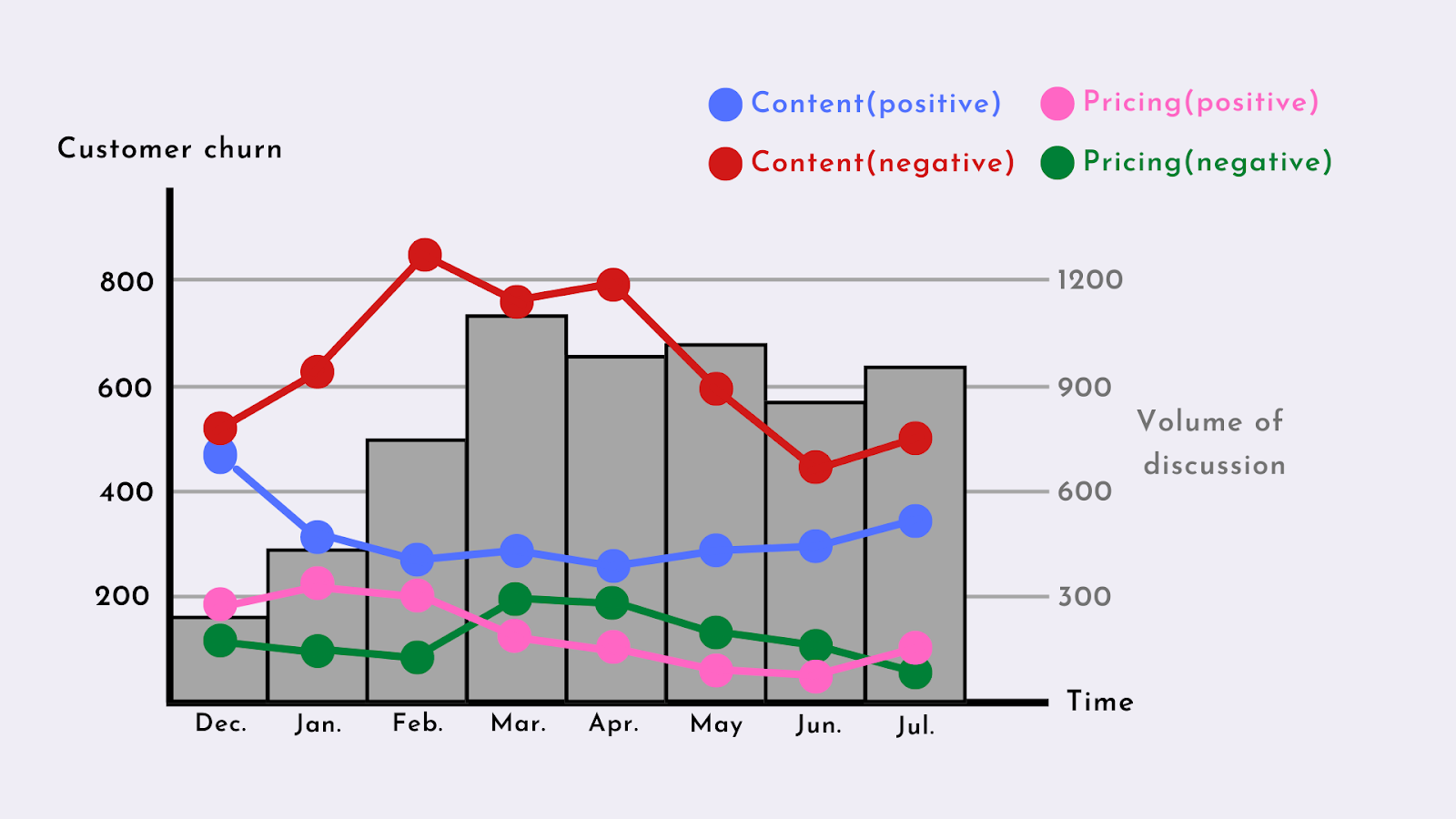
When Service N applied this temporal analysis to their data, a striking finding emerged: content quality was a significantly more influential driver of churn than pricing. While pricing complaints were present and persistent, they remained relatively stable over time. Content-related dissatisfaction, on the other hand, showed clear spikes that correlated with periods of high cancellation volume. Customers were not leaving primarily because the service cost too much. They were leaving because they felt the catalog did not justify the cost — a subtle but strategically important distinction.
The temporal view also surfaced an anomaly worth investigating. In March, pricing complaints showed a noticeable uptick that did not correspond to any change in Service N’s own pricing structure. Further analysis suggested this increase correlated with competitor activity — specifically, a rival service had launched a promotional campaign offering a lower entry price. This kind of insight is invisible in aggregate satisfaction scores or monthly churn rates, but it becomes actionable when you can trace the shift back to specific language in customer feedback. Service N could now decide whether to respond with a pricing adjustment, a value communication campaign, or a targeted retention offer for the customer segment most influenced by the competitive move.
Exploiting AI Benefits in Text Analysis
The lesson from Service N’s experience — and from the growing body of evidence across industries — is that organizations which rely exclusively on quantitative metrics are working with an incomplete picture. Numbers tell you that something is happening. Text tells you why it is happening. The most effective Voice of the Customer programs are those that incorporate both, using behavioral data to identify where to look and text analytics to understand what they find.
AI-powered text analysis does not replace human judgment. It amplifies it. By processing qualitative feedback at a scale and speed that no human team can match, it surfaces the patterns, themes, and sentiment shifts that inform better decisions. It transforms unstructured data — the sprawling, inconsistent, often contradictory mass of things customers say — into structured, actionable intelligence. For organizations willing to invest in this capability, the result is a VoC program that goes beyond measurement and becomes a genuine driver of strategic advantage.
The path forward is clear: stop treating text data as a secondary source and start treating it as the primary window into customer intent. The voice of your customers is already there, captured in every review, every support conversation, every comment thread. The question is whether you have the tools and the commitment to listen.
Antony Lu
Contributor